I’ve heard some version of this at almost every family gathering I can remember. The concern is genuine — it comes from people who watched homeownership build wealth for a generation and are extrapolating forward. But the math that made it true from 1980 to 2010 doesn’t automatically hold in 2026, and in a lot of markets, it’s running in reverse.
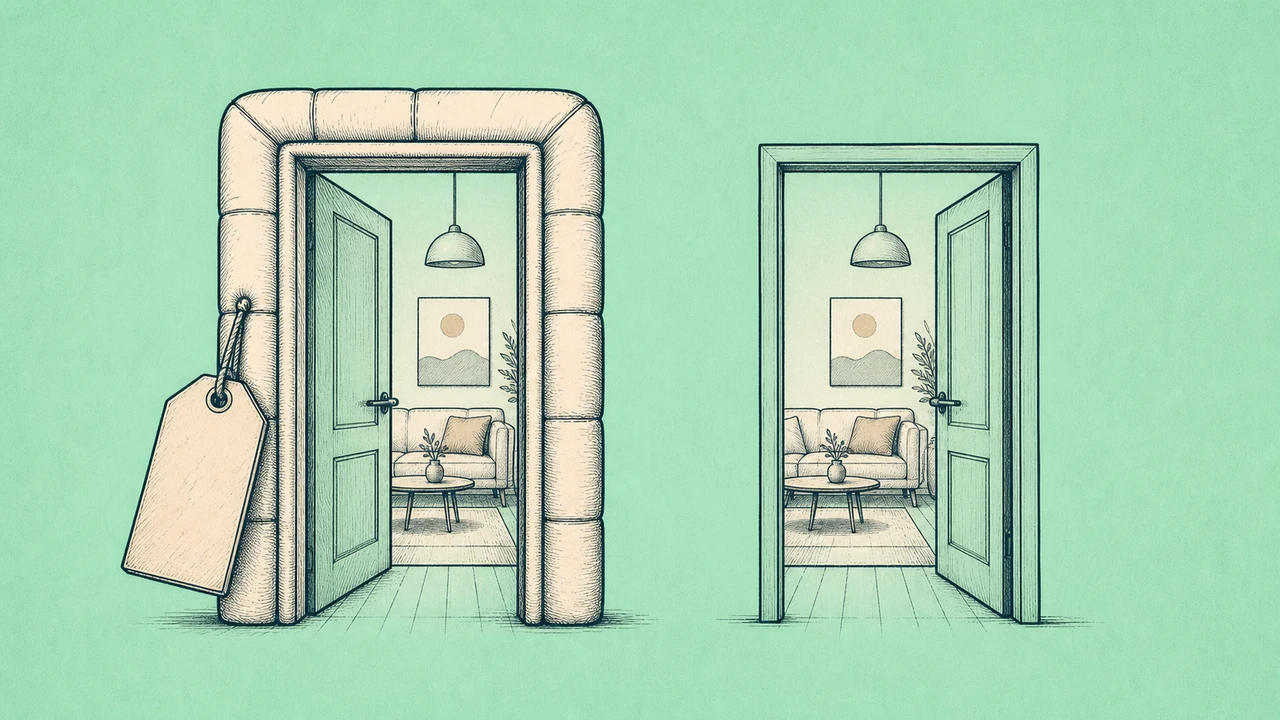
The phrase “throwing money away” implies that rent is pure loss while mortgage payments are pure accumulation. That’s not how either works. A mortgage payment in the first ten years of a 30-year loan is mostly interest — money paid to the bank for the privilege of borrowing, which is gone exactly as completely as rent. On top of that, homeowners pay property taxes, maintenance costs, and the transaction friction of buying and selling. None of those build equity. All of them are unrecoverable.
The comparison that actually matters isn’t “rent payment vs. mortgage payment.” It’s “total unrecoverable cost of renting vs. total unrecoverable cost of owning.” When you run that comparison honestly, the answer is more surprising than most people expect — and it varies dramatically by market.
The Costs That Don’t Build Equity
When someone says a mortgage payment builds equity while rent doesn’t, they’re thinking about the principal repayment portion of the mortgage. That’s true as far as it goes. But a mortgage payment has two components — principal and interest — and in the early years of a 30-year loan, the split is heavily weighted toward interest.
On a $600,000 mortgage at 7%, the first monthly payment of roughly $3,992 includes about $3,500 in interest and $492 in principal. That interest is gone. After five years of payments, you’ve paid nearly $200,000 and your principal balance has dropped by about $30,000. The other $170,000 went to the bank.
Beyond mortgage interest, homeownership carries three other categories of unrecoverable cost that rarely get included in the comparison. Property taxes run between 1% and 2% of home value annually in most markets — on a $600,000 home that’s $6,000 to $12,000 per year, every year, regardless of whether you’re building equity or not. In Texas metros specifically, that number runs significantly higher. Maintenance and repairs typically consume another 1% annually over any extended period — the rule of thumb exists because it’s been validated repeatedly by actual homeowner experience. And transaction costs — agent commissions, closing costs, transfer taxes — run 6-10% of the home’s value when you buy and again when you sell, which means you need meaningful appreciation just to break even on the transaction itself.
The honest framing: rent is roughly the ceiling of what you’ll pay monthly for housing. A mortgage is the floor.
The 5% Rule: The Only Math You Need to Start
Ben Felix, a Canadian portfolio manager who’s done some of the most rigorous public analysis of this question, popularized what he calls the 5% rule as a quick comparison tool. I’ve found it more useful than any other single heuristic on this topic.
The rule: multiply the purchase price of a home by 5%, then divide by 12. If your monthly rent for a comparable property is lower than that number, renting is likely the better financial decision.
The 5% figure combines three unrecoverable annual costs of ownership: roughly 1% for property taxes, 1% for maintenance, and 3% for the cost of capital — the opportunity cost of your down payment and the interest on your mortgage.
Join The Global Frame
Money, work, and tech — one read every Saturday that actually changes how you think.
In practice: a $600,000 home generates $30,000 per year in unrecoverable costs under this framework, or $2,500 per month. If you can rent a comparable property for less than $2,500 monthly, you’re paying less to occupy the space than the owner is — and the owner is also exposed to the risk that the home’s value falls.
Current Zillow and Apartmentlist data for markets like Denver and Austin shows comparable two-bedroom units renting for roughly $2,100 to $2,400 — below the 5% rule threshold for a $600,000 purchase. In those markets, on that math, renting is cheaper than the unrecoverable cost of owning right now.
The 5% rule is a starting point, not a complete answer. It doesn’t account for rent increases over time, local market appreciation rates that deviate from the national average, or the specific terms of a mortgage you might qualify for. But it’s a faster way to identify whether the deeper analysis is even worth running, and for a lot of markets at current prices and interest rates, it signals that renting deserves serious consideration before the cultural default of “buy as soon as you can afford to” takes over.
What Happens to the Down Payment
This is the part of the analysis that changes the most minds when people actually run it, because the down payment tends to disappear from the mental model once it’s deployed into a home.
A 20% down payment on a $600,000 home is $120,000. Once that money goes into the house, it earns whatever the home earns — roughly inflation-level appreciation over long periods, which historically runs around 3-4% annually in real terms across the US housing market. In some markets and some periods it runs much higher; in others it goes negative. The national long-run average is unimpressive relative to equities.
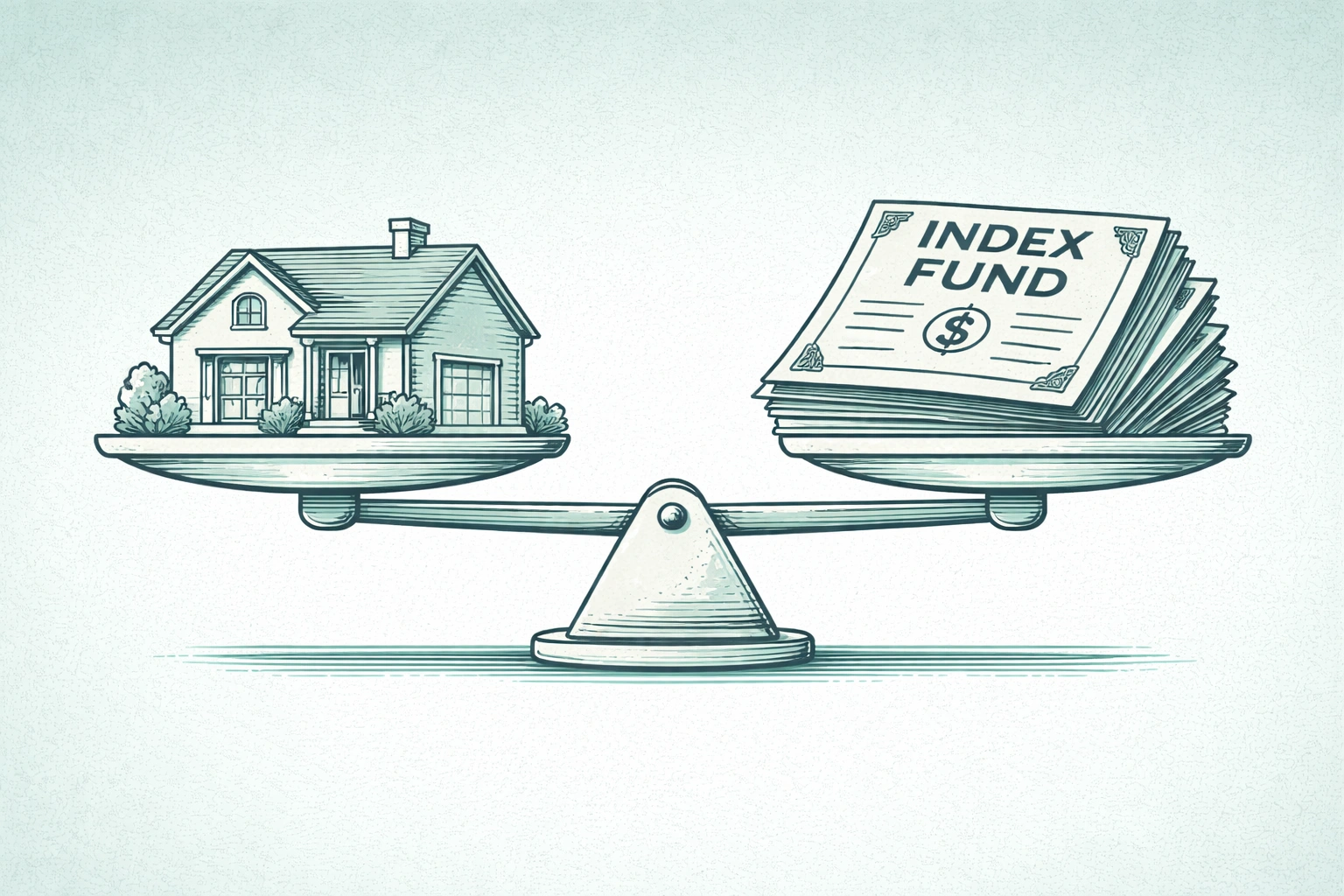
That same $120,000 invested in a broad index fund at historical market returns of roughly 8-10% annually becomes approximately $259,000 over ten years. The home equity on a $600,000 purchase appreciating at 3.5% annually reaches roughly $848,000 — but your $120,000 down payment plus ten years of principal payments got you there. The return on your specific capital contribution is different from the appreciation on the full home value.
The compounding math on liquid investments over long periods is the clearest argument for the rent-and-invest path. The caveat that’s equally important: this only works if the money actually gets invested. Renting and spending the difference on lifestyle upgrades produces worse outcomes than buying. The rent-and-invest calculation requires actual investing, which is a behavioral commitment that not everyone makes.
I’ve written about this in the context of the barbell strategy — keeping capital liquid and deployed in higher-return assets while avoiding illiquid concentrations in single assets. A home in a single market is the opposite of that structure: maximum concentration, minimum liquidity, high transaction costs to rebalance.
The Liquidity Argument That Gets Ignored Until It Matters
Home equity is real wealth. It just can’t be accessed quickly, partially, or cheaply.
If you own a $700,000 home with $200,000 in equity and lose your job, that equity doesn’t pay your grocery bills. Accessing it requires either selling the house — which takes months and costs 6% in transaction fees — or taking on additional debt through a HELOC or cash-out refinance, which resets your equity position and adds to your carrying costs.
The investor with a $200,000 portfolio and a month-to-month lease can liquidate what they need in 48 hours and keep the rest invested. In a recession, the difference between those two positions is the difference between an inconvenience and a crisis.
This is particularly relevant given the current job security environment. The forever layoffs pattern that’s emerged in the tech sector — continuous small reductions rather than one-time events — means career disruption risk is more distributed and less predictable than it was in previous cycles. Geographic flexibility has real value in that environment. A homeowner facing a significant job opportunity in another city has to either time two real estate transactions simultaneously, carry two mortgages, or decline the opportunity. A renter breaks a lease.
When Buying Actually Wins
The honest version of this analysis has to include the cases where ownership is the better outcome, because there are genuine ones.
Long time horizons change the math substantially. Transaction costs are fixed at roughly 8-10% of the home’s value regardless of how long you stay. Over a 10-year ownership period, that friction gets amortized into something manageable. Over a 3-year period, you likely need double-digit appreciation just to break even on the transaction alone. If you know with reasonable confidence you’ll stay in a city for a decade or more, the equation shifts toward buying.
Price-to-rent ratios vary significantly by market. The 5% rule produces a buying threshold that looks unattractive in San Francisco or New York and more reasonable in markets where home prices are lower relative to rents. In cities where median home prices run 2-3x the national average, renting is almost always cheaper. In lower-cost markets, the comparison is often closer.
The psychological and practical benefits of ownership are real, even if they’re not financial. Stability for a family with school-age children. The ability to renovate and customize. The social meaning some people attach to ownership. These aren’t irrational preferences — they’re legitimate values that belong in the decision even when the financial math favors renting. The argument here isn’t that you should never buy. It’s that you shouldn’t buy because “renting is throwing money away,” because that framing misrepresents how both options actually work.
And there’s the forced savings argument. For people who genuinely would not invest the difference between rent and a mortgage payment, homeownership functions as a mechanism that accumulates equity automatically. A mortgage builds some equity with every payment, even if the return is lower than alternatives. That’s better than the alternative of a lower rent payment that goes into consumption rather than investment.
The Three Questions Worth Answering Before You Decide
The question “should I buy or rent?” is actually three separate questions:
First: Is the purchase price reasonable relative to local rents? Run the 5% rule. If renting a comparable property costs less than 5% of the purchase price annually, renting is cheaper in unrecoverable costs. If renting costs more, owning may be comparable or cheaper.
Second: How long are you staying? If the answer is under five years, transaction costs make buying very difficult to justify financially regardless of the market. If the answer is ten years or more, the friction gets amortized and appreciation has time to work.
Third: Will you actually invest the difference? If you rent below the 5% threshold and deploy the savings and down payment capital into a low-cost index fund, you’re likely to accumulate more wealth than the owner in the same market over ten years. If you spend the difference, you won’t. This is a behavioral question that deserves an honest answer before you run any of the math.
The three engines of wealth framework I think about a lot positions optionality as an undervalued asset. A renter with liquid investments and geographic flexibility has more optionality than a homeowner with equity locked in a single asset in a single city. Whether that optionality is worth more than the wealth accumulation and stability homeownership provides depends on where you are in your career, what your income trajectory looks like, and how much you value the ability to move.
“Throwing money away” was never the right frame. You’re paying for housing either way. The question is which option builds wealth, preserves flexibility, and fits your actual life. In 2026, for more people in more markets than anyone wants to admit, that answer is renting.