Most personal finance writers hedge this into meaninglessness. I’m not going to do that.
The Roth IRA is one of the best retirement accounts in the US tax code. If you’re eligible, you should probably have one. The backdoor Roth exists precisely because the account is valuable enough that high earners work around the income limit to access it. None of what follows is an argument against the Roth IRA.
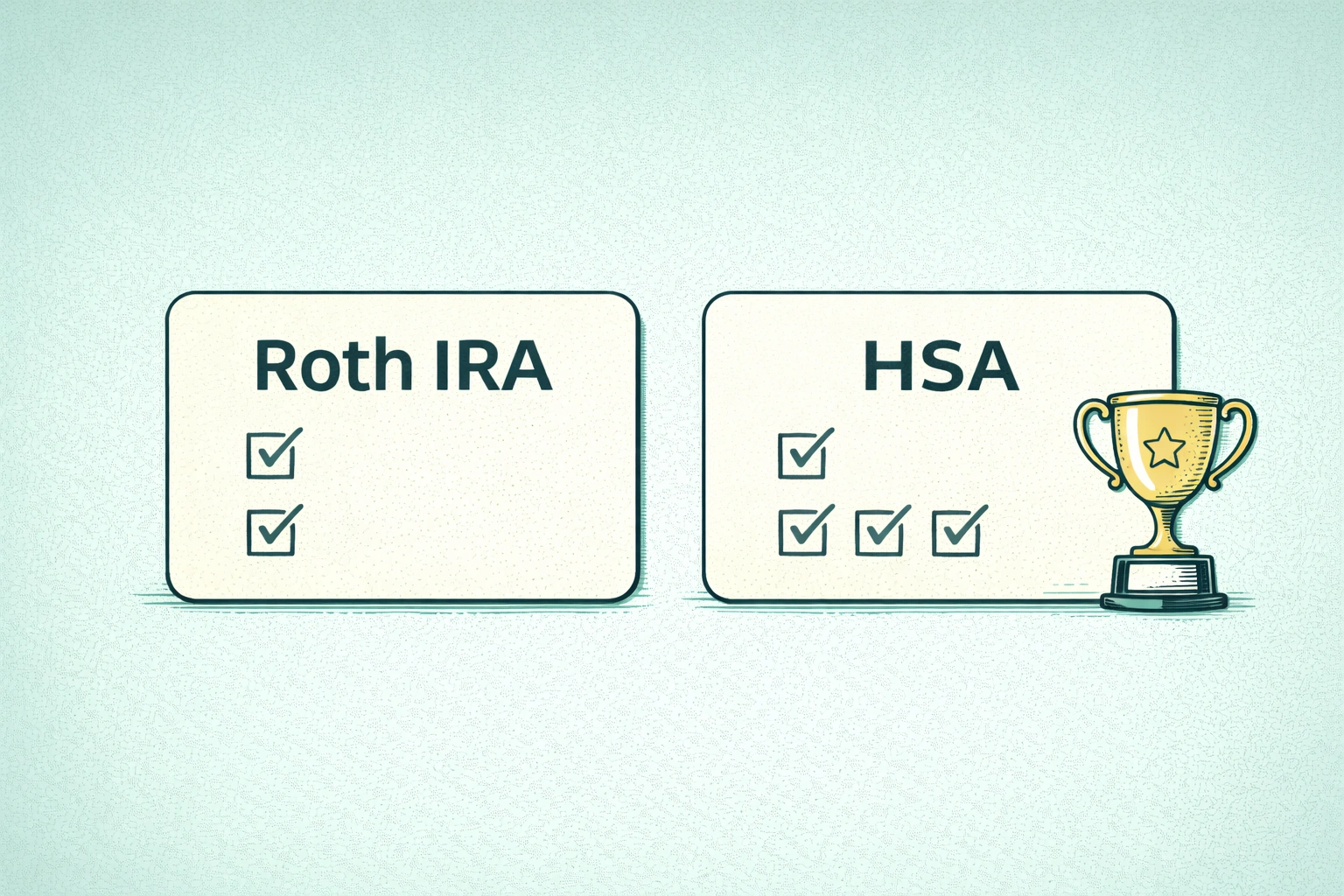
The argument is narrower: for someone who qualifies for both accounts and has limited dollars to allocate between them, the HSA wins on a pure tax efficiency basis. Not slightly. Clearly. And the reason is structural — the HSA does something no other account in the US tax code does, and most people who have one don’t know it.
Why the Comparison Usually Gets Made Wrong
The standard framing pits the HSA against the Roth IRA on tax treatment, and the tax treatment comparison is genuinely important. But it misses a more fundamental difference that determines which account you should prioritize.
A Roth IRA taxes you on the way in. You contribute after-tax dollars, the money grows tax-free, and qualified withdrawals come out tax-free. That’s two out of three tax events working in your favor — you pay on contribution, you’re exempt on growth and withdrawal.
An HSA gives you all three. Contributions reduce your taxable income in the year you make them, exactly like a traditional 401(k). Growth inside the account — dividends, capital gains, rebalancing — generates no taxable event. And withdrawals for qualified medical expenses come out completely tax-free, no income tax owed regardless of how much the account has grown.
There’s a fourth benefit that rarely appears in these comparisons. HSA contributions made through payroll deduction bypass FICA taxes — Social Security and Medicare — which run at 7.65% for employees. A Roth IRA contribution or a 401(k) contribution doesn’t avoid FICA. An HSA contribution through payroll does. That’s an immediate 7.65% return on every dollar contributed via payroll that genuinely cannot be replicated anywhere else. If you’re contributing directly from a bank account rather than payroll, you lose this specific benefit — worth confirming how your employer’s plan works.
The comparison on a dollar-in, dollar-out basis: a dollar going into a Roth IRA has already been taxed. A dollar going into an HSA through payroll hasn’t been taxed at the federal level, hasn’t been taxed for FICA, will grow without tax drag, and will come out tax-free if used for medical expenses. These aren’t equivalent dollars.
The Eligibility Question You Have to Settle First
None of this matters if you can’t contribute, and HSA eligibility has a specific requirement that rules out a significant portion of people: you must be enrolled in a High Deductible Health Plan.
For 2026, an HDHP is defined as a plan with a minimum deductible of $1,650 for self-only coverage or $3,300 for family coverage, and maximum out-of-pocket limits that don’t exceed $8,300 (self) or $16,600 (family). If your plan’s deductible is below those thresholds, it doesn’t qualify, and you can’t contribute regardless of how much you want to.
Join The Global Frame
Money, work, and tech — one read every Saturday that actually changes how you think.
The HDHP trade-off is real and worth evaluating honestly. A high-deductible plan means you absorb more medical costs before insurance kicks in. For someone with chronic conditions, regular prescriptions, or predictably high healthcare utilization, the premium savings and HSA tax benefits may not compensate for higher out-of-pocket exposure. Running the actual numbers — your expected medical costs under each plan type, the premium differential, the HSA tax savings — is worth the 30 minutes it takes.
For people who are generally healthy and have an emergency fund that could cover the deductible without financial stress, the HDHP plus HSA combination typically produces a better outcome than a low-deductible plan. The premium savings alone often partially offset the higher deductible, and the HSA tax benefits are on top of that.
Two additional eligibility constraints worth knowing: you can’t contribute to an HSA while enrolled in Medicare, which affects the timing of when to maximize contributions before reaching 65. And an active general-purpose FSA (Flexible Spending Account) typically disqualifies you from HSA contributions — if your employer offers both, you’d need a limited-purpose FSA to maintain HSA eligibility.
The 2026 contribution limits: $4,400 for self-only coverage, $8,750 for family coverage, with a $1,000 catch-up contribution available at age 55 and older.
The Receipt Strategy, Explained Properly
I’ve covered the core receipt strategy in detail in the HSA investment guide, but this is the single most valuable tactical insight about the account and it’s worth explaining again from a different angle.
There is no deadline for HSA reimbursements. The IRS requires that the expense was a qualified medical expense and that it occurred after you opened your HSA. It does not require that you claim the reimbursement in the same calendar year, or the same decade.
What this means practically: every dollar you don’t withdraw from your HSA today stays invested and compounding. A $200 co-pay paid out of pocket and left in the HSA at 7% annual returns becomes roughly $1,520 over 30 years. When you eventually reimburse yourself for that $200, the withdrawal is tax-free. The remaining $1,320 keeps growing in the account.
The operational requirement is just receipt documentation. Photograph every receipt — pharmacy, dental, vision, hospital, co-pays — and store them in cloud storage. Don’t rely on physical receipts; ink fades. A simple folder in Google Drive or iCloud labeled “HSA receipts by year” is enough. You’re building an archive that can generate tax-free cash withdrawals decades from now, and the only work it requires is a phone photo at the time of each expense.
The behavior change that makes this work: stop using the HSA debit card. Pay medical expenses from your checking account or a rewards credit card, and leave the HSA balance fully invested. If the balance is currently sitting in a cash position earning nominal interest, logging into your provider’s portal and switching to a low-cost index fund is the single highest-impact change you can make to the account.
What to Actually Buy Inside the HSA
Most HSA providers default new accounts to a cash or money market position. That default is quietly destructive for anyone treating the HSA as a long-term wealth vehicle — inflation erodes cash value, and you’re foregoing decades of compound growth on contributions that can never be recaptured given the strict annual limits.
The investment approach inside an HSA should mirror your other long-term retirement accounts. This is money you’re not planning to touch for years or decades, which means it should be invested in diversified, low-cost equity funds rather than trying to optimize for short-term stability.
For most people, a single total market fund handles everything. VTI (Vanguard Total Stock Market ETF) or its mutual fund equivalent provides exposure to the entire US equity market in one holding. VOO (Vanguard S&P 500 ETF) is a reasonable alternative if your provider doesn’t offer VTI. Both have expense ratios under 0.05% annually — the compounding math over 30 years makes fee minimization genuinely meaningful.
For people who want broader geographic diversification, a three-fund approach works well here as it does in other retirement accounts: a US total market fund, an international fund like VXUS, and a bond fund like BND. The specific allocation depends on your time horizon and risk tolerance, but for HSA money that won’t be touched for 20+ years, a high equity allocation is typically appropriate.
The provider matters more than people realize. Fidelity’s HSA has no investment minimum, no account fees, and offers direct access to low-cost index funds — it’s generally considered the best option for people who want to invest the full balance. Lively is a close second. If your employer’s designated HSA provider charges fees or requires a cash minimum before you can invest, transferring to a better provider is straightforward — an HSA transfer doesn’t trigger a taxable event, similar to an IRA rollover.
The Caveats That Apply to Specific Situations
California and New Jersey are the two states that don’t conform to federal HSA tax treatment. Both states tax HSA earnings — dividends, capital gains generated inside the account — as ordinary income on your state return. This creates additional paperwork at tax time and reduces (but doesn’t eliminate) the tax efficiency advantage.
The federal benefits still apply in full regardless of state. Given that federal income tax is typically the larger component of total tax burden, the HSA remains advantageous in California and New Jersey — it just requires more careful tracking of investment activity inside the account for state tax reporting purposes.
The age 65 provision deserves more attention than it usually gets. After 65, the 20% penalty on non-medical HSA withdrawals disappears. Non-medical withdrawals become subject to ordinary income tax — identical to traditional 401(k) withdrawals. This means the account has a genuine floor: worst case, it functions as a pre-tax retirement account. Best case — used against decades of accumulated medical expense receipts — it functions as a tax-free account with no income limit and no required minimum distributions.
That last point is worth sitting with. The Roth IRA has no RMDs, which makes it excellent for estate planning. The HSA also has no RMDs. Combined, they represent the two accounts in your retirement portfolio where the government never forces a taxable distribution — which gives you control over the timing of your tax exposure in retirement that traditional pre-tax accounts don’t provide.
The Honest Priority Order
The question of where the HSA fits in the sequence of accounts worth maximizing is worth being direct about.
Capture the full employer match on your 401(k) first — that’s an immediate 50-100% return on contribution that nothing else can match. After the match, the HSA’s combination of triple tax advantage and FICA exemption makes it the next most tax-efficient place to put dollars, ahead of additional 401(k) contributions or a Roth IRA for most people. After maxing the HSA, continue with the 401(k), then a backdoor Roth IRA if income limits apply.
This sequence assumes you can afford to pay medical expenses out of pocket. If cash flow is tight and you need the HSA as a medical expense buffer, the calculus changes — there’s no penalty for using the account as intended. The investment strategy only makes sense when the financial foundation underneath it is solid.
For people who’ve had an HSA for years and never invested it, the first step is logging in and moving the balance out of cash today. The second is setting up payroll deductions for the 2026 contribution limit if you haven’t already. The third is starting the receipt folder.
None of those steps are complex. The account has been outperforming what you’re using it for, quietly, the entire time you’ve had it.