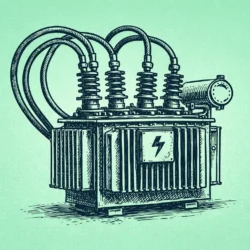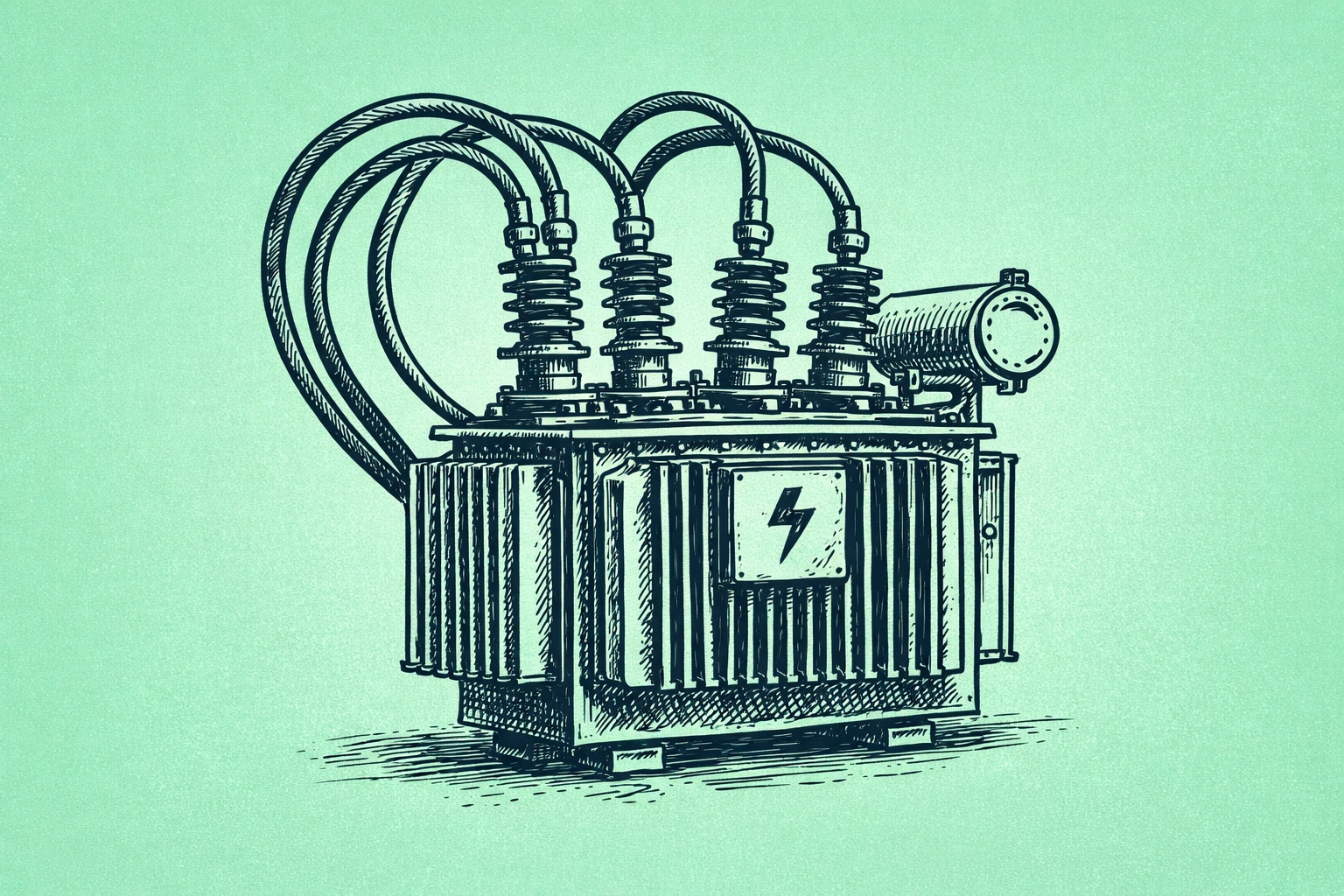
The cleanest green investing strategy available right now involves no solar panels, no EV manufacturers, and no ESG fund with a leaf in its logo. It involves transformers. Specifically, the ones sitting in utility yards across Georgia and Texas, queued for delivery to data centers that are already under construction and desperately short of power. Lead times: 18 to 24 months. Demand: unprecedented. The companies building them: printing money.
This is where serious green capital is moving in 2026 — not toward the obvious plays that have already been priced, but toward the physical infrastructure that makes the entire clean energy transition possible. Transmission lines, grid-scale substations, regulated utilities sitting in the path of a demand shock that no amount of efficiency software can route around. The green investing conversation got captured by a specific aesthetic: panels on rooftops, batteries in garages, ticker symbols that rhyme with environmental virtue. The actual structural opportunity is less photogenic and considerably more durable.
Why the Conventional Green Portfolio Is Underperforming
For most of the last decade, a green investing strategy meant assembling some combination of clean energy ETFs, EV exposure, and ESG-screened index funds, then waiting for the world to catch up. The thesis was sound. The execution got crowded. Clean energy funds got front-run by institutional capital, ESG indexes became a repackaging of the same large-cap tech names you already owned, and EV manufacturers discovered that selling cars at scale is operationally brutal regardless of what powers them.
The S&P 500’s top ten holdings now represent over 35% of the index. Passive investors who believe they own diversified exposure are, in practice, heavily concentrated in software and semiconductor valuations. The index fund concentration problem that Michael Burry has been flagging for two years is not hypothetical — it’s what the weights actually show. A green investing strategy that routes through a broad index is a green investing strategy that’s mostly NVIDIA.
The overlooked alternative sits in the part of the energy transition that doesn’t generate press releases: the grid itself.
The Infrastructure Play That Is Both Green and Structurally Inevitable
Here is the thing about AI data centers that changes the green investing calculus. They will consume as much electricity as Japan by the end of 2026. Microsoft, Amazon, Meta, and Google are collectively projected to spend over $1.4 trillion modernizing U.S. electrical infrastructure, according to Goldman Sachs research, to keep their models running. And the power they need — increasingly, by contractual commitment to state regulators and public pressure — has to be clean. Microsoft has a 100% renewable energy pledge. Google has been carbon-neutral since 2007. Amazon has the world’s largest corporate clean energy portfolio. Every gigawatt they add to the grid creates a demand signal for renewable generation, transmission capacity, and grid modernization. That demand signal flows straight to the companies building the physical infrastructure.
Data center power consumption is on track to hit 106 gigawatts by 2035, per Grid Strategies’ national transmission planning analysis — a figure revised upward 36% from forecasts made just seven months earlier. This isn’t a demand spike. It’s a structural re-orientation of what America’s electrical infrastructure exists to serve.
Regulated utilities — NextEra, Duke, Southern Company — are the most structurally protected position in this trade. They operate as legal monopolies in the geographies where data center construction is concentrating: Georgia, Texas, and the Carolinas, after Northern Virginia exhausted its available grid capacity. When a hyperscaler needs power, the utility builds the infrastructure and recovers the cost from ratepayers under state-approved tariffs. That’s a guaranteed revenue mechanism operating inside a green transition that is accelerating whether or not quarterly AI earnings disappoint. NextEra alone has more renewable energy capacity than most countries. It is, without much argument, the largest clean energy company in the world — and it is also a direct beneficiary of every data center that gets built in Florida and Texas.
The barbell structure applies cleanly here. A heavy allocation — 80% of the infrastructure sleeve — in regulated utilities and grid equipment manufacturers: companies like Quanta Services, which builds transmission lines and substations and reported backlog growth of over 30% year-over-year and is fully booked through 2027, and Eaton and Hubbell, which manufacture the switchgear and distribution hardware that every new grid connection requires. A smaller allocation, around 20%, in earlier-stage plays: nuclear microreactor developers, geothermal cooling technology, industrial cable manufacturers. The core compounds slowly and reliably. The speculative sleeve bets on how fast the transition accelerates.
Data center REITs sit at the intersection of real estate and energy infrastructure. Equinix and Digital Realty own sites with grid access and cooling density that hyperscalers cannot easily replicate — and increasingly, those sites are being powered by on-site renewable generation or long-term renewable purchase agreements. AI-grade facilities are leasing at $300-500 per kilowatt per month, up from $100-150 for conventional colocation. Vacancy is near zero. These are landlords in a neighborhood that keeps growing, with a green premium built into the lease structure.
Join The Global Frame
Money, work, and tech — one read every Saturday that actually changes how you think.
What This Strategy Is Actually Betting On
The risk that most directly threatens this thesis is a slowdown in AI capital expenditure. If the large foundation model investments don’t deliver the commercial returns they’re priced to produce, hyperscaler infrastructure budgets get reviewed. That review would affect data center REITs first and utilities last — because transformer orders are already placed and physical infrastructure has multi-decade lifespans. Utilities don’t decommission substations when a quarterly earnings call disappoints.
Regulatory risk is worth watching in specific states. Residential electricity bills rose in eight of the nine largest data center markets in 2025. State legislators are being asked why their constituents are subsidizing server farm infrastructure, and some are listening. Cost pass-through caps are not hypothetical. But utilities have navigated regulatory environments for over a century and tend to win the long game with commissioners who want jobs and tax revenue in their districts.
The passive income math on dividend aristocrats — Procter & Gamble, Coca-Cola — doesn’t survive scrutiny under current inflation. A 2.5% yield minus a 25-30% tax bite minus 3.2% inflation produces a negative real return. Owning a utility growing earnings at 8-10% annually with structural demand tailwinds is a fundamentally different proposition. It doesn’t scan as exciting. It compounds anyway.
The green investing conversation spent a decade chasing the most visible symbols of the energy transition. The actual transition — the one requiring copper wire, concrete pads, and switchgear rated for industrial loads — is happening in places that don’t photograph well. Google figured this out when it paid $4.75 billion for a nuclear developer and said almost nothing about it publicly. The infrastructure is back at the center of how serious capital thinks about clean energy. It was always going to end up here. The grid is where electricity comes from — regardless of how clean the generation is, it still needs somewhere to go.