I started looking into this about a year ago after reading a statistic that I kept coming back to: Baby Boomers own approximately 41% of all small businesses in the United States. That’s roughly 12 million businesses — plumbing companies, HVAC services, car washes, dry cleaners, pest control operations, landscaping firms. Businesses that have been running profitably for 20 or 30 years, embedded in local communities, with established customer bases and trained employees.
And their owners are in their mid-60s to mid-70s, actively looking for a way out.
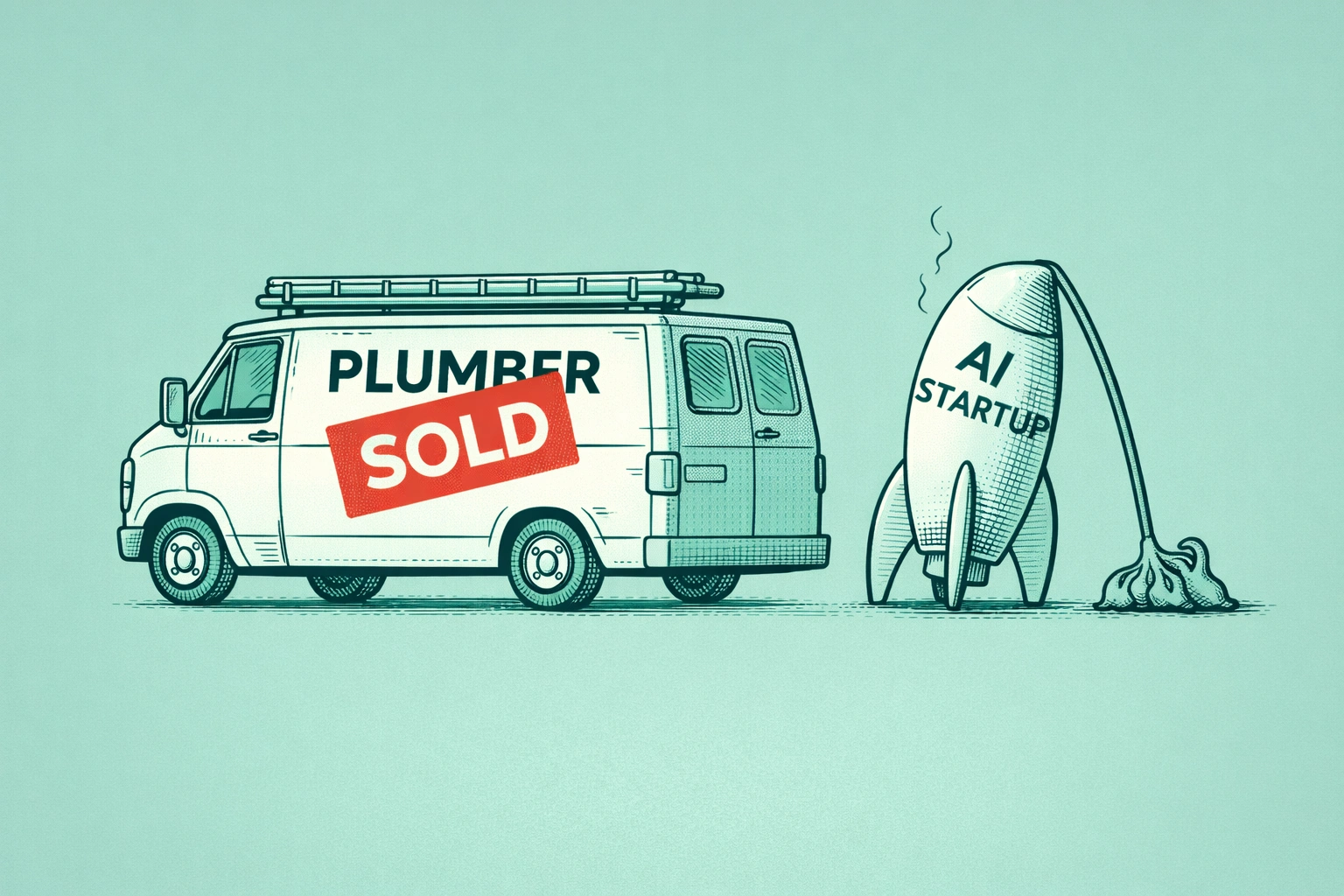
The question that struck me wasn’t “are these businesses for sale?” They clearly are. The question was: who’s buying them? The owners’ kids mostly went into marketing or tech and have no interest in managing a fleet of plumbing vans. Private equity ignores anything below about $5 million in EBITDA — a $2 million revenue HVAC company is too small to register. And most people who have the capital and business skills to acquire and operate one of these companies are either chasing startup opportunities or haven’t thought about this category at all.
That mismatch — millions of profitable businesses coming to market with a structural shortage of qualified buyers — is the opportunity. It’s not glamorous. It will not get you profiled in a tech publication. But the math is more compelling than almost anything else available to someone with $50,000 in capital and the willingness to actually run a business.
Why Buying Beats Building Here
The failure rate argument for startups is well-documented and I don’t want to belabor it, but the contrast with acquisition entrepreneurship is sharp enough to be worth stating directly.
When you start a company from zero, you’re betting on a hypothesis. Will people pay for this? Can you find them? Can you build the product before you run out of money? Every startup begins with those questions unanswered, and 90% of them close before they get answered satisfactorily.
When you acquire an existing business, those questions have already been answered. Customers exist and are paying. Employees have been hired and know what they’re doing. The brand has standing in its local market. The revenue isn’t a projection — it’s a track record. You’re not betting on a hypothesis. You’re buying a system that’s already working and asking whether you can operate and improve it.
The category of businesses that fits this profile best — what some acquisition entrepreneurs call “Lindy businesses,” after the principle that things which have survived a long time tend to keep surviving — are the essential service businesses that recessions don’t eliminate. Toilets break regardless of what the stock market is doing. Roofs leak. HVAC systems fail in August. Grass grows. The demand for these services doesn’t track consumer sentiment or tech adoption cycles. It tracks human beings living in buildings, which is a more reliable customer base than most.
The Demographic Math Behind the Opportunity
The Silver Tsunami is the term researchers use for what’s happening: a historically large cohort of business owners reaching retirement age simultaneously, with no obvious succession pipeline waiting behind them.
Stop on that number. Twelve million businesses. Owners who’ve spent decades building something and now want to monetize it without simply closing the doors. Many of them care about legacy — they want the business to continue, the employees to keep their jobs, the customers to keep being served. That emotional component actually helps buyers, because a founder who wants to preserve what they built is often more flexible on price and terms than a purely financial seller would be.
Join The Global Frame
Money, work, and tech — one read every Saturday that actually changes how you think.
The supply-demand imbalance is real and it’s been building for a while. BizBuySell’s transaction data shows small business transaction volume has been rising, but the inventory of businesses for sale continues to outpace the pool of qualified buyers. For the buyer, that means negotiating leverage — better prices, more flexible terms, and sellers who are motivated to make deals work rather than waiting for a better offer.
The “Digital Arbitrage” That Actually Works
One angle on these acquisitions that I find particularly interesting — and that the financial coverage of this space mostly ignores — is how much value is available from simply modernizing the business’s basic digital presence.
Most of these Boomer-owned businesses are running on processes that haven’t changed in fifteen years. No Google Business Profile, or one that hasn’t been updated since 2018. No online booking. Reviews that are sparse or unanswered. Websites that look like they were built during the first Obama administration. Billing done manually. Customer follow-up nonexistent.
A buyer who understands basic digital marketing — SEO fundamentals, Google Business optimization, automated scheduling, reputation management — can often increase revenue 20-30% in the first year just by implementing things that any modern service business should already have. That’s not a strategic masterstroke. It’s table stakes for 2026. But because the previous owner never did it, it represents genuine upside that isn’t priced into the acquisition.
This is the kind of operational use that AI tools now make accessible to a single owner-operator without a full staff. Automated customer follow-up, review request sequences, basic content for local SEO, scheduling optimization — what would have required a dedicated marketing hire five years ago can now be handled by a small stack of tools running in the background. For a solopreneur or small operator acquiring a service business, that asymmetry between what the business currently does and what basic digital infrastructure could produce is often the most reliable source of first-year returns.
How the Financing Actually Works
The capital barrier is lower than most people assume, and it’s worth understanding why.
The SBA 7(a) loan program exists specifically to enable this kind of acquisition. The US government has a structural interest in keeping small businesses operational and employing people — when a profitable business closes because its owner couldn’t find a buyer, the jobs disappear and the community loses a service. The SBA program is the mechanism Congress created to address that.
In practice, a standard SBA 7(a) acquisition looks like this: you contribute 10% of the purchase price as a down payment, and the bank covers the remaining 90% with an SBA-guaranteed loan, typically over a 10-year term. For a $1 million business generating $250,000 annually in profit, that means $100,000 down controls an asset producing returns that would be essentially impossible to replicate in public markets or index funds.
The seller financing component adds another layer. In many transactions, sellers will finance a portion of the purchase price — typically up to 5% under current SBA rules — as a standby note, meaning no payments are made on that portion for the life of the SBA loan. For a seller who wants the deal to close and cares about the business continuing, accepting a deferred payment on 5% of the price is often acceptable. The buyer’s effective cash requirement drops to 5% of the purchase price.
That’s $50,000 to control a $1 million asset. The math isn’t magic — the debt service on the SBA loan comes out of business cash flow, and if the business underperforms, you’re still on the hook for the payments. But for a business with a verified earnings track record and stable customer demand, the risk profile is fundamentally different from a startup where the revenue is entirely hypothetical.
The caveat that deserves emphasis: verified earnings are the operative phrase. Any acquisition requires genuine due diligence — ideally with an accountant who specializes in small business transactions reviewing the financials, and ideally a period of working alongside the current owner before closing. Sellers motivated by retirement sometimes have a rosier picture of the business than the books support. The SBA financing structure protects the bank; it doesn’t protect you from buying something that doesn’t perform as represented.
Where to Actually Find Deals
The listed marketplace — BizBuySell, Acquire.com for digital businesses, broker listings — is a real starting point but it surfaces the most shopped inventory. The better opportunities are usually off-market, and reaching them requires some directness that most people find uncomfortable at first.
The most efficient approach I’ve seen described by people who’ve done this successfully: go to Google Maps, search for service businesses in your target category and geography, and look for the signals of an owner who hasn’t adapted. A business with a 3-star rating where the reviews mention “nobody answers the phone.” A listing with no website, or a website that hasn’t been updated in years. A business that’s clearly established — it’s been on that corner for fifteen years — but shows no signs of active management.
These are often owned by someone in their late 60s who’s tired, doesn’t particularly want to deal with Google reviews, and hasn’t thought explicitly about selling but would be receptive to the conversation.
A physical letter — not an email, not a LinkedIn message — sent to the business address, explaining that you’re a local buyer looking to acquire and continue operating a business rather than strip it for parts, gets a meaningful response rate from owners who wouldn’t respond to a broker inquiry. It signals that you’re not private equity. That matters to sellers who care about what happens after they leave.
The conversation itself doesn’t need to be a negotiation in the first meeting. It’s an inquiry. Are you thinking about the next chapter? Would you be open to talking about what that might look like? Most business owners who are five years from retirement have thought about this more than they’ve talked about it, and finding someone who takes their life’s work seriously enough to send a letter is often the beginning of a real discussion.
What This Requires From You
I want to be direct about the profile this fits, because the “buy a business for $50k and watch it print money” framing that circulates in entrepreneurship content is real but incomplete.
Acquiring and operating a service business requires actual operational involvement, at least initially. You’re not a passive investor. You’re managing employees, handling customer relationships, making daily decisions about scheduling and pricing and quality. That’s not a part-time commitment, especially in the first year before you’ve built the systems and the team that let you step back from daily operations.
The fractional executive path suits some people better than ownership for exactly this reason — if what you want is high income with limited operational involvement, running someone else’s function part-time has a better risk profile than owning a business outright. Business acquisition makes most sense for someone who actually wants to build and run an operation, not someone looking to add a passive income stream to an existing career.
If that description fits — if you find operations genuinely interesting, if you have management experience and capital discipline, if you’d rather own something real than speculate on something exciting — then the demographic math of the Silver Tsunami creates an unusual window. Millions of profitable businesses, motivated sellers, government-subsidized financing, and a buyer pool that’s mostly distracted by something shinier.
The least glamorous businesses in America are quietly becoming one of the better risk-adjusted opportunities available to someone with the skills and temperament to run one. That won’t make headlines. It rarely does.