Part 2 of the Rational Compounding Framework
I know a guy who made $400K last year. He lives paycheck to paycheck.
I know another person who makes $120K. She has $800K in investments and will retire at 52.
The difference isn’t intelligence. It’s not work ethic. It’s not even luck.
It’s understanding that building long-term wealth isn’t one-dimensional.
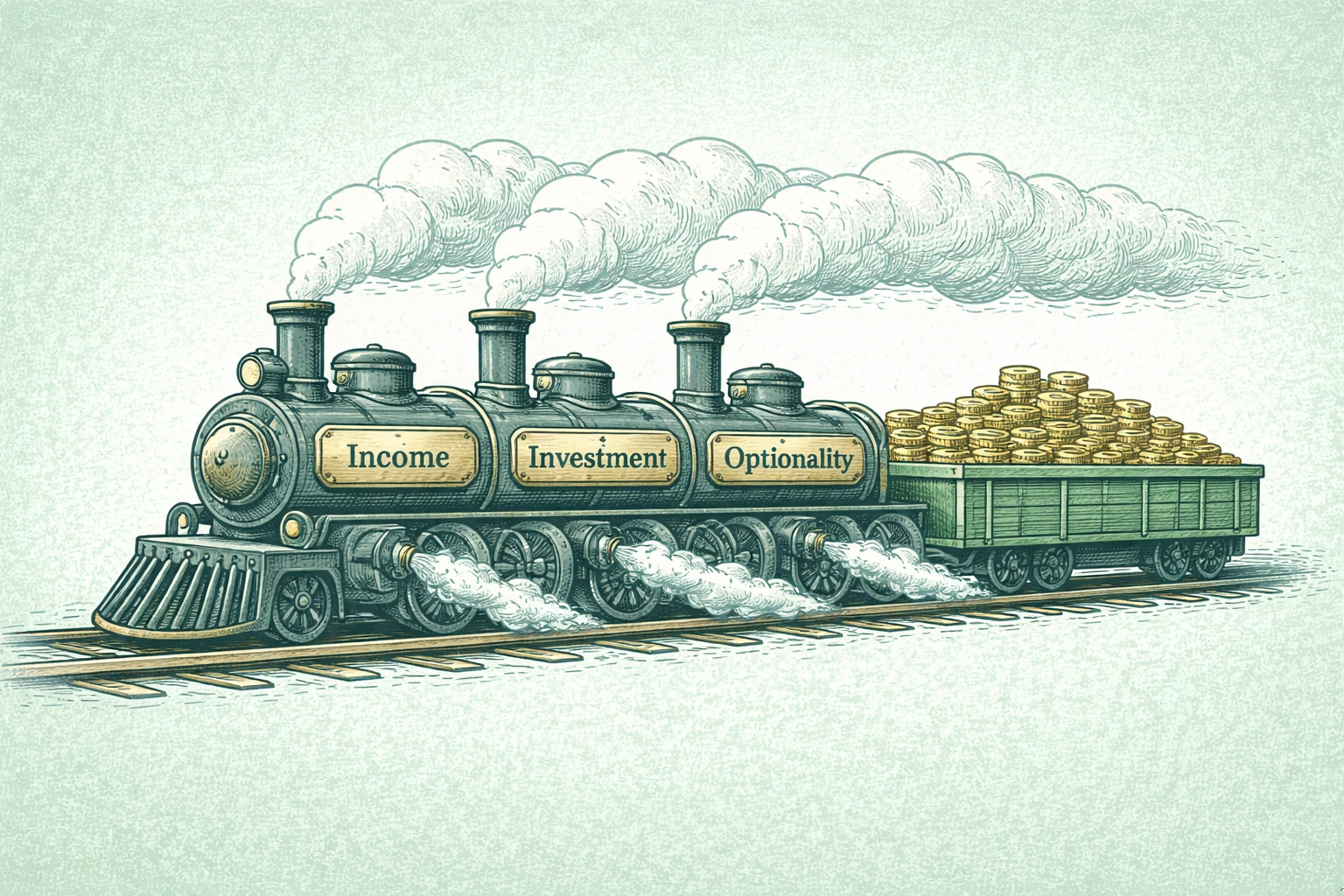
This framework explains how to build wealth systematically using three reinforcing engines: income, investment, and optionality. Most people optimize one variable and wonder why they’re not building wealth. They maximize income but let lifestyle inflation eat it. They save aggressively but keep everything in cash earning 4%. They invest well but trap all their capital in illiquid assets with no flexibility.
Building systematic wealth requires three engines running simultaneously:
- The Income Engine – Maximize after-tax earnings, minimize lifestyle drag
- The Investment Engine – Deploy capital systematically, let it compound
- The Optionality Engine – Preserve flexibility to move fast when opportunities appear
Most people run one engine at 80% and the others at 20%. That’s not a system. That’s a bottleneck.
In Part 1, we covered the math of compounding: A = P(1 + r)^t. Now let’s talk about how to actually maximize P, protect r, and create the conditions for sustained growth.
This is your operating system for wealth.
The Three Engines of Wealth: Definitions
Before we break down each engine, here’s what they actually mean:
Income Engine: The system that generates deployable capital after taxes and lifestyle expenses. Not gross salary—what you actually keep.
Investment Engine: The system that compounds your deployable capital through tax-advantaged accounts, index funds, and strategic asset allocation.
Optionality Engine: The system that preserves strategic liquidity and flexibility, allowing you to move fast when opportunities appear or risks emerge.
Most people conflate “making money” with “building wealth.” They’re not the same. Making money feeds the income engine. Building wealth requires all three engines working together.
Join The Global Frame
Money, AI, and career leverage. One email every Saturday to help you stay ahead of the curve.
Engine 1: Income (The Fuel)
Income is the most visible lever. It’s also the one most people misunderstand.
Income isn’t about how much you make. It’s about how much you keep after taxes and lifestyle.
The Income Illusion
Let’s compare two scenarios:
Person A:
- Gross income: $300,000
- Effective tax rate: 35%
- After-tax income: $195,000
- Lifestyle expenses: $150,000
- Deployable capital: $45,000 (15% of gross)
Person B:
- Gross income: $180,000
- Effective tax rate: 22% (optimized through tax strategies)
- After-tax income: $140,400
- Lifestyle expenses: $75,000
- Deployable capital: $65,400 (36% of gross)
Person B deploys $20,400 more per year despite earning $120K less.
Over 20 years at 8% returns:
- Person A: $2,061,008
- Person B: $2,994,552
Person B has $933,544 more wealth despite lower income.
This is the income illusion. Gross salary is a vanity metric. What matters is:
Deployable Capital = Gross Income – Taxes – Lifestyle
The Three Levers of the Income Engine
Lever 1: Increase Gross Income
This is obvious but harder to execute than people think. Real income growth comes from:
- Strategic job changes: The biggest salary jumps come from switching companies, not internal promotions. A 15-20% bump from a job change beats 3-5% annual raises every time.
- Skill stacking: Don’t just get better at your job. Add orthogonal skills that multiply your value. Example: A developer who can also do product management is worth 40% more than a pure developer.
- Negotiation: Most people leave $10K-30K on the table because they don’t negotiate. Every new job is a negotiation opportunity. Use it.
If you’re serious about income growth, read our guide on salary negotiation strategies that actually work.
Lever 2: Minimize Taxes
Most high earners pay 10-15% more in taxes than they should. Not because they’re doing anything illegal. Because they’re not using the tools available.
Here’s what optimized tax strategy looks like:
- Max out 401k: $23,500/year (2026 limit) = $8,225 tax savings at 35% bracket
- Backdoor Roth IRA: $7,000/year tax-free growth
- Mega Backdoor Roth: Up to $46,000/year if your plan allows (read our mega backdoor Roth guide)
- HSA triple advantage: $4,300 individual / $8,550 family tax-deductible, grows tax-free, withdraws tax-free for medical (see HSA investment strategy)
- Tax-loss harvesting: Offset gains with strategic losses (details in our tax-loss harvesting guide)
A $250K earner who maximizes these strategies pays an effective rate of 22-25% instead of 35%.
That’s $25,000-32,000 more per year in after-tax income.
Over 20 years? $1.14 million to $1.46 million more deployable capital.
Lever 3: Control Lifestyle Inflation
This is the silent killer of wealth.
Every promotion, every bonus, every windfall gets absorbed by a nicer apartment, a better car, fancier vacations. Your income grows 40%. Your lifestyle grows 45%. Your savings rate shrinks.
Here’s the rule: When your income increases, your lifestyle can increase—but only by half.
Example:
- Salary increases from $150K to $200K (+$50K)
- After-tax increase: ~$32,500
- Lifestyle can increase by: $16,250
- Deployable capital increases by: $16,250
This prevents the hedonic treadmill from eating your wealth.
The person making $400K who lives paycheck to paycheck? Their lifestyle grew at the same rate as their income. They have no deployable capital. They have no wealth engine.
Engine 2: Investment (The Multiplier)
Income is linear. Investment is exponential.
Every dollar you deploy compounds. Every dollar you spend is gone forever.
The Investment Engine takes your deployable capital and turns it into wealth.
The Investment Hierarchy
Not all investments are equal. Here’s the priority order:
Tier 1: Tax-Advantaged Retirement Accounts
Max these out before you invest a single dollar elsewhere:
- 401k: $23,500/year (employer match is free money—take it all)
- Backdoor Roth IRA: $7,000/year
- HSA: $4,300-$8,550/year
- Mega Backdoor Roth: $46,000/year if available
Why these first? Because tax drag destroys compounding.
A taxable account earning 8% with 35% taxes = 5.2% after-tax.
A Roth IRA earning 8% = 8% after-tax (zero taxes ever).
Over 30 years on $100K:
- Taxable: $432,194
- Roth: $1,006,266
That’s $574,072 in lost wealth from taxes.
Tier 2: Taxable Index Funds
After maxing tax-advantaged space, use taxable brokerage accounts for:
- Low-cost index funds (Vanguard, Fidelity, Schwab)
- Total stock market or S&P 500
- Keep expense ratios under 0.1%
Avoid:
- Actively managed funds (you’re paying 1% for underperformance)
- Individual stock picking (you’re not smarter than the market)
- Crypto as a core holding (it’s speculation, not investment)
Tier 3: Alternative Investments (Optional)
Only after you’ve maxed Tier 1 and have meaningful Tier 2 holdings:
- Real estate (rental properties, REITs)
- Private equity (if accredited investor)
- Angel investing (if you have expertise + capital)
Most people skip Tier 1 and 2 to chase Tier 3 “opportunities.” That’s backwards.
The Deployment Discipline
Having capital isn’t enough. You need a system for deploying it.
Rule 1: Automate Everything
- Auto-transfer from paycheck to investment account
- Auto-invest on a schedule (weekly, monthly)
- Remove yourself from the decision loop
Emotion kills returns. Automation eliminates emotion.
Rule 2: Maintain Asset Allocation
Pick an allocation based on your age and risk tolerance:
- Age 30-40: 80-90% stocks, 10-20% bonds
- Age 40-50: 70-80% stocks, 20-30% bonds
- Age 50-60: 60-70% stocks, 30-40% bonds
Rebalance annually. That’s it. Don’t overthink it.
Rule 3: Ignore Daily Noise
Markets up 2%? Cool.
Markets down 3%? Cool.
Still investing the same amount.
Check your portfolio quarterly at most. Daily checking leads to emotional decisions. Emotional decisions destroy wealth.
The Compounding Timeline
Here’s what systematic investment looks like in practice:
Years 1-10: The Grind
- Your contributions matter more than returns
- Compounding feels slow
- Discipline is boring
Years 11-20: The Inflection
- Compound growth starts catching up to contributions
- Your money is working harder than you are
- Momentum builds
Years 21-30: The Acceleration
- Compound growth dwarfs new contributions
- Your portfolio grows by more each year than you can contribute
- Wealth becomes self-sustaining
Example on $30K/year contributions at 8%:
- Year 10: $434,000 (contributions: $300K, growth: $134K)
- Year 20: $1,377,000 (contributions: $600K, growth: $777K)
- Year 30: $3,396,000 (contributions: $900K, growth: $2,496K)
By Year 30, growth is adding $272K/year while you’re contributing $30K.
That’s the Investment Engine working.
Engine 3: Optionality (The Multiplier on the Multiplier)
This is the engine most people ignore. It’s also the one that separates the wealthy from the truly wealthy.
Optionality is not about safety. It’s about strategic positioning.
Cash and liquid capital allow you to act when others cannot. It’s not an emergency fund sitting in a savings account waiting for disaster. It’s dry powder that lets you move fast when opportunities appear—or when everyone else is forced to sell.
What Optionality Actually Means
It’s not just emergency savings. It’s strategic liquidity.
Optionality lets you:
- Take a calculated career risk (start a company, go freelance, take a pay cut for equity)
- Deploy capital during market crashes (buy assets when everyone else is selling)
- Make big moves without stress (relocate, switch industries, go back to school)
Without optionality, you’re stuck.
You can’t leave a toxic job because you need the paycheck.
You can’t buy during crashes because everything is locked up in 401ks and real estate.
You can’t take entrepreneurial risks because you have no runway.
Optionality is freedom. Lack of optionality is a cage.
The Three Layers of Optionality
Layer 1: Emergency Fund (3-6 Months)
This is baseline survival optionality.
If you lose your job tomorrow, you can cover rent, food, insurance for 3-6 months while you find the next thing.
Keep this in a high-yield savings account earning 4-5%. Don’t invest it. It’s insurance, not growth.
Layer 2: Opportunity Fund (6-12 Months)
This is beyond survival. It’s strategic capital.
Market crashes 30%? You have cash to deploy.
Dream job opens up but pays 20% less? You can afford the transition.
Want to start a business? You have 12 months of runway.
Keep this partially liquid:
- 50% in high-yield savings
- 50% in short-term bonds or conservative index funds
Layer 3: Walk-Away Capital (2-5 Years)
This is when optionality becomes transformative.
You have 2-5 years of living expenses in semi-liquid assets. You can:
- Walk away from anything that doesn’t serve you
- Take entrepreneurial swings without fear
- Negotiate from a position of total leverage
- Live on your terms
This is stored in:
- Taxable brokerage accounts (index funds)
- Bonds
- Conservative dividend stocks
The key: It’s accessible within 30-90 days if needed.
The Optionality Paradox
Here’s the paradox: The more optionality you have, the less you need to use it.
When you have 12 months of cash, you don’t panic during a 3-month job search.
When you have 5 years of runway, you don’t take shitty jobs out of desperation.
When you can walk away, people stop jerking you around.
Optionality is power. And power is rarely exercised because everyone knows you have it.
The person making $400K with no savings has zero optionality. One bad quarter, one layoff, one market crash—and they’re scrambling.
The person making $120K with $800K invested has massive optionality. They can weather almost anything.
The Wealth System in One Sentence
Income creates deployable capital. Investment compounds that capital. Optionality preserves flexibility and leverage.
Running all three engines simultaneously is how long-term wealth is built.
How the Three Engines Work Together
Here’s where most people fail. They optimize one engine and ignore the others.
Common failure modes:
Type 1: The High Earner with No Wealth
- Income Engine: 90%
- Investment Engine: 30%
- Optionality Engine: 10%
They make $300K-500K. They live a $300K-500K lifestyle. They have nothing deployable. One job loss and they’re in crisis. Their Income Engine is strong, but their Investment and Optionality Engines are broken.
Type 2: The Frugal Hoarder
- Income Engine: 40%
- Investment Engine: 50%
- Optionality Engine: 80%
They save 60% of income. But they keep it all in savings accounts earning 4%. They have optionality but no wealth growth. Inflation eats them alive. Their Optionality Engine is strong, but their Investment Engine is idle.
Type 3: The YOLO Investor
- Income Engine: 60%
- Investment Engine: 90%
- Optionality Engine: 10%
They invest aggressively. Everything is locked in 401ks, real estate, or illiquid assets. No emergency fund. One unexpected expense and they’re selling at a loss or going into debt.
The Optimal System:
All three engines running at 70-80%:
- Income Engine: Maximize after-tax income through strategic career moves and tax optimization
- Investment Engine: Deploy 30-40% of gross income into tax-advantaged and taxable accounts
- Optionality Engine: Maintain 6-12 months emergency fund + opportunity capital
This creates a reinforcement loop:
Income Engine
↓
Deployable Capital
↓
Investment Engine
↓
Wealth
↓
Optionality Engine
↓
Career & Life Freedom
↓
(Protects Income Engine)When one engine strengthens, it amplifies the others.
Income funds investment. Investment creates wealth. Wealth creates optionality. Optionality protects your ability to earn income (you can take risks, negotiate from strength, walk away from bad situations).
This is exactly why the Rational Compounding Framework treats income, investment, and optionality as separate but reinforcing systems. You can’t optimize one without considering how it affects the others.
The Metrics That Actually Matter
Forget net worth for a moment. Here are the metrics that tell you if your engines are working:
Income Engine Health
Metric 1: Deployable Capital Rate
This is the single most important metric for your Income Engine.
Formula: (Gross Income - Taxes - Lifestyle) / Gross Income
- Below 15%: Your income engine is broken
- 15-25%: Decent
- 25-35%: Strong
- 35%+: Elite
Metric 2: Effective Tax Rate
Formula: Total Taxes / Gross Income
- Above 30%: You’re not optimizing
- 25-30%: Room for improvement
- 20-25%: Well-optimized
- Below 20%: Elite (requires significant deductions/strategies)
Investment Engine Health
Metric 1: Tax-Advantaged Space Utilization
Are you maxing:
- 401k? ($23,500)
- IRA/Backdoor Roth? ($7,000)
- HSA? ($4,300-$8,550)
- Mega Backdoor? (If available)
If no to any of these, your investment engine is underperforming.
Metric 2: Portfolio Growth Rate vs. Contribution Rate
In your first 10 years, contributions should exceed growth.
By year 15-20, they should be roughly equal.
By year 25+, growth should exceed contributions.
If you’re at year 15 and contributions still dwarf growth, you either:
- Started too late
- Are too conservative with asset allocation
- Have too much in cash
Optionality Engine Health
Metric 1: Months of Runway
Formula: Liquid Assets / Monthly Expenses
- Under 3 months: Critical risk
- 3-6 months: Baseline
- 6-12 months: Strong
- 12+ months: Elite optionality
Metric 2: Liquidity Ratio
Formula: Liquid Assets / Total Net Worth
- Under 10%: You’re over-allocated to illiquid assets
- 10-20%: Reasonable
- 20-30%: Strong optionality
- Over 40%: You’re under-invested (unless intentionally building runway)
Real-World Example: Three Engines in Action
Let me show you what this looks like in practice.
Sarah, Age 35, Software Engineer
Sarah’s system is simple: every dollar has a destination before it arrives.
She doesn’t budget in the traditional sense. She built a system once, automated it, and now it runs itself.
Her Three Engines:
Income Engine (38% deployable capital rate):
- Gross: $185,000
- Effective tax rate: 24% (optimized through 401k + HSA + backdoor Roth)
- After-tax: $140,600
- Lifestyle: $70,000
- Deployable capital: $70,600
Investment Engine (100% of deployable capital invested):
- 401k: $23,500
- Backdoor Roth: $7,000
- HSA: $4,300
- Taxable brokerage: $35,800
- Asset allocation: 85% stocks, 15% bonds
- Expense ratio: 0.04%
Optionality Engine (14 months runway):
- Emergency fund: $35,000 (6 months)
- Opportunity fund: $50,000 in short-term bonds
- Total liquid: $85,000
Her System:
Every paycheck:
- Auto-max 401k and HSA
- Auto-transfer $2,000 to taxable brokerage (auto-invests in VTI)
- Maintain $5,000 checking buffer
Every year:
- Do backdoor Roth conversion
- Rebalance portfolio if drift exceeds 5%
- Review tax strategy
Projected Outcome at Age 60:
- 25 years of $70K/year investment at 8%: $5,119,000
- Optionality maintained throughout
- Multiple career pivots taken (2 job changes, 1 startup attempt that failed but didn’t bankrupt her)
- Retired at 60 with $5M+ portfolio
All three engines working together.
Building Your System
Here’s how to audit and fix your engines:
Step 1: Calculate Your Current State
Income Engine:
- What’s your deployable capital rate?
- What’s your effective tax rate?
- Are you maxing all tax-advantaged accounts?
Investment Engine:
- What percentage of gross income are you investing?
- What’s your asset allocation?
- What are your expense ratios?
Optionality Engine:
- How many months of runway do you have?
- What percentage of net worth is liquid?
Step 2: Identify the Bottleneck
Most people have one weak engine.
If Income Engine is weak:
- Focus on salary negotiation
- Maximize tax optimization
- Cut lifestyle inflation
If Investment Engine is weak:
- Max tax-advantaged accounts first
- Set up automation
- Shift from cash to invested capital
If Optionality Engine is weak:
- Build 3-month emergency fund immediately
- Then build to 6-12 months
- Don’t sacrifice investment for excess cash hoarding
Step 3: Build the System
Once you know your bottleneck, build a personal wealth framework to fix it.
Example system for someone with weak Investment Engine:
Month 1:
- Open Roth IRA and max it ($7,000)
- Increase 401k to max ($23,500/year)
- Open taxable brokerage account
Month 2:
- Set up auto-transfers to taxable brokerage
- Choose index fund (VTI, VTSAX, FSKAX)
- Set up auto-invest
Month 3:
- Review and rebalance if needed
- Lock in the system
- Don’t touch it for a year
The system runs itself. You just monitor quarterly.
The Long Game
Wealth isn’t built in one year. It’s built over 20-30 years of all three engines running consistently.
Most people:
- Optimize income, ignore investment and optionality
- Or save aggressively but never invest it
- Or invest everything and have zero flexibility
The winners run all three engines simultaneously.
They maximize after-tax income. They deploy 30-40% into investments. They maintain 6-12 months of optionality.
And they do it for decades.
Wealth is not built by optimizing one variable. It is built by running three engines at the same time—income, investment, and optionality—for decades.
Not sexy. Not fast. But it works.
Next in the series: Part 3: Why High Earners Still Fail to Build Wealth
(Link will be live after Post #3 publishes)
Action Items:
- Calculate your deployable capital rate: (Gross Income – Taxes – Lifestyle) / Gross Income. If it’s under 20%, you have an income engine problem.
- Audit your investment engine: Are you maxing 401k, IRA, HSA? If not, that’s $40K-$77K/year in tax-advantaged space you’re leaving on the table.
- Check your optionality: Liquid Assets / Monthly Expenses. If it’s under 6 months, build your emergency fund before aggressive investing.
All three engines. Running simultaneously. For decades.
That’s how you build wealth.
This is Part 2 of the Rational Compounding Framework. Read Part 1: The Math of Wealth for the compounding mathematics, or see the complete framework.