Part 8 of the Rational Compounding Framework
Here’s something that took me an embarrassingly long time to understand: getting from zero to $1 million and getting from $1 million to $5 million are not the same journey with more zeros. They’re almost completely different problems. Different levers, different enemies, different psychological traps. The strategies that get you to the first milestone will, in some cases, actively work against you at the next one.
Most wealth content doesn’t tell you this because it’s easier to sell universal advice. Max your 401k. Buy index funds. Avoid lifestyle inflation. Good advice — for a specific stage. As blanket guidance for someone at $2 million in net worth, parts of it are actively wrong.
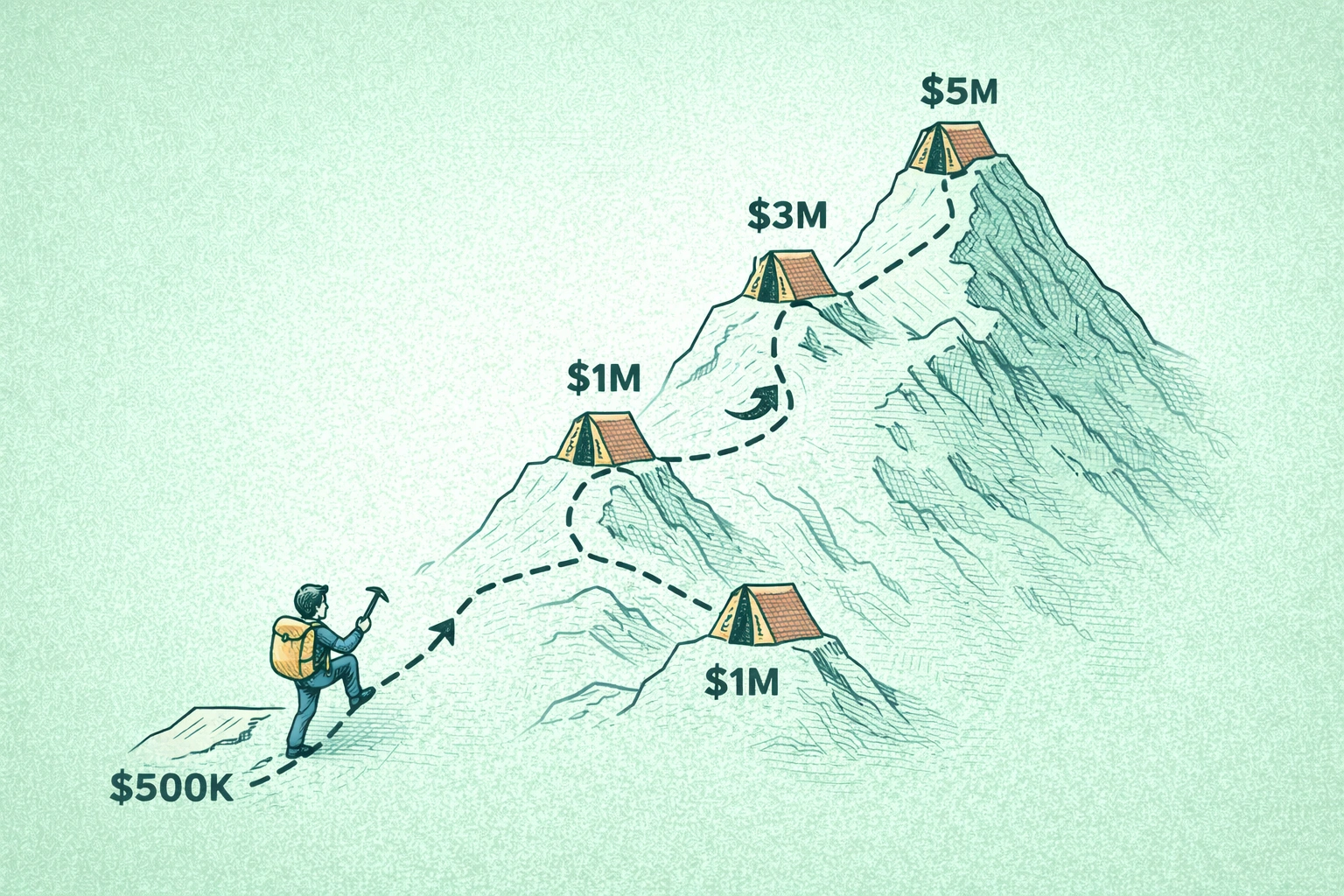
The four net worth milestones that matter — $0 to $500K, $500K to $1M, $1M to $3M, and $3M to $5M — each have their own logic. Miss the transition, and you keep playing the previous game long after the rules have changed.
Stage One and Two: When Your Savings Rate Is Everything
Below $500K, the math is blunt. Your portfolio isn’t large enough for compounding to do meaningful work on your behalf — a 10% return on $200K is $20,000, which is real money, but it’s dwarfed by what you can add through disciplined saving. At this stage, your income is your primary wealth-building tool, and your savings rate is the only lever that moves the needle significantly.
This sounds obvious. What’s less obvious is the trap that comes with it: because income matters so much in this phase, high earners often conclude that income will always matter this much. So they optimize for income indefinitely — chasing promotions, jumping for salary bumps, tolerating bad situations because the pay is good. They’re right about the tactic and wrong about the timeline.
The psychological enemy below $500K is discouragement. Compounding feels theoretical when your portfolio is small. You’re doing everything right — maxing the 401k, investing consistently, avoiding lifestyle inflation — and your net worth is still moving slowly. This is where most people either give up or start taking on inappropriate risk to accelerate the process. Don’t. The early contributions matter more than they feel like they do; they’re the ones that have the longest runway to compound.
From $500K to $1M, the dynamic shifts slightly. Compounding is now contributing meaningfully alongside your savings — you’re getting real money from returns, not just from new contributions. The trap here is lifestyle creep. A $400K salary in your late 30s creates enormous social pressure to spend at a certain level. The people around you are buying bigger houses, taking expensive holidays, upgrading cars. The gap between what you earn and what you keep is never more fragile than in this phase, because the income feels large enough to justify almost anything.
The other thing that kills momentum between $500K and $1M is concentration. You’ve been at a tech company long enough that RSUs have become a meaningful slice of your net worth. It feels like free money — it’s just stock you were given. But concentrated employer stock is risk you’re not being paid to take, and people who let it build up through this stage often discover their “diversified portfolio” is 70% tied to one company’s fortunes.
Stage Three: Where the Game Actually Changes
The $1M to $3M range is where the rules change most dramatically, and where the most experienced investors get caught flat-footed.
Join The Global Frame
Money, work, and tech — one read every Saturday that actually changes how you think.
Two things happen around $1M that most people aren’t prepared for. First, your portfolio starts generating returns that compete with your annual savings. At $1M invested with a 7% return, you’re making $70,000 from the portfolio — before you add a single new dollar. At $2M it’s $140,000. The math is shifting underneath you: you’re transitioning from someone whose wealth depends on what they earn and save, to someone whose wealth is increasingly determined by how their capital is deployed and protected.
Second, taxes become a real drag in a way they weren’t before. A smaller portfolio mostly lives in tax-advantaged accounts — 401k, Roth, HSA — where growth is sheltered. A larger one inevitably spills into taxable accounts, and suddenly you’re paying capital gains taxes, managing wash sale rules, thinking about asset location across accounts. Tax strategy at this stage isn’t a nice-to-have. It’s worth real money.
The psychological trap in this range is what I’d call competence overconfidence. You got to $1M doing roughly the right things — index funds, consistent contributions, some tax efficiency. You feel like you understand investing. And that feeling, more than anything else, is what leads people to start making active bets: individual stocks, private deals, alternative assets pitched by someone who seems credible at a dinner party. Getting from $0 to $1M is mostly about behavior. Getting from $1M to $3M is partly about behavior and increasingly about structure — how your assets are held, where, and in what form.
The $1M to $3M stage is also harder than it looks because the increments feel smaller even as the absolute dollars are larger. Going from $200K to $300K net worth felt like real progress — 50% growth. Going from $2M to $2.1M is $100,000, which is objectively more money, but feels like nothing moved. That distorted perception leads people to swing for the fences right when patience is what’s actually required.
Stage Four: The Problems You Didn’t Expect to Have
The $3M to $5M range introduces a set of problems nobody talks about, mostly because not enough people get here to complain publicly about them.
Career stops being your primary lever. At $3M invested, a 7% return is $210,000 a year — more than most people earn. Taking a promotion that adds $50K to your salary while adding 20 hours to your week is a genuinely different calculation than it was at $500K. The trade-offs change. Some people realize this and make better life decisions. Others keep grinding toward the next title because the identity built around career achievement is harder to update than the math.
Sequence of returns risk — which sounds technical and abstract at smaller numbers — becomes real and personal. If you’re planning to wind down or retire in a specific time frame, a bad five-year stretch for markets can shift your number by years. The wealth operating system you built needs to evolve here: the asset allocation appropriate for aggressive accumulation in your 30s isn’t right when you’re within a decade of drawing on the portfolio. This isn’t about getting conservative — it’s about being deliberate about the risk you’re holding and why.
Concentration risk also resurfaces in a different form. At $4M, you might have $1.5M in a single stock, $800K in real estate, and $1.7M in index funds. Looked at one way, that’s diversification. Looked at another way, you’re holding 37% in a single name, which is a meaningful bet on a specific outcome. The rebalancing triggers you set in your wealth system matter more at this stage, not less.
The psychological trap at $3M to $5M is the goalpost problem in its purest form. When you had $500K you thought $1M would feel like security. When you had $1M you thought $2M would do it. At $3M, the number that feels like enough is $5M, and at $5M it will be something else. This isn’t unique to money — it’s how most achievement-oriented people are wired. But recognizing it is necessary, because the trap isn’t just psychological. People who can’t feel secure at $3M often start taking on risk to accelerate to $5M, and they do it right when patience and protection matter most.
$5 million isn’t an endpoint — nothing in wealth building really is. But it’s a number at which, invested conservatively, you could generate $150,000 to $200,000 a year in perpetuity without touching the principal. For most people, that’s financial independence in a real, functional sense. The fact that most high earners never get there isn’t because they don’t earn enough. It’s because they keep playing the wrong game for the stage they’re actually in — optimizing for accumulation when they should be thinking about protection, swinging for returns when consistency is what compounds.
The stages matter. Know which one you’re in.
This is Part 8 of the Rational Compounding Framework. Read Part 1: The Math of Wealth, Part 2: The 3 Engines, Part 3: Why High Earners Fail, Part 4: The RSU Trap, Part 5: Buy the Dip, Part 6: The Tax Hacks Illusion, Part 7: Your Wealth System, or see the complete framework.
Next in the series — Part 9: Career Capital > Market Returns (Until It Doesn’t)