Updated July 2026: Significant change since this was written: the OBBBA (signed July 4, 2025) made TCJA income tax brackets permanent. The anticipated 2026 bracket increases — including the top rate reverting from 37% to 39.6% — did not happen and are now off the table permanently (absent future legislation). This changes the Roth vs. Traditional calculus: the urgent case for aggressive Roth conversions before a TCJA sunset no longer applies. The underlying framework in this post for thinking about your current vs. expected future rate remains valid — but the time pressure component has been removed. If your strategy depended on acting before December 31, 2025, that specific deadline is moot. If your strategy depends on your own current-vs-future bracket analysis, it still applies.
The standard framing of this question — “Roth if you expect higher taxes in retirement, Traditional if you expect lower” — sounds like advice. It’s actually a placeholder for advice, because nobody knows future tax rates and the framing doesn’t help you decide anything.
The more useful version of this analysis starts with a fact that changes the whole conversation: if you earn above certain income thresholds and have a 401(k) at work, you cannot deduct a Traditional IRA contribution. The deduction — the entire reason to choose Traditional over Roth — is already gone. You’re making after-tax contributions either way. The question becomes whether you want after-tax money growing tax-deferred or tax-free, and that’s an easy question.
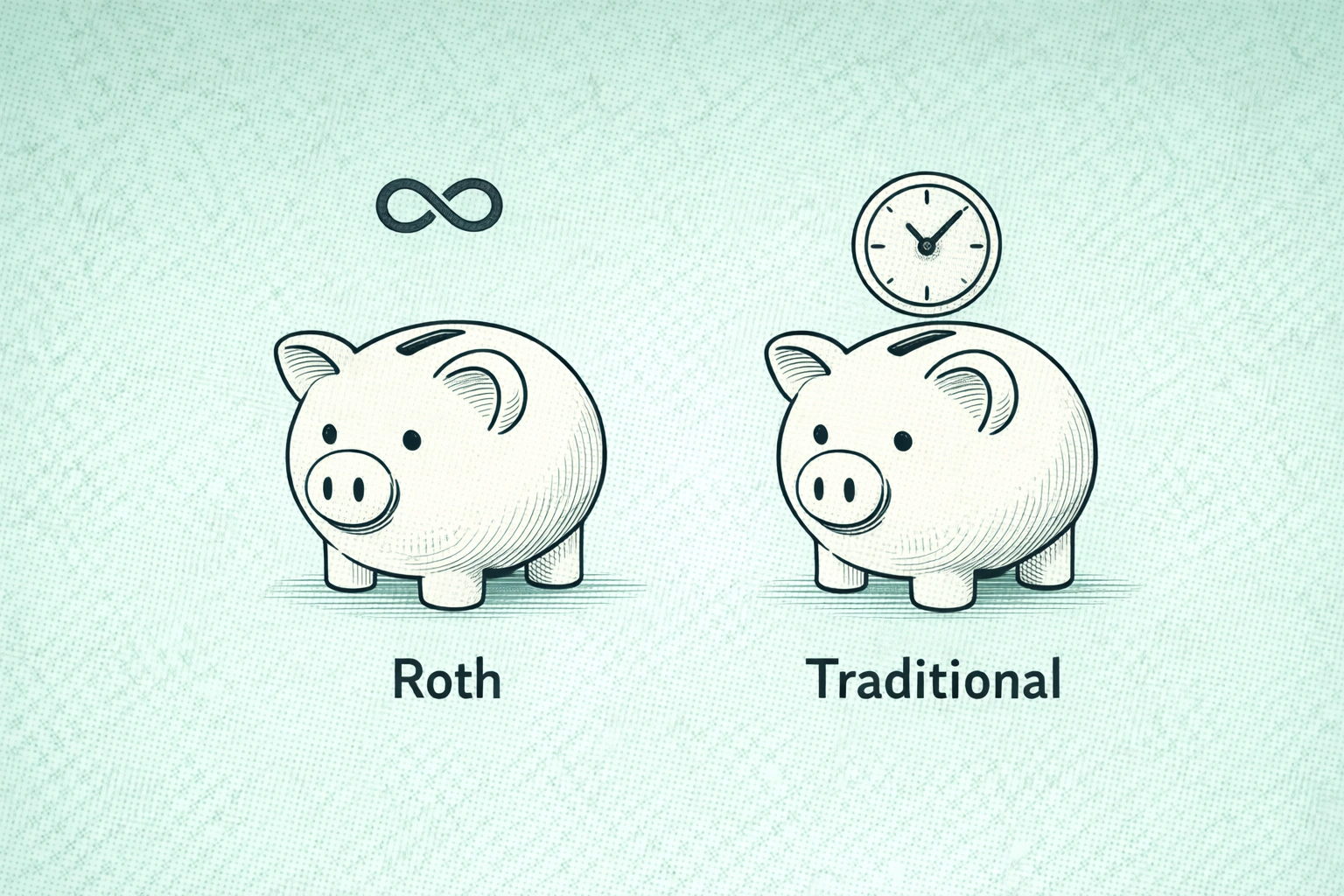
The phase-out for deducting Traditional IRA contributions for someone covered by a workplace retirement plan starts at $79,000 for single filers in 2026 and ends at $89,000. For married couples filing jointly, it’s $126,000 to $146,000. If your income is above those thresholds and you have a 401(k), your Traditional IRA contribution is non-deductible. It goes in after-tax, grows tax-deferred, and comes out partially taxable. The Roth, by contrast, goes in after-tax, grows tax-free, and comes out completely tax-free.
Non-deductible Traditional IRA is almost always worse than Roth. The money goes in the same way — after taxes — but the withdrawal treatment is inferior. With Roth, you withdraw everything tax-free. With non-deductible Traditional, you get your contributions back tax-free but owe ordinary income taxes on all the growth. Decades of compounded returns, taxed as ordinary income on withdrawal. That’s a bad deal.
So for most high earners: the debate is already settled. Do the backdoor Roth.
The Cases Where the Choice Is Genuinely Open
The scenario where Traditional IRA actually competes is when you can take the deduction — when your income is low enough relative to the thresholds, or when you don’t have a workplace retirement plan. In those situations, you’re choosing between a real tax benefit today versus tax-free growth later, and the math depends on the spread between your current and future tax rates.
The logic of the Traditional IRA is tax rate arbitrage. You avoid taxes at your current marginal rate on the contribution — 24% or 32% today, for example — and pay taxes at your (presumably lower) retirement rate on the withdrawals. If you’re in the 32% bracket now and expect to be in the 15% bracket in retirement, that 17-point spread, compounded over decades, produces a meaningfully better outcome than paying taxes upfront at 32%.
The math on this actually closes faster than people expect, though. The Traditional IRA advantage over Roth requires that you’re right about the tax rate differential. If your retirement rate ends up being 22% instead of 12%, the advantage shrinks or disappears. If tax rates rise generally — which is a plausible scenario given where federal debt trajectories are heading — the Traditional IRA’s deferred obligation becomes more expensive than it looked when you made the contributions.
The Roth has a structural advantage that doesn’t depend on predicting anything: tax-free growth means no taxes on what’s often the most valuable part of a long-term investment — the compounding. The $7,000 you contribute grows to something substantially larger over 30 years. Traditional taxes that growth on exit. Roth doesn’t. The longer the time horizon, the more that difference matters.
Join The Global Frame
Money, work, and tech — one read every Saturday that actually changes how you think.
The RMD Problem Nobody Prices In
There’s a dimension of the Traditional versus Roth comparison that almost never appears in basic analyses and has significant practical impact for high earners who are genuinely building wealth.
Traditional IRAs have Required Minimum Distributions starting at age 73. The IRS mandates withdrawals based on a Uniform Lifetime Table — roughly 3.77% of the balance in the first year, rising over time. If you’ve accumulated $500,000 in a Traditional IRA by 73, you’re forced to withdraw roughly $18,850 in that first year whether you need the money or not.
The downstream effects compound. Forced withdrawals push taxable income higher, potentially moving you into a higher federal bracket. They can trigger Medicare IRMAA surcharges — higher premiums that step up in income bands — which effectively raises your marginal cost of Traditional IRA withdrawals by several percentage points. They can increase the taxable portion of your Social Security benefits. All of this happens regardless of whether you actually wanted or needed that income.
Roth IRAs have no RMDs during your lifetime. The money grows until you choose to use it. For people building wealth faster than they’ll spend it, a Roth IRA is genuinely the more flexible vehicle — and if you’re passing assets to heirs, they receive Roth distributions tax-free over a ten-year window under current SECURE Act rules, compared to paying ordinary income tax on Traditional IRA distributions at whatever rate applies to them.
The Geographic Arbitrage Scenario
The one case where Traditional IRA pulls ahead decisively, when the deduction is available, is geographic tax arbitrage — living in a high-state-income-tax state now and planning to retire in a state with no income tax.
A California resident in the 24% federal bracket is also paying 9.3% state income tax. A Traditional IRA contribution avoids both — immediate savings of 33.3 cents per dollar contributed. If that person retires to Florida, Texas, or Nevada, retirement withdrawals face only federal tax, potentially at the 12% or 15% bracket if income is managed carefully. That 20-plus point spread makes the Traditional IRA math work significantly in their favor.
This is worth running explicitly if you’re in a high-tax state and genuinely planning to move in retirement. The relocation calculator context matters here — the tax treatment of retirement income is one of the most meaningful variables in the state-to-state comparison, and Traditional IRA contributions made during high-earning, high-tax years can fund substantial tax-free retirement income if withdrawn in a zero-state-income-tax environment.
The Roth Conversion Ladder for Early Retirement
There’s a more advanced version of this analysis for people targeting early retirement — before 59½, when Roth earnings can’t be accessed without penalty.
The Roth conversion ladder addresses this by systematically converting Traditional 401(k) or IRA balances to Roth during early retirement years, when income has dropped and tax brackets are lower. You retire at, say, 50 with substantial Traditional 401(k) assets. In years one through five of retirement, you live on taxable brokerage funds or existing Roth contributions while converting $50,000 to $60,000 annually from Traditional to Roth at the 12% or 22% bracket. Five years after each conversion, those funds are accessible as Roth without penalty.
The arbitrage: you contributed to the Traditional 401(k) at 32-35% marginal rates during peak earning years, then converted at 12-22% marginal rates during early low-income retirement years. The compounding math on that spread over decades is substantial. This is how people retire in their early fifties with significant assets and pay relatively modest lifetime taxes.
It requires the cash bridge — five years of expenses accessible outside retirement accounts — and the discipline to execute the conversions systematically. But for someone building toward early financial independence, it’s worth understanding.
The Practical Priority Order
For most high earners in 2026, the sensible sequence is this.
Capture the full employer match on your 401(k) first. This is a guaranteed 50-100% immediate return on those dollars and nothing else competes with it.
Max the HSA next if you’re on a qualifying high-deductible health plan. The triple tax advantage — deduction on contribution, tax-free growth, tax-free withdrawal for medical expenses — makes it the most efficient savings vehicle in the tax code on a per-dollar basis, and accumulated receipts from years of out-of-pocket medical expenses can fund substantial future tax-free withdrawals.
Then the backdoor Roth IRA — $7,000 annually, non-deductible Traditional contribution immediately converted to Roth, clean execution with no tax owed if there are no existing pre-tax IRA balances to trigger the pro-rata rule.
Continue maxing the 401(k) after the above are covered. The pre-tax 401(k) contribution still makes sense for most high earners even when the IRA deduction isn’t available — the tax deferral on large contributions at high marginal rates is real, and the mega backdoor Roth path through the 401(k) allows substantial additional Roth accumulation for people whose plans support it.
Taxable brokerage for anything beyond these limits, invested in low-cost index funds held for long periods. Long-term capital gains rates — 15-20% for high earners — are meaningfully lower than ordinary income rates, and the step-up in cost basis at death can eliminate the tax entirely for assets passed to heirs.
The Honest Answer on Predicting Future Tax Rates
You can’t. Neither can I. Neither can anyone offering confident predictions about where marginal rates will be in 2040 or 2050.
What you can do is hedge deliberately. Having money in all three tax buckets — pre-tax Traditional accounts, tax-free Roth accounts, and taxable brokerage — gives you flexibility to manage your retirement income across different tax environments. You can draw from whichever bucket is most efficient in a given year based on actual tax rates, actual income, and actual spending needs. A portfolio concentrated in a single tax treatment gives you no such flexibility.
The people who end up best positioned in retirement aren’t necessarily the ones who made the “right” call on Traditional versus Roth in any given year. They’re the ones who saved consistently, built diversified tax exposure, and maintained the flexibility to adapt. The debate between Roth and Traditional is worth resolving correctly, but it shouldn’t become the obstacle to simply putting the money somewhere.
The salary negotiation work that increases income, the wealth-building discipline that prevents lifestyle inflation from absorbing every raise — those compound more predictably than any tax optimization decision.