I’ve been paying attention to the tax changes that came out of the One Big Beautiful Bill — the legislation Congress passed on July 4th, 2025 — and most of the coverage has focused on the provisions that affect high earners and businesses. That’s where the political controversy lives. But buried in the same legislation is a provision that’s genuinely useful for middle-income retirees and has received almost no plain-language explanation anywhere.
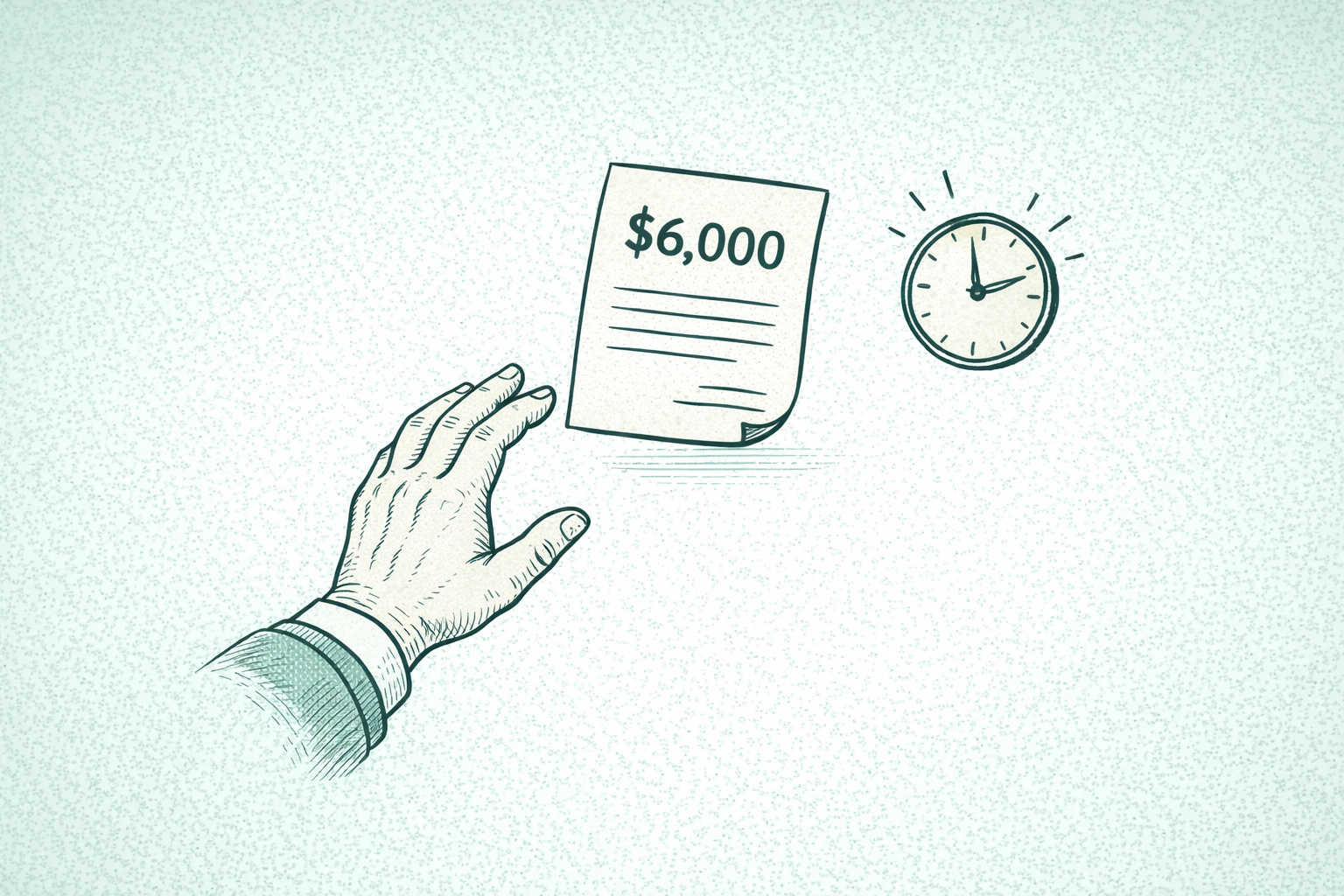
Starting January 1, 2025, taxpayers 65 and older can deduct an additional $6,000 from their taxable income. If you’re married and both spouses are 65 or older, that doubles to $12,000. This deduction stacks on top of the regular standard deduction and the existing senior deduction — it doesn’t replace either of them.
It expires December 31, 2028. Four tax years. That’s it.
The deduction exists, the IRS will formalize it on the updated Form 1040, and most of the people it was designed to help are going to miss it or underuse it because nobody has explained how it actually works.
What You’re Actually Getting
The stacking math is worth walking through explicitly, because it’s more generous than it sounds on first read.
In 2026, a single filer who is 65 or older gets: the regular standard deduction of $16,100, plus the existing senior deduction of $2,050, plus the new $6,000 deduction from the OBBBA. That’s $24,150 of income shielded from federal taxes without itemizing a single receipt.
For a married couple where both spouses are 65 or older: $32,200 in regular standard deduction, $3,300 in existing senior deduction, and $12,000 from the new provision. Total: $47,500.
The 2026 tax brackets context matters here — for a retired couple living on Social Security and modest retirement account withdrawals, $47,500 in sheltered income means a significant portion of their income may face little to no federal tax. For people in the 12% or 22% bracket, the $6,000 deduction is worth $720 to $1,320 in actual tax reduction annually. Over four years, that’s $2,880 to $5,280 that stays with the retiree rather than the Treasury.
Who This Was Actually Designed For
The deduction phases out above certain income levels, and the phase-out structure reveals exactly who the provision was built for.
For single filers and heads of household, the deduction begins phasing out at $75,000 in Modified Adjusted Gross Income and disappears entirely at $175,000. For married couples filing jointly, the range is $150,000 to $250,000. The phase-out rate is 6 cents per dollar over the threshold — so a single filer earning $85,000 is $10,000 over the limit, losing $600 of the $6,000 deduction. That filer keeps $5,400.
Join The Global Frame
Money, work, and tech — one read every Saturday that actually changes how you think.
The sweet spot is middle-income retirees: singles earning $40,000 to $70,000, married couples earning $80,000 to $140,000. People living on Social Security plus modest retirement account withdrawals, who aren’t wealthy but aren’t in poverty either. This is not a provision for high earners — anyone above $175,000 (single) or $250,000 (joint) gets nothing.
One thing worth knowing: the deduction is age-based, not retirement-based. A 67-year-old who still works part-time and earns $55,000 from consulting qualifies just as fully as someone who retired at 62 and lives entirely on pension income. The IRS cares about your age as of December 31, not your employment status.
MAGI is also not the same as the number on line 11 of your 1040. Modified Adjusted Gross Income adds back certain items — foreign earned income, student loan interest deductions, IRA contribution deductions — that are excluded from standard AGI. If you’re anywhere near the phase-out thresholds, running the precise MAGI calculation before assuming you qualify fully is worth the time or the cost of an hour with a CPA.
The Social Security Interaction Nobody Mentions
This is the part that most coverage of this deduction misses entirely, and it matters significantly for the people most likely to benefit.
Social Security benefits are taxed based on something called “combined income” — your AGI plus half your Social Security benefits plus any tax-exempt interest. If combined income exceeds $25,000 for single filers or $32,000 for joint filers, up to 85% of your Social Security becomes taxable.
The new $6,000 deduction reduces your AGI. A lower AGI reduces your combined income. If that reduction pushes your combined income below the thresholds, a portion of your Social Security that was previously taxable becomes tax-free. The deduction produces a compounding tax benefit that the headline number doesn’t capture.
A concrete example: a single 68-year-old receiving $24,000 in Social Security annually, plus $18,000 from a pension and $8,000 in investment income. Without the deduction, AGI runs around $26,000, combined income reaches $38,000, and up to 85% of Social Security is taxable. With the $6,000 deduction, AGI drops to $20,000, combined income falls to $32,000, and only 50% of Social Security is taxable. The deduction doesn’t just save the 12-22% on $6,000 of income — it reclassifies thousands of dollars of Social Security benefits that were previously fully taxed.
The actual federal tax reduction in this scenario runs closer to $1,500 than the $660-$1,320 the headline deduction implies. That gap is entirely invisible if you only calculate the direct effect of the deduction without tracing through the Social Security interaction.
How to Actually Use the Four Years You Have
The deduction expires after 2028, which makes the timing of income decisions between now and then worth thinking through deliberately.
Roth conversions become more attractive during this window. If you have traditional IRA money you’ve been planning to convert, the additional $6,000 in deductions creates more room to convert at lower effective rates each year. Spreading conversions across 2025 through 2028 rather than doing a lump sum takes advantage of four years of the deduction rather than one.
Capital gains timing is the same logic. If you have appreciated positions you’ve been planning to sell, doing it during these four years — particularly for those in the 0% long-term capital gains bracket — is worth considering. The deduction effectively lowers the income level at which you’d be pushed into a higher bracket.
Charitable giving can be bunched. If you’re charitably inclined and typically give $2,000-$3,000 a year, concentrating two or three years of giving into one tax year while the deduction is active, through a donor-advised fund, lets you take an itemized deduction in the high-giving year while taking the standard deduction in other years — and the OBBBA deduction is available in either case.
For anyone still working and earning wages, traditional 401(k) or IRA contributions that lower MAGI can protect the full $6,000 deduction from phase-out. A 66-year-old earning $80,000 who contributes $15,000 to a traditional 401(k) brings their MAGI to $65,000 — comfortably below the single-filer phase-out threshold.
The Details That Actually Matter for Filing
The deduction is not automatic. Unlike the standard deduction, which applies unless you elect to itemize, this one requires you to actively claim it on your Form 1040. The IRS updated the form for the 2025 tax year — filed in 2026 — to include the relevant line. If you file early or your tax software hasn’t incorporated the update, you can miss it. When in doubt, confirm your software version is current before filing.
Married filing separately does not qualify. If you and your spouse file separate returns for any reason, neither of you can claim the deduction.
The deduction requires a Social Security number. If you’re a permanent resident using an Individual Taxpayer Identification Number rather than an SSN, you don’t qualify.
State tax treatment varies significantly. Some states automatically conform to federal deductions; others maintain independent treatment. California, New York, and New Jersey are among the states that don’t necessarily follow federal changes. Your state return may still tax the $6,000 depending on where you live. Check with your state’s Department of Revenue or a CPA familiar with your state before assuming the benefit transfers.
What Happens After 2028
The deduction sunsets January 1, 2029, and reversion to the pre-OBBBA rules is automatic unless Congress acts to extend it. Given the cost estimate — over $100 billion across the four-year window — extension is not a safe assumption.
For retirees with any control over income timing — retirement account withdrawal amounts, stock sales, part-time income decisions — 2025 through 2028 represent a window where the tax cost of income realization is lower than it’s been in recent memory and lower than it will be afterward. The practical implication is to do income-generating things in this window that you’d planned to do in 2029 or 2030 anyway.
The personal wealth management principle here is straightforward: tax policy creates temporary windows. Most people don’t notice until they’re closed. This one is open, it’s straightforward, and the people it was written for have almost no idea it’s there.