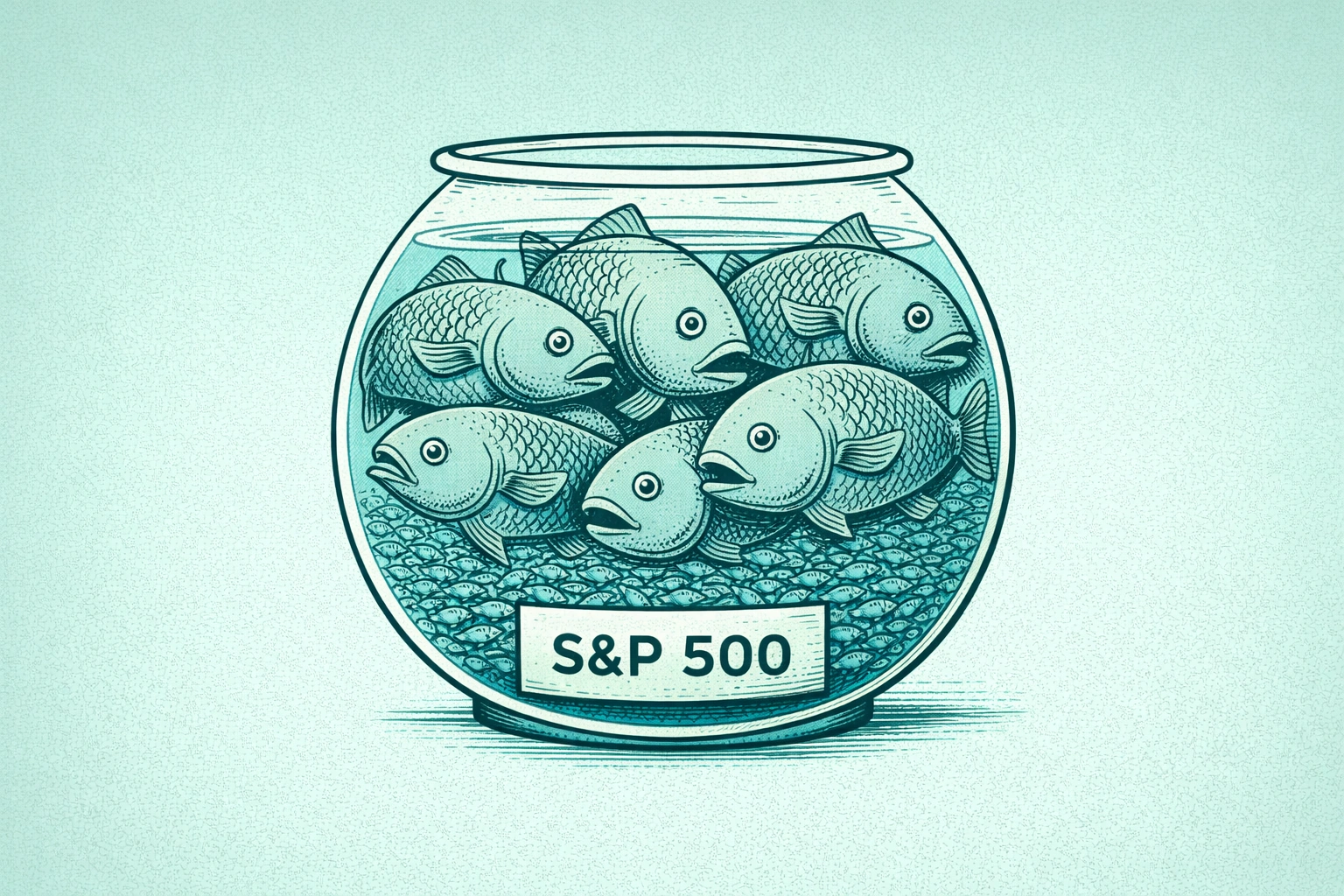
There’s a number that changed how I think about passive investing: 34%.
That’s the share of the S&P 500 that the ten largest companies represent as of 2026. In 2010 that number was 18%. The index hasn’t changed — it still contains 500 companies — but the weight distribution has shifted dramatically toward the top, because the index is market-cap weighted and the largest companies have gotten much larger relative to everything else.
What this means practically: when you buy a standard S&P 500 index fund, roughly a third of every dollar you invest goes to ten companies. Most of those ten are in tech. Nvidia, Apple, Microsoft, Amazon, Meta, Alphabet, Tesla — the so-called Magnificent Seven — collectively account for a share of the index that bears almost no resemblance to what “500 diversified companies” implies.
I’m not arguing you should sell your index funds. The case for low-cost passive investing over long horizons is still strong and the evidence behind it is extensive. What I am arguing is that the product you’re buying in 2026 is meaningfully different from the product that accumulated the track record you’re relying on, and understanding that difference is worth the time it takes.
What Market-Cap Weighting Actually Does
The mechanics are simple but their implications are underappreciated.
A market-cap weighted index allocates money to each company proportional to its total market value. Apple’s market cap is larger than the smallest 200 companies in the S&P 500 combined. So when money flows into an S&P 500 index fund, a disproportionate share goes to Apple — not because someone evaluated Apple and decided it deserved more capital, but because the weighting formula says so.
This creates a self-reinforcing dynamic. As more money flows into passive index funds — and passive funds now control over 55% of US equity assets — the largest companies receive the largest inflows automatically. Larger inflows push their prices higher. Higher prices increase their market cap. A higher market cap means a larger index weight. A larger index weight means even more of the next dollar flows to them.
Michael Burry, who became famous for shorting mortgage securities before the 2008 crisis, has been making this argument publicly since around 2019 — that passive investing has distorted price discovery in ways that resemble previous bubble dynamics. He’s not alone. Several academic papers on the concentration effects of passive investing have raised similar structural concerns.
The honest caveat: Burry has been early or wrong on several macro calls since 2008, and the concentration argument has been made for years without the predicted correction materializing. This isn’t a prediction. It’s a structural observation worth holding alongside everything else you know about your portfolio.
The Diversification You Think You Have
Here’s where I think the practical implication is clearest, and it’s less about bubble risk than about a more mundane problem: you may be less diversified than you think you are.
Join The Global Frame
Money, work, and tech — one read every Saturday that actually changes how you think.
If your 401(k) is entirely in an S&P 500 index fund and your taxable brokerage account also holds an S&P 500 ETF, you’re not doubly diversified. You own the same concentrated position twice. And if that position is 34% allocated to ten companies that are all exposed to the same AI growth narrative — the thesis that has driven most of the index’s outperformance over the last several years — you have meaningful concentration risk that the word “diversified” obscures.
This matters in a specific scenario that’s worth thinking through. If the AI investment narrative shifts — not necessarily collapses, just rerates — the companies that have benefited most from it correct most. Because those companies dominate the index, the index corrects with them. The 400 smaller companies in the S&P 500 don’t save you, both because they’re a smaller portion of your investment and because in a genuine risk-off environment, correlations tend to rise and most things fall together.
I’ve been thinking about this alongside the barbell strategy framework — where the goal is explicit about what each piece of the portfolio is doing rather than assuming a single index fund handles everything. The index fund’s track record is real. The diversification it provided in earlier decades, when the weight distribution was more even, was also real. The question is whether the current product delivers the same thing its historical performance implies.
The Liquidity Question
The other dimension of the concentration argument worth understanding — not as a prediction but as a structural feature — is what happens to an index fund in a fast market decline.
Index funds promise daily liquidity. You can sell your shares any business day at the closing price. What makes this work in normal conditions is that there are always buyers on the other side — other investors, market makers, arbitrageurs keeping the ETF price aligned with its underlying holdings.
In a fast, correlated selloff, that mechanism gets tested. To pay redemptions, the fund has to sell the underlying stocks. It sells the most liquid ones first — the large caps. As the large caps get sold, the bid for them weakens. Eventually the fund reaches the less liquid smaller positions, where there may be fewer natural buyers during a panic. This isn’t a new concern — it’s a structural feature of any pooled vehicle that promises more liquidity than its underlying assets always have.
The 2020 COVID crash provided a partial stress test. Liquidity did become challenged briefly in March 2020, including in normally liquid Treasury markets, before the Fed intervened aggressively. The system held. Whether it holds in a scenario without that intervention is a genuine open question that nobody can answer with confidence.
None of this means the risk is unacceptable. It means it exists, and building a portfolio with some awareness of it is different from building one that assumes it doesn’t.
What Actually Changes if You Take This Seriously
The answer isn’t to abandon index investing — the cost and behavioral advantages of passive funds are real and well-documented. It’s to think more carefully about which index and how it weights, and whether your overall portfolio is as diversified as the fund name implies.
The equal-weight S&P 500 — ticker RSP — holds the same 500 companies but allocates equally to each rather than by market cap. By construction, it reduces concentration in the largest companies and increases exposure to the smaller ones. Historically it has tracked the standard index reasonably closely while providing meaningfully different exposure during periods when large-cap tech diverges from the rest of the market. It’s a different bet, not obviously a better one, but one that addresses the concentration concern directly.
Small-cap value funds — VBR and AVUV are commonly cited — represent a category that passive inflows have systematically underweighted, because money flowing into cap-weighted large indices doesn’t flow proportionally to smaller companies. If the concentration argument is right that large caps are overpriced relative to fundamentals, small-cap value represents the other side of that gap. The academic evidence on small-cap value as a factor is reasonably solid over long periods, though it’s had extended underperformance stretches that test patience.
International diversification addresses a different version of the same issue. The concentration problem is primarily a US phenomenon — emerging markets and developed international indices trade at far lower valuation multiples than the US market currently does, partly because they haven’t experienced the same passive inflow dynamics and partly because their largest companies aren’t exposed to the same AI narrative. Geographic diversification doesn’t eliminate equity risk, but it does reduce the specific risk of owning a US tech concentration at US tech valuations.
What I Actually Think About This
The index fund bubble thesis has been circulating in one form or another for several years without the predicted crisis materializing. That’s worth noting. Markets can sustain dynamics that look unsustainable for longer than critics expect, and the people making these arguments have been wrong on timing repeatedly.
The more modest version of the concern — that the S&P 500 is more concentrated than it’s historically been, that the word “diversified” describes it less accurately than it used to, and that the passive investing consensus has gotten close enough to unanimity that it’s worth examining rather than accepting — seems clearly true and worth holding.
I keep coming back to the compounding argument as the anchor. The evidence for staying invested over long periods, through volatility, through concentration concerns, through macro uncertainty, is strong. The DCA data through every crash since 2008 supports systematic investment even when the case for caution feels compelling. The people who acted on bubble warnings in 2021 and moved to cash watched a significant run-up from the sidelines.
What I’m more persuaded by is the diversification check rather than the timing call. Not “should I sell?” but “do I actually know what I own and whether the diversification I think I have is real?” For most people who’ve been building a retirement portfolio with a standard S&P 500 fund for years, the honest answer to the second question has become more complicated than it used to be.
That’s the part that doesn’t get mentioned.