There is a phrase that has done more damage to American wealth than almost any other.
“Renting is throwing money away.”
You hear it at Thanksgiving dinner. You see it on Instagram. Your parents say it with a look of concern. The narrative is always the same: If you are renting, you are paying your landlord’s mortgage. If you buy, you are “building equity.”
It sounds logical. It feels responsible.
But in the economic reality of 2026, it is often mathematically wrong.
For the vast majority of people living in high-cost US cities today, buying a home is not an investment. It is a luxury consumption good that masquerades as an asset. It traps your capital, destroys your mobility, and frequently yields a lower return than a simple index fund.
If you feel guilty because you are “still renting,” stop. You might actually be the smartest person in the room.
Here is the math that real estate agents don’t want you to see.
Table of Contents
The “Unrecoverable Cost” Fallacy
The argument for buying usually hinges on one sentence: “When I pay rent, that money is gone. When I pay a mortgage, I keep that money in the house.”
This is a fundamental misunderstanding of how a mortgage works.
Join The Global Frame
Money, work, and tech — one read every Saturday that actually changes how you think.
When you own a home, you have Unrecoverable Costs just like a renter does. These are costs that do not build equity. They are money “thrown away.”
- Property Taxes: Usually 1-2% of the home’s value. Gone forever.
- Maintenance: The rule of thumb is 1% per year. Roofs leak. Boilers explode. Lawns need care. This is money you spend just to keep the asset from rotting.
- Cost of Capital (Mortgage Interest): In the first 10 years of a 30-year mortgage, the vast majority of your monthly check goes to the bank as interest, not to your principal.
- Transaction Costs: Buying and selling a home costs roughly 6-10% in fees. That is massive friction.
The Golden Rule:
- Rent is the maximum you will pay each month.
- A Mortgage is the minimum you will pay each month.
When your dishwasher breaks in a rental, you call the landlord. When it breaks in your house, you call your savings account.
The 5% Rule: The Calculator You Need
How do you know if you should buy or rent? Don’t guess. Use the 5% Rule.
This is a heuristic used by portfolio managers (popularized by Ben Felix) to compare the two costs instantly.
The Formula:
- Take the price of the home you want to buy.
- Multiply it by 5%.
- Divide by 12.
If your monthly rent is lower than that number, Renting is the better financial decision.
Where does the 5% come from? It is the sum of three unrecoverable costs: 1% Property Tax + 1% Maintenance + 3% Cost of Capital.
Real World Case Study (2026 Market)
Let’s look at a typical scenario using late-2025 data from markets like Austin, TX or Denver, CO. You are looking at a nice, updated 2-bedroom condo.
- Purchase Price: $600,000
Run the 5% Rule:
The Threshold: If you can rent a similar condo for less than $2,500/month, renting wins.
The Reality:
According to recent data from Zillow and RentCafe, similar 2-bedroom units in these metros are currently listing for $2,100 – $2,400.
By renting for $2,300, you are saving $200/month relative to the unrecoverable costs of owning, plus you keep your down payment liquidity.
The Comparison: Buying vs. Renting & Investing
“But wait!” the homeowner screams. “My house appreciates in value!”
Does it? Historically, US residential real estate appreciates at roughly inflation levels (3-4%). Compare that to the S&P 500, which historically returns 8-10%.
Here is the “Equity Trap” breakdown over 10 years.
Assumption: You have $120,000 cash (20% down payment).
| Scenario | Where is your $120k? | Monthly Cash Flow | 10-Year Outcome |
| Scenario A: Buy Home | Locked in Home Equity | Pays Mortgage + Repairs | Home grows at ~3.5% (Wealth is trapped in walls) |
| Scenario B: Rent & Invest | Invested in S&P 500 ETF | Pays Rent (Cheaper) | Portfolio grows at ~8% (Wealth is liquid cash) |
The Math:
- Home Equity Growth ($120k @ 3.5%): Grows to ~$169,000.
- Stock Portfolio Growth ($120k @ 8%): Grows to ~$259,000.
The Difference: $90,000+ in lost wealth.
By buying the house, you lost nearly $100,000 because you trapped your most powerful capital (the down payment) in a slow-growth asset.
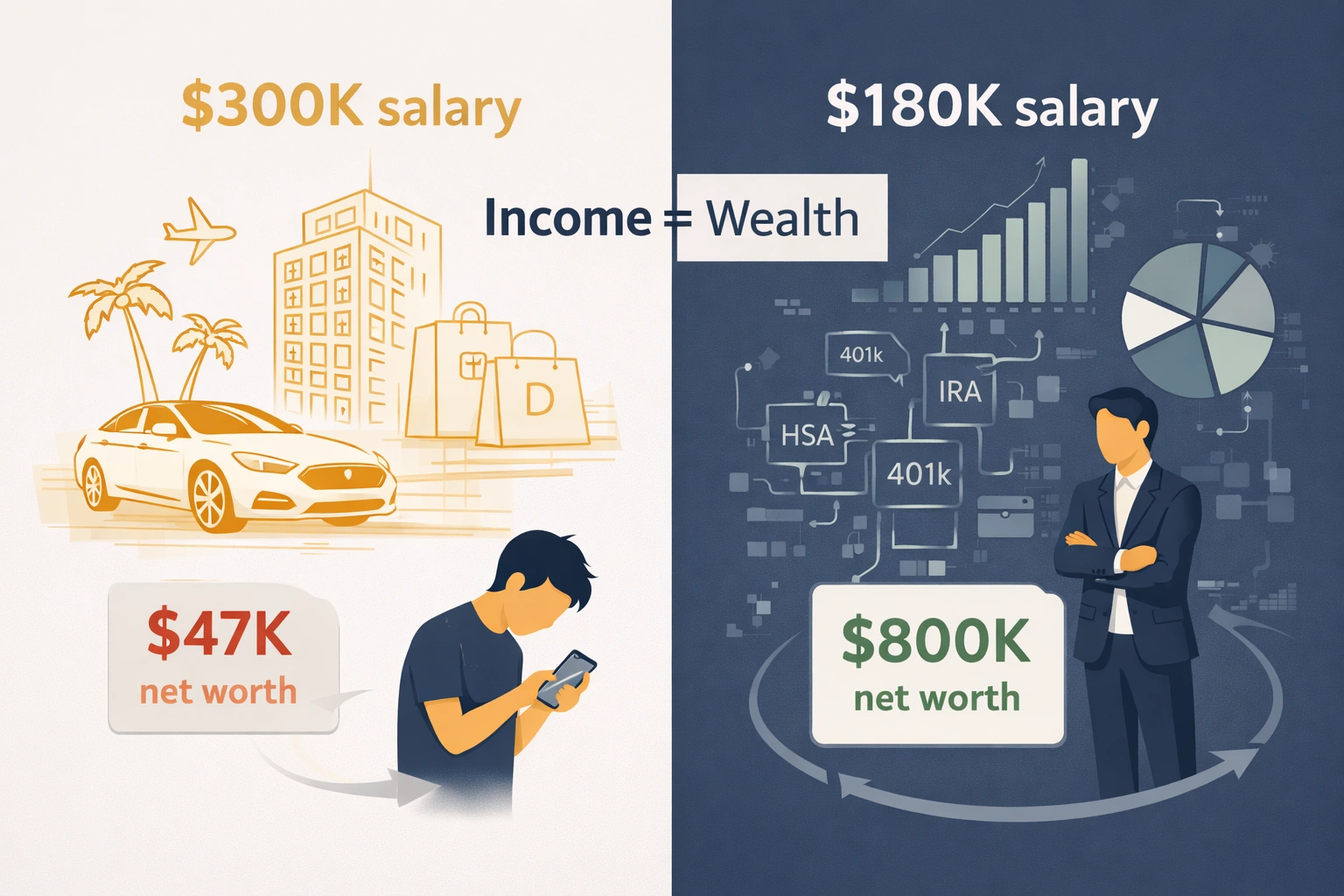
⚠️ Crucial Disclaimer: This strategy only works if you are a Disciplined Investor. If you rent but spend the savings on DoorDash and vacations, you will lose. You must take the money you would have spent on a down payment/repairs and invest it religiously.
Liquidity: You Can’t Eat Your Kitchen
Wealth is not just about Net Worth; it is about Liquidity (how easily you can access your money).
- Stocks: You can sell $5,000 of Apple stock on your phone while sitting on the couch and have the cash in 2 days.
- Real Estate: You cannot sell “just the bathroom” if you lose your job. To access your money, you have to sell the whole house (which takes months and costs 6% fees) or beg the bank for a loan.
In a recession, liquidity is king. Homeowners are often “House Poor”—high net worth on paper, zero cash to buy groceries. Renters with a fat investment portfolio are bulletproof.
The Verdict: Mobility is the New Wealth
The American Dream needs an update.
In the 1970s, buying a house was the only way to build wealth because there were no trading apps and no low-cost ETFs. A mortgage was a “forced savings account.”
In 2026, you have better options.
You can rent a luxury apartment, let the landlord fix the roof, keep your down payment in the market earning compounding returns, and—most importantly—move whenever you want.
If you get a job offer in New York that doubles your salary, you can break your lease and leave. If you own a home, you are anchored.
That isn’t “throwing money away.” That is buying freedom.