Updated July 2026: This post was written when AI-assisted performance reviews were a visible controversy in early 2024. Two years on, the practice has become widespread and largely normalized — the debate shifted from “is this appropriate?” to “how do you detect it?” The strategic framing in this post now applies to both sides of the review: managers using AI to write reviews, and employees using it to write self-assessments. The detection and positioning advice below is still relevant.
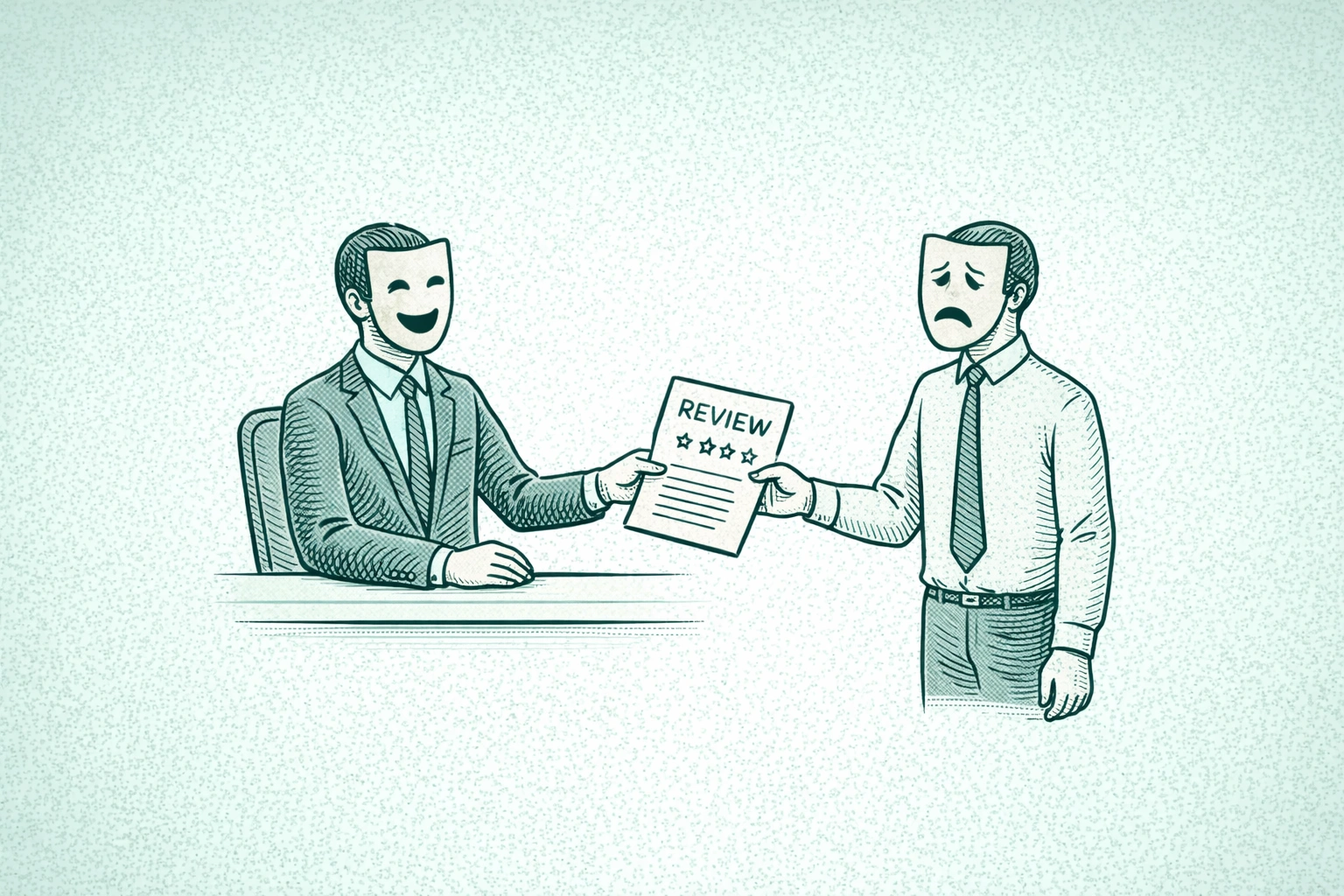
In early 2024, directors of engineering at companies like BetterUp started posting their ChatGPT prompts for writing performance reviews on LinkedIn. Not anonymously. Not apologetically. Openly, as productivity tips, as if they were sharing a good keyboard shortcut.
The discourse that followed focused on ethics — is it appropriate to outsource human judgment about an employee’s work to a language model? That’s the wrong question. The right question is why the adoption happened so quickly, so openly, and with essentially no resistance from anyone in the system.
Employees didn’t revolt. HR didn’t issue bans. Senior leadership didn’t express concern. The overwhelming response was: yeah, that makes sense, I might try that.
That near-universal shrug is the most revealing thing that’s happened to the performance review system in the twenty years I’ve been watching it operate. When you outsource a process to AI and nobody objects, it’s because everyone already knew the process was mechanical. You don’t use ChatGPT to draft your product strategy or your compensation philosophy. You use it to generate content that follows a template, hits required keywords, and exists primarily to satisfy a bureaucratic requirement.
The AI adoption of performance reviews wasn’t a scandal. It was an accidental confession.
What the System Actually Costs
Before getting into what reviews are actually for, the direct cost is worth stating plainly.
A company with 10,000 employees spends approximately $35 million annually running performance reviews. Managers invest around 210 hours per year on the process. Employees spend roughly 40 hours. That’s one full working week, per person, dedicated to a process that research by Betterworks found 64% of employees consider a complete or partial waste of time.
The return on that investment: 30% of performance reviews actively decrease employee performance. Not “fail to improve” — decrease. The system doesn’t just fail to work. It works in reverse for nearly a third of the people going through it.
Apple’s former chief talent officer called annual reviews “the stupidest thing American companies do.” Microsoft, GE, Adobe, and Netflix have all abandoned traditional reviews. These aren’t startups experimenting — these are the companies with the most sophisticated HR functions in the world, concluding after careful analysis that the apparatus produces negative value.
Join The Global Frame
Money, work, and tech — one read every Saturday that actually changes how you think.
And yet most organizations continue. So what’s actually going on?
The Five Things Performance Reviews Are Actually For
The gap between the stated purpose of reviews — improving employee performance through constructive feedback — and their actual function is the core of the problem.
The primary function is legal documentation. The paper trail created by an annual review is defensible in wrongful termination litigation. Managers aren’t building development plans — they’re building a liability shield. Everything else in the process exists downstream of this.
The second function is compensation justification. In most organizations, salary and bonus decisions are made during budget cycles, months before review conversations happen. The feedback follows the number, not vice versa. The review provides post-hoc rationalization for decisions already finalized.
Third is forced ranking. Many organizations require bell-curve distributions of ratings. If your entire team is exceptional, someone still has to be rated below average because the math demands it. This is not a quirk — it’s the design. It also structurally undermines collaboration, because your colleague’s advancement comes at the cost of yours.
Fourth is hierarchy reinforcement. The annual review ritual is a power ceremony. It reminds everyone of their place in the org chart, concentrates judgment in managers, and requires employees to submit their self-assessments to someone above them for evaluation and correction.
Fifth, somewhere around here, is the stated purpose: developing employees.
Why Managers Can’t Actually Evaluate You
Even if the system were designed honestly, it would fail because of a structural problem with knowledge work that no rubric can solve.
Most of what makes someone valuable in a knowledge work role is invisible. The software engineer whose architectural suggestion prevented a catastrophic scaling failure at launch. The product manager whose pushback on a roadmap item saved six months of engineering time. The analyst whose model assumption caught an error that would have cost seven figures. These contributions don’t surface in dashboards. They’re not captured in metrics. By the time review season arrives, the manager who benefited from them has often moved on, and the people doing the evaluation weren’t in the room.
What managers can evaluate is visibility. The person who talks in every meeting. The person who sends frequent updates to senior leadership. The person whose output is legible and loudly attributed. Research consistently shows that more than 50% of a performance rating reflects the characteristics of the evaluator rather than the person being evaluated. Your score predicts your manager’s rating tendencies better than it predicts your actual contribution.
This is why the CEB found that two-thirds of employees receiving the highest scores in typical performance management systems are not the organization’s highest performers. The system isn’t measuring the wrong thing poorly — it’s measuring a different thing entirely.
I’ve been tracking this dynamic since writing about what actually makes someone structurally indispensable at work. The qualities that protect people during layoffs — owning critical systems, driving measurable revenue, creating genuine dependencies — are largely orthogonal to the qualities that generate high performance ratings. Visibility is a different skill from value creation, and the review system consistently rewards the former.
What Netflix and Microsoft Figured Out
The companies that abandoned traditional reviews didn’t replace them with nothing. They replaced them with something that functions differently.
Netflix moved to informal, continuous 360-degree conversations happening throughout the year. Former Chief Talent Officer Patty McCord put it simply: if you talk honestly about performance on a regular basis, you get better outcomes than a company that grades everyone annually on a five-point scale. The insight is that feedback loses most of its utility the farther it gets from the moment it’s relevant. A note about a presentation six months after it happened changes nothing. A note immediately after changes the next one.
Microsoft eliminated stack ranking after recognizing what the forced distribution was actually doing to behavior. When managers are required to label a fixed percentage of their team as underperformers regardless of actual performance, they produce teams where helping a colleague is a rational risk. You don’t help someone who might end up above you in the ranking. The system selected for zero-sum cultures in a company that needed collaborative ones.
The pattern across every company that has moved away from traditional reviews is the same: they were competing hard enough on talent and innovation that they couldn’t absorb the morale damage the system inflicts. The job security research is consistent here — people who feel arbitrarily evaluated disengage, and disengaged people don’t take the risks that produce exceptional work.
What to Do If You’re Still Subject to the System
Most people reading this work at organizations that haven’t abandoned reviews, and won’t anytime soon. The legal, financial, and political incentives maintaining the system are deeply entrenched. HR departments have built empires around elaborate review processes. The system continues.
The productive response isn’t trying to reform it. It’s treating it as the compliance exercise it is and investing energy accordingly.
Keep a running record of your actual contributions throughout the year — specific outcomes, numbers where you have them, situations where your involvement mattered. This isn’t for your development. It’s so that when your manager sits down to type a prompt into ChatGPT, you’ve made it easy to include the things that actually matter. Your job is to make your value legible to someone who doesn’t have the context to see it independently.
Build visibility that travels outside your direct reporting chain. The review system is most vulnerable to manipulation when your evaluator is the only person who knows what you’re doing. Work on projects that create artifacts with your name on them. Solve problems that other teams know about. Develop relationships with people who can speak to your contribution when ratings are debated — because in most organizations, ratings are debated, and your manager’s ability to advocate for you depends on their political capital as much as your performance.
Decouple the feedback you actually use from the feedback that goes in the system. Seek real-time input from peers doing similar work, from people who’ve handled similar paths, from customers or stakeholders who experience your output directly. Performance reviews happen once a year through a politically filtered channel. The feedback worth acting on is continuous and comes from people with direct visibility into what you’re doing.
Understand that your compensation is ultimately determined by what the external market will pay you, not what your internal rating says. Salary negotiation research consistently shows that internal ratings are a lagging indicator of market value at best. Test the external market regularly — even if you’re not planning to leave, knowing what you’re actually worth gives you data that no performance rating can substitute for.
The Broader Pattern
The AI performance review moment is worth sitting with beyond its immediate implications for the review process specifically.
When institutions rapidly automate a supposedly human-centered process and nobody objects, the silence is informative. It means the participants already knew the process was mechanical. The AI didn’t change what the process was — it just made visible what everyone had already privately concluded.
Performance reviews are the most visible example of a broader category: organizational theater that survives because it serves institutional needs (legal coverage, hierarchy, budget justification) while producing essentially nothing toward its stated objective. Strategic planning cycles that produce documents nobody references. All-hands meetings designed to convey the impression of transparency. Mandatory training that changes no measurable behavior.
The review system’s rapid AI adoption is a useful diagnostic tool. It tells you, precisely and without ambiguity, what the organization believes about the value of its own processes.
High performers use this information. They don’t optimize for the rubric. They optimize for capabilities that compound across roles, for relationships that travel between organizations, for work that creates legible value in ways that no review cycle can obscure. They treat the review as a checkbox and invest their attention where the ceiling is higher than a half-point raise.
The process isn’t going to change. But your relationship to it can.