Updated July 2026: Major estate tax update: the OBBBA permanently raised the federal estate and gift tax exemption to $15 million per person ($30 million per married couple) for 2026, inflation-indexed going forward. Previously, the exemption was approximately $14.6 million in 2025 and was set to revert to roughly $7 million after 2025 when TCJA expired. The permanent $15M+ exemption significantly reduces the number of estates subject to federal estate tax — the estate planning principles in this post remain important regardless, as most states have lower exemption thresholds and the non-tax elements (probate, beneficiary designations, healthcare directives) apply universally.
I’ve noticed something in conversations about personal finance: people who spend serious time thinking about their 401(k) allocation, their Roth conversion strategy, and whether they should dollar-cost average into index funds have often given almost no thought to what happens to all of it when they die. The cognitive dissonance is striking. Someone will optimize their investment account down to the basis point and then have no will, no trust, beneficiary designations that haven’t been updated since their first job at 24, and a life insurance policy that still lists an ex-partner.
This is not a problem reserved for the very wealthy. It’s not even primarily a problem of estate taxes — the OBBBA raised the federal estate tax exemption to $15 million per individual in 2026, which means federal estate tax is genuinely irrelevant for most households reading this. The problems that actually affect the $150,000 to $800,000 household — the person with a home, a 401(k), some brokerage accounts, and maybe a growing business or RSU portfolio — are quieter and more mundane. They’re about control: who gets what, who decides things when you can’t, who raises your kids if both of you are gone. And unlike estate tax, those problems don’t disappear with a high exemption. They show up when you least expect them, move at the speed of a probate court, and create consequences that are sometimes permanent.
What “No Plan” Actually Means Legally
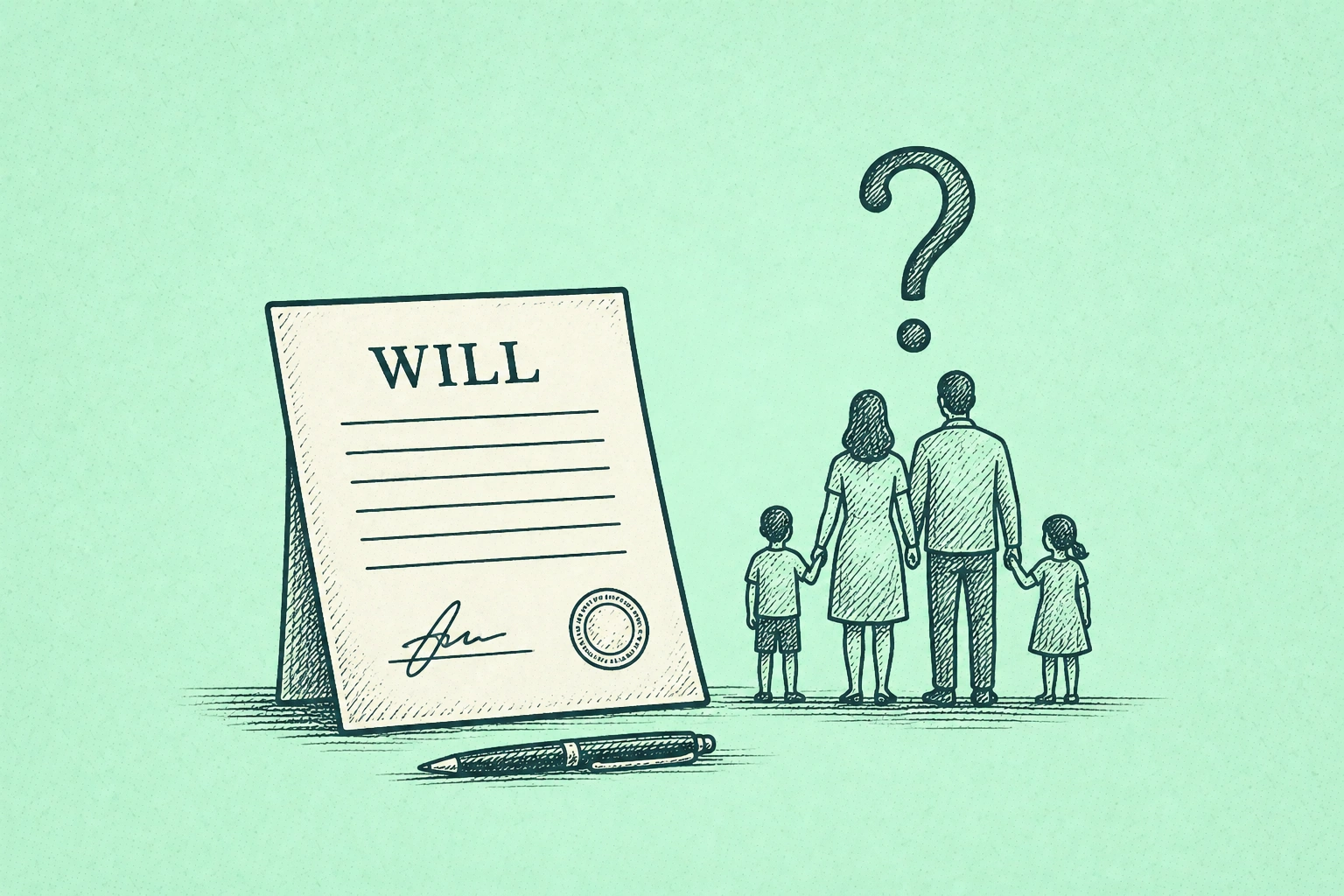
When someone dies without a valid will — the legal term is dying “intestate” — the state steps in and applies its own formula for distributing whatever assets are in your name alone. Every state has intestate succession laws, and they follow a fairly standard hierarchy: spouse first, then children, then parents, then siblings, and so on down the family tree.
This sounds reasonable until you look at the specifics. If you’re married with children from a previous relationship, many states split your estate between your current spouse and your children from that earlier relationship — often in proportions you would never have chosen. If you’re in a long-term unmarried partnership, your partner receives nothing under intestate succession in most states, regardless of how long you’ve been together or what your intentions were. Stepchildren who were never legally adopted receive nothing. Charities you cared about receive nothing. Friends receive nothing. The formula is strict and it doesn’t know your actual life.
What Probate Actually Is and Why It’s Expensive
This matters even more for high earners because the assets at stake are larger. A $500,000 brokerage account distributed by state formula is a very different outcome than that same account distributed the way you would have directed. The state’s formula doesn’t care that you wanted to leave something to a sibling who helped you build your business, or that your relationship with one of your children is strained, or that you have a specific charitable intention. It applies the formula regardless.
Beyond distribution, dying without a will means a probate court — not you — chooses who administers your estate. Without a named executor, the court defaults to a statutory priority list. The person who ends up administering your estate may be the last person you would have chosen. And without a named guardian for minor children, a court decides that too, without input from you.
The Beneficiary Designation Problem Most People Don’t Know They Have
Here’s the part that catches even otherwise well-prepared people: your will doesn’t control most of your financial accounts. It controls your probate estate — the assets in your name alone with no beneficiary designation. But your 401(k), your IRA, your Roth, your life insurance, and many brokerage accounts pass by beneficiary designation, completely outside the will.
This means the person who inherits your retirement accounts is whoever you named when you opened them — even if that was fifteen years ago, even if circumstances have changed dramatically since then, even if your will says something entirely different.
The consequences of outdated beneficiary designations are some of the most documented and preventable financial disasters in estate planning. A retirement account paid to an ex-spouse because the beneficiary was never updated after a divorce. A life insurance policy paid directly to a minor child, triggering a court-ordered guardianship of funds because minors can’t receive large direct inheritances. An IRA paid to a parent who predeceased the account holder, with no contingent beneficiary named, sending the asset through probate unnecessarily.
Join The Global Frame
Money, work, and tech — one read every Saturday that actually changes how you think.
Arnold & Porter’s OBBBA advisory makes a point worth underscoring: now that the $15 million estate tax exemption is permanent, the planning emphasis has shifted away from transfer tax minimization and toward income tax planning — specifically, maximizing the step-up in basis at death. A step-up in basis means inherited assets are valued at their fair market value at death, wiping out unrealized capital gains accumulated during the decedent’s lifetime. But claiming the full step-up requires the assets to actually pass through the estate correctly. Poor beneficiary designations, outdated trust language, and incorrect titling can all create situations where assets bypass the estate in ways that lose the step-up — leaving heirs with unexpected capital gains exposure.
The beneficiary designation audit — going through every account and confirming that beneficiaries are current, correctly named, and that contingent beneficiaries are in place — is probably the highest-value per-hour estate planning action available, and it requires no attorney.
The Four Documents Every Adult Needs
What the $15 Million Exemption Actually Changed
Before the OBBBA, the estate tax exemption was scheduled to drop from approximately $13.99 million per individual in 2025 to roughly $7 million at the start of 2026 — a consequence of the TCJA’s sunset provision. That cliff was a source of genuine urgency for wealthy families: advisors were recommending large lifetime gifts before year-end to lock in the higher exemption. The OBBBA removed that deadline entirely, raising the exemption to $15 million per individual ($30 million for a married couple using portability) and making it permanent, indexed for inflation beginning in 2027.
For most households — anyone below $15 million in individual net worth — this means federal estate tax is simply not part of the conversation. The 40% federal estate tax rate above the exemption still exists, but statistically, fewer than 0.2% of estates owe it. That’s genuinely good news, but it also creates a false sense of security: “I don’t have an estate tax problem, so I don’t have an estate planning problem.” These are different things.
The issues that actually affect the professional-class household aren’t about tax. They’re about control, speed, cost, and the protection of people you care about. A will takes these off the court’s hands and puts them in yours. A trust can do more — avoiding probate entirely for the assets it holds, providing ongoing management for assets left to minors or beneficiaries who might not manage a lump sum well, and allowing more sophisticated distribution structures. But even a simple will with updated beneficiary designations solves the most catastrophic problems.
The Documents You Actually Need
Estate planning sounds like a project for wealthy retirees. In practice, it’s most urgently needed by people in their 30s and 40s who have accumulated meaningful assets, have dependents, and haven’t acted yet. Here’s what a baseline plan looks like for someone in that position.
A will is the foundation. It names an executor to administer the estate, directs distribution of your probate assets, and — critically if you have minor children — names a guardian. A will that names a guardian for your children is worth creating even if you have almost no other assets. Without it, the court makes that decision.
A durable power of attorney covers financial decisions if you become incapacitated but don’t die. It names someone to manage your finances, pay your bills, and make financial decisions on your behalf while you’re alive but unable to act. Without this document, a family member who wants to help may need to go to court to establish a guardianship — a process that takes months and costs money.
A healthcare proxy or medical power of attorney names who makes medical decisions if you can’t. A living will or advance directive documents your preferences for end-of-life care. These documents matter enormously to the people who would otherwise be in an impossible position without guidance from you.
A revocable living trust is the next step beyond a basic will for people with significant assets, real estate in multiple states, minor children, or complex family situations. Assets held in a trust pass directly to beneficiaries after death without going through probate — which means faster distribution, lower cost, and privacy. Unlike a will, a trust doesn’t become a public record. For someone with a home, retirement accounts, an investment portfolio, and RSUs or other equity compensation, the question of whether to use a revocable trust is worth a conversation with an estate planning attorney. It’s not mandatory, but for many TGF readers the probate savings and distribution control are worth the upfront cost.
Beneficiary Designations: The Mistake That Overrides Everything Else
The Step-Up in Basis: The Planning Opportunity Nobody Talks About
With the estate tax off the table for most households, the most valuable financial planning opportunity in estate planning right now is the step-up in basis — and it’s almost never discussed in personal finance content aimed at high earners.
Here’s the mechanics: when you die holding appreciated assets, your heirs receive those assets with a cost basis equal to the fair market value at your date of death. If you bought a stock for $10 and it’s worth $100 when you die, your heir’s basis is $100. They can sell it immediately and owe zero capital gains tax on the $90 of appreciation that occurred during your lifetime.
This has significant implications for how you think about which assets to hold versus give away during your lifetime. Appreciated assets — stocks, real estate, business interests with significant unrealized gains — are often better held until death rather than gifted during life, because lifetime gifts carry over the original cost basis, creating capital gains exposure for the recipient. The tax loss harvesting and RSU concentration risk strategies I’ve covered on this blog both intersect with this planning framework — the assets you’re managing today are the assets your estate will eventually pass, and the basis structure matters.
The interaction with charitable giving is also worth noting. The OBBBA introduced a new 0.5% AGI floor on charitable deductions — meaning you need to give more than 0.5% of your AGI before any charitable deduction kicks in. For high earners, this is modest. But the step-up in basis makes donating appreciated assets directly to charity even more attractive: you avoid the capital gains you’d otherwise pay on a sale, and you get the deduction based on fair market value. A donor-advised fund accepts appreciated assets, provides an immediate deduction, and lets you distribute the funds to charities over time. This strategy is significantly more tax-efficient than writing a check from your bank account, and it interacts with the SALT deduction and tax bracket planning most high earners are already doing.
The Minimum Viable Estate Plan
The mistake most people make is treating estate planning as something to be done comprehensively or not at all. a detailed plan with a trust, pour-over will, healthcare directive, power of attorney, and coordinated beneficiary designations takes time and a few thousand dollars in attorney fees. It’s worth doing eventually.
But a minimum viable plan can be assembled faster and cheaper than most people think. A will can be drafted in a single attorney meeting for $500 to $1,500 in most markets. Beneficiary designation updates on every financial account cost nothing and take an afternoon. A durable power of attorney and healthcare proxy can typically be prepared at the same time as the will for modest additional cost.
The personal wealth management system post I wrote last year argued for treating your finances as a set of interconnected systems rather than isolated accounts. Estate planning is the connective layer of that system — the part that ensures everything you’ve built actually reaches the people you intend, in the way you intended, without unnecessary delay, cost, or court involvement. Building that layer doesn’t require the urgency it did before the OBBBA. The estate tax cliff is gone. What remains is the quieter, more personal work of making sure the life you’ve built has a plan that reflects the intentions behind it.