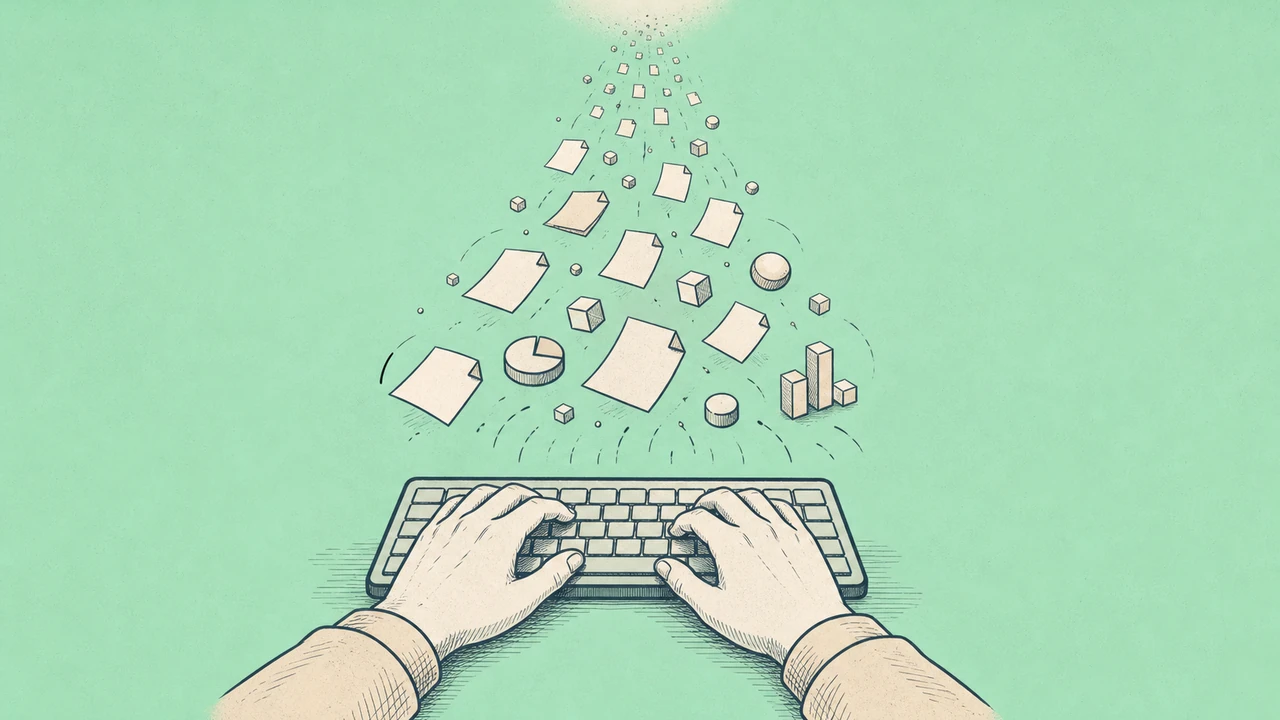
There’s a specific moment a lot of professionals are handling right now without quite having the language for it. You receive an email from a colleague — maybe a manager, maybe a peer — and something about it is slightly off. The tone is right, the content is relevant, but there’s a smoothness to it, a certain completeness, that doesn’t quite match how that person normally communicates. The structure is a little too clean. The transitions are too fluid. It doesn’t have the slight roughness of something a person actually typed.
You’re probably right. Over 75% of professionals now use AI tools in their daily work, according to a study of 1,100 professionals published in the International Journal of Business Communication by researchers at the University of Florida and USC Marshall School of Business. Writing and editing workplace messages with tools like ChatGPT, Gemini, Copilot, or Claude has become, in that study’s words, “a commonplace practice.” A separate ZeroBounce survey of 1,000 US professionals found that nearly 1 in 4 employees use AI daily for drafting or editing workplace emails — and 21% reported catching a coworker using the exact same AI-generated email they had seen before.
The AI-saturated workplace is not coming. It is here. And the question that matters for anyone trying to handle it isn’t whether to be alarmed by this — it’s what to actually do with that information.
What AI-Written Communication Actually Looks Like
The signature patterns of unedited AI-generated workplace communication aren’t hard to identify once you know what to look for. They’re not about grammar or factual accuracy — modern AI writes clean, grammatically correct prose that’s typically more accurate than a rushed human draft. The tells are structural and tonal, not mechanical.
How to Spot AI-Written Emails
Structural completeness that doesn’t match the context. An AI-written email asking for a meeting will include a clear subject, a brief context paragraph, a specific ask, two or three available times, and a polite close — even when the human writing it was in a hurry and genuinely only needed one sentence. The completeness is a tell because humans under pressure write compressed, context-dependent messages. AI defaults to full form.
Transitions that are too smooth. Human writing jumps. It assumes shared context. It uses shorthand. AI-generated writing bridges every gap: “And ” “In addition to the above,” “In short, the key points discussed.” The connective tissue is always there because the model is trained to produce coherent prose — not because the human sender thought all those transitions were necessary.
Absence of personal anchors. Human professional communication, even in formal contexts, tends to contain brief personal references — a mention of a specific conversation, a reference to something that happened last week, the particular way someone structures a greeting. AI-generated drafts, unless explicitly prompted otherwise, are neutral. They don’t reference the specific shared history between sender and recipient because the model doesn’t have access to it.
Consistent register regardless of content. A person writing to relay good news versus writing to flag a problem typically shifts register slightly — something in the tone changes, even in professional contexts. AI-generated communication tends to maintain a consistent professional register across all content types, which creates a subtle uncanniness when the topic is emotionally weighted.
None of these patterns is definitive alone. Some people simply write formally. The combination of all four — excessive completeness, smooth transitions, no personal anchors, flat register regardless of content — is a reasonably reliable signal in someone who doesn’t normally write that way.
The Research on What Happens to Trust
The University of Florida and USC research is worth understanding in detail because it establishes something important: the problem with AI-written workplace communication isn’t quality. It’s attribution.
Join The Global Frame
Money, work, and tech — one read every Saturday that actually changes how you think.
Why It Actually Matters for Your Career
The study found that when managers used a small amount of AI assistance — grammar corrections, light editing — employees continued to view them as caring and competent. The AI-assisted communication was actually perceived as more professional than unassisted writing. But when emails were largely composed by AI, employees judged them as inauthentic and their perception of the manager’s sincerity, integrity, and leadership ability declined. The researchers described this as a “perception gap”: message quality up, sender credibility down.
The mechanism is straightforward. When someone receives a message, they’re not just processing information — they’re making inferences about the sender. A well-crafted message implies the sender cared enough to craft it. When it becomes apparent (or even suspected) that the message was assembled by a model in thirty seconds, the inference reverses: the sender didn’t care enough to write it themselves. The professional signal that a polished message was supposed to send gets inverted by the evidence of how it was produced.
This dynamic is particularly acute for high-stakes communication — performance feedback, motivational messages, difficult conversations, acknowledgments of good work. These are precisely the contexts where AI use is most tempting (they’re hard to write) and most damaging (they’re read for human signal, not information content). An AI-drafted performance review that says all the right things is experienced very differently from one that reflects the specific things a manager actually observed. Employees can tell the difference, and the ZeroBounce data suggests they’re already looking for it — 21% of those surveyed had already caught a colleague using duplicate AI-generated text.
What This Means for How You Work
The reasonable response to an AI-saturated workplace communication environment is not to scan every message for tells or to assume cynically that nothing you receive is genuine. That’s exhausting and uncharitable. The more useful response is to understand where AI-generated communication creates problems and to make deliberate choices about your own communication accordingly.
There are categories of professional communication where AI assistance is largely irrelevant to the recipient’s experience: status updates, meeting logistics, straightforward information requests, scheduling, project coordination. The content is the message. Whether it was drafted by a person or a model in thirty seconds has no bearing on whether the meeting is at 2pm on Thursday. Use whatever tools help you produce these communications efficiently.
There are other categories where AI assistance introduces a meaningful gap between what the communication signals and what the recipient experiences it as: feedback on someone’s work, recognition of effort, expressions of concern, communication around sensitive personnel situations, persuasive professional arguments where your credibility is part of the ask. In these categories, the human signal is not incidental to the message — it is the message. Deploying AI-generated text in these contexts doesn’t just reduce efficiency gains; it actively undermines the goal.
The promotion conversation dynamic is a useful example. If you’re building a relationship with a skip-level sponsor through regular communication, the whole point is that the communication is genuinely from you. An AI-polished email to your manager’s manager reads to an experienced professional as exactly what it is. What you’re trying to signal — that you’re someone worth backing — requires communication that reflects how you actually think.
The Confidentiality Problem Most People Ignore
There’s a dimension of workplace AI communication that gets much less attention than the trust question, and it’s the one most likely to create professional or legal consequences: what goes into the prompt.
How to Use AI in Your Own Writing Without Losing Your Voice
When an employee opens ChatGPT and pastes in a client email to generate a reply, the client’s information — potentially confidential, potentially proprietary, potentially subject to NDAs — has just been submitted to a third-party system. When someone uses a public AI tool to draft performance feedback, the employee’s name and a description of their work challenges may end up in a training dataset. When a lawyer uses a consumer AI tool to polish a case summary, privileged information has potentially left the firm’s control.
Most companies that have AI policies require human review of AI-generated content before sending. What fewer policies address clearly is what information employees are permitted to input in the first place. The legal firm Brabners, writing on AI employment risks in early 2026, cited a specific example: a junior associate pasting a client’s grievance summary into a public AI chatbot to improve the tone of a response — creating a potential breach of confidentiality and data protection obligations in a single thirty-second action.
The practical standard worth applying: treat the context window of a consumer AI tool the same way you’d treat a public email list. Anything you’d be uncomfortable posting publicly, don’t paste in. For genuinely sensitive work, either use your company’s approved enterprise AI tools (which operate under different data handling agreements) or draft without AI assistance.
The Disclosure Question Nobody Is Asking Out Loud
The Debevoise & Plimpton Data Blog published a thoughtful analysis in February 2026 making the case for internal AI-use disclosure policies — the idea that employees should indicate when significant portions of a document were AI-generated, particularly for work product that others will rely on for decisions. The argument was straightforward: disclosure normalizes AI use as legitimate, ensures AI-generated outputs get the appropriate level of scrutiny, and prevents the professional deception that flows from presenting AI work product as personal work.
The professional culture hasn’t settled on a norm here yet. Most workplaces sit in an uncomfortable middle ground: AI use is pervasive, mostly undisclosed, and everyone knows it’s happening but nobody says so. This creates a diffuse form of professional inauthenticity that doesn’t feel acute in any single instance but compounds over time.
The individual response to this ambiguity is worth being deliberate about. In contexts where the quality of your thinking is part of what you’re being evaluated on — strategy documents, recommendations, analyses, proposals — presenting AI-generated content as your own original reasoning is a professional risk that’s different from using AI to draft a scheduling email. The former involves the attribution of judgment you may or may not have exercised. The latter is a productivity tool applied to a task where attribution of the thinking is irrelevant.
The line isn’t always obvious and the norms are evolving. But having thought about where your line is — rather than defaulting to whatever seems convenient in the moment — puts you ahead of most people handling this in real time.
The Competitive Implication
There’s a straightforward career advantage available to anyone who uses AI fluently for the tasks where it helps and communicates genuinely in the contexts where authenticity matters. It’s a smaller group than it appears. Most people are doing one or the other: either avoiding AI tools out of discomfort, or using them indiscriminately without distinguishing between contexts where the tool helps and contexts where it undermines the goal.
The AI generalist skills framework I wrote about earlier in the year covers this at the workflow level — the productivity gains from fluent AI use in the right tasks are real and compounding. The communication context adds a second layer: the person who is also a clear, genuine, specific human communicator in high-stakes professional contexts stands out more now than they did before, because the average is getting smoother and more generic as AI-assisted communication proliferates.
Your manager who received thirty similar AI-drafted updates this week will remember the one that had a specific detail, a particular turn of phrase, a clear point of view. That’s not a small thing in a promotion trajectory. It’s precisely the kind of differentiation that happens at the margin and compounds over a career.