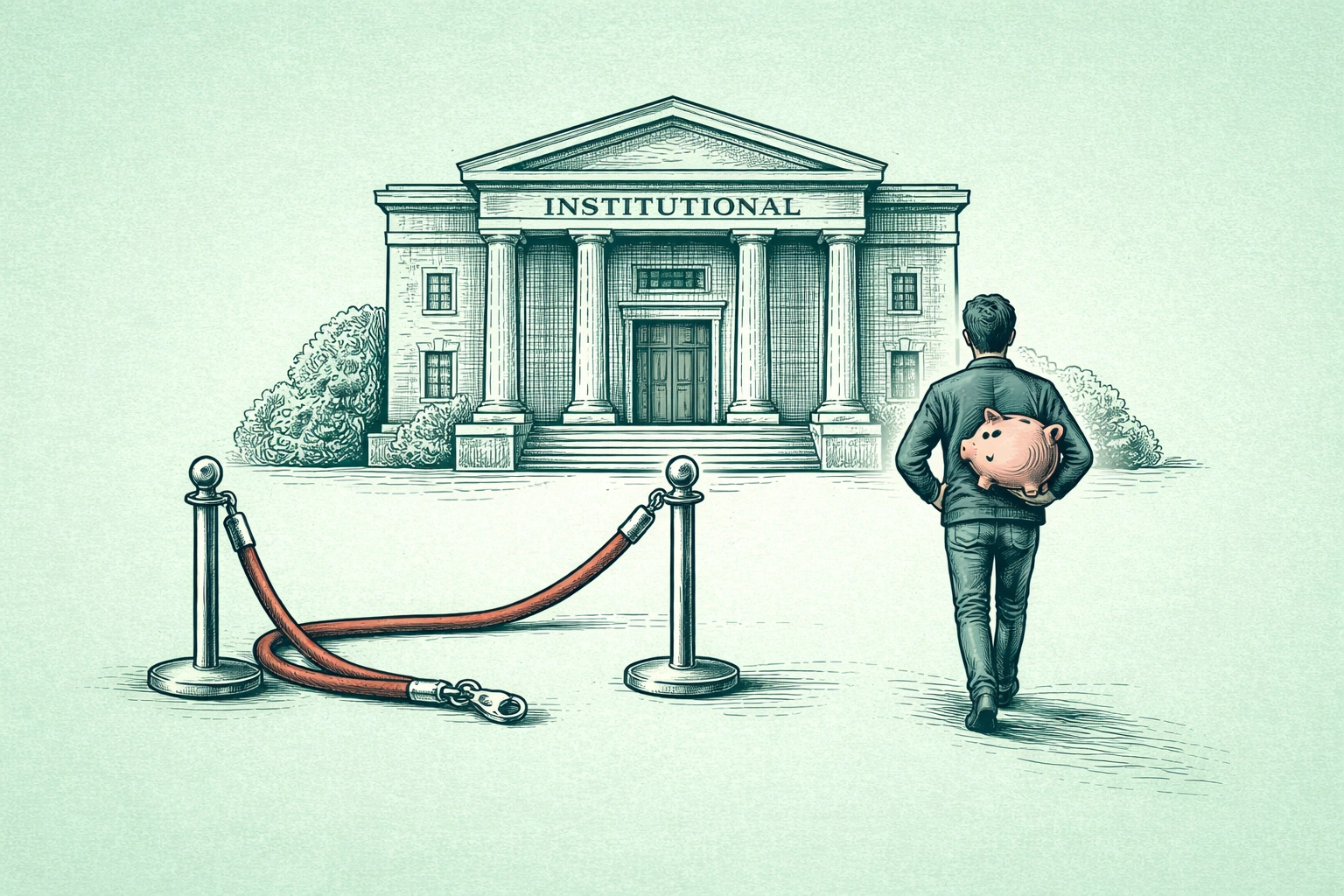
Private credit investing has been the quietly dominant strategy of endowments, family offices, and sovereign wealth funds for roughly two decades. While retail investors were cycling between stocks and bonds, Harvard’s endowment was earning 8 to 12% annually by doing something structurally simpler: acting as a bank. Lending money to mid-sized companies that the actual banks had stopped serving. Collecting interest. Not worrying about stock market volatility because the loans weren’t priced on an exchange. The velvet rope around this asset class wasn’t a conspiracy — it was a $250,000 minimum check size and a $5 million net worth requirement that made it structurally inaccessible to everyone outside institutional capital. That has materially changed in the last eighteen months.
Blackstone, Apollo, and KKR — the firms that built the private credit market — have spent 2025 aggressively opening retail access through interval funds, non-traded vehicles, and lowered minimums specifically designed for individual investors. The yields on offer: 8 to 12%, floating with interest rates, with senior secured collateral backing the loans. Blackstone’s primer on private credit frames this as democratization. That framing is partially true and requires some scrutiny before you act on it.
What Private Credit Investing Actually Is
Strip away the institutional language and private credit investing is straightforward: a company needs capital, the traditional banks won’t provide it on acceptable terms, and a private fund fills the gap at a higher interest rate. The borrowers are typically mid-market businesses — a regional healthcare operator, a software company expanding into new verticals, a distribution firm acquiring a competitor — with revenues between $50 million and $1 billion. Too large for community bank lending, too small or too leveraged for the investment-grade bond market.
The regulatory backstory matters for understanding why this market exists at the scale it does. After the 2008 financial crisis, and again following the 2023 regional banking failures, Basel III capital requirements forced traditional banks to hold substantially more reserves against riskier loans. Lending to a mid-market company with leverage ratios that would have been unremarkable in 2006 became expensive for a bank to hold on its balance sheet. Private credit funds, which aren’t subject to the same reserve requirements, stepped into the vacuum. The market has grown from roughly $400 billion in 2012 to between $1.7 and $2 trillion today — not because the strategy is new, but because regulation created a structural gap that private capital was positioned to fill.
The yield mechanism works through floating rates. Most private credit loans are structured as the base rate — currently around 4.5% — plus a spread, typically 5 to 7 percentage points. When the Federal Reserve holds rates elevated, those spreads produce total yields in the 10 to 12% range. Unlike a fixed-rate bond, which loses value when rates rise, a floating-rate loan adjusts automatically. This is why private credit largely held its value during 2022 and 2023 while the Bloomberg Aggregate Bond Index fell 13% — the rate environment that crushed conventional fixed income actually improved the income on floating-rate private loans.
How Retail Access Actually Works — and Where It Gets Complicated
There are two practical paths for individual investors approaching private credit investing. The first is Business Development Companies — BDCs — which are closed-end funds that trade on public exchanges like ordinary stocks. Ares Capital (ARCC) and Main Street Capital (MAIN) are the most established names, with dividend yields currently in the 9 to 10% range and multi-decade track records. You can buy them through any brokerage account at any time, sell them the same way, and receive dividends quarterly. The tradeoff: because BDCs trade publicly, their share prices move with market sentiment, not just with the quality of the underlying loans. During the March 2020 COVID panic, ARCC fell roughly 40% even though its loan portfolio was performing. Investors who sold locked in real losses. Investors who held — or bought — recovered fully within months. The underlying loans were fine. The stock price wasn’t.
The second path is interval funds and non-traded vehicles — the products that Blackstone (BCRED), KKR, and Blue Owl are actively marketing to retail investors. These are priced at net asset value rather than on an exchange, so they don’t exhibit the same day-to-day volatility as BDCs. Minimums have dropped to as low as $2,500 on some platforms. The structural catch, which deserves clear-eyed attention, is liquidity. These funds typically permit redemptions of only 5% of total assets per quarter. If you want your money back in a market environment where many investors are withdrawing simultaneously, you join a queue. This happened in 2023 with major non-traded real estate funds — investors waited months to access their capital as redemption gates came down. The illiquidity isn’t a design flaw; it exists because the underlying loans are 5 to 7-year instruments that can’t be liquidated on short notice. But it means private credit investing through these vehicles requires capital you genuinely don’t need for the foreseeable future. Emergency funds, near-term spending, and liquidity reserves have no place here.
The credit risk question is the one that tends to get understated in the marketing materials. Private credit portfolios have historically experienced lower loss rates than high-yield bonds — the senior secured structure, which gives lenders first claim on company assets in default, provides meaningful protection. Preqin’s 2025 private debt report puts historical default rates for senior secured direct lending at roughly 2 to 3% annually in normal economic conditions. The risk concentrates in recession scenarios where defaults across the middle market rise simultaneously. Unlike a diversified stock index where volatility is cushioned by breadth, a private credit fund with 50 to 100 borrowers is making a more concentrated bet on the health of mid-market corporate America. The 10% yield is compensation for that bet, not a free lunch.
The portfolio allocation logic that makes most sense here treats private credit as a bond replacement rather than an equity supplement. The conventional 60/40 stock-bond split was built around the assumption that bonds provided reliable income and acted as a counter-cyclical buffer during equity drawdowns. Neither of those assumptions held in 2022. Private credit investing, structured correctly — BDCs for the liquid portion, a single established interval fund for the illiquid portion — can provide the income that bonds promised without the duration risk that destroyed fixed income portfolios when rates moved. The income that actually compounds over time isn’t found in 4% Treasury yields or 2.5% dividend aristocrat payouts — it’s in asset classes that most retail investors are still treating as inaccessible. They’re not, anymore. The minimum has dropped. The complexity hasn’t.