Part 6 of the Rational Compounding Framework
There’s a certain type of finance content that feels incredibly productive to read. It goes something like this: max your HSA, do the backdoor Roth, set up a mega backdoor Roth if your plan allows it, look into a Solo 401k if you freelance, harvest losses in taxable accounts every December. By the end of it you’ve got six browser tabs open, a notes app full of acronyms, and a vague sense that you’ve figured something out.
I’ve been there. I spent a solid two months going deep on tax hacks for high earners a few years back. And here’s what I noticed: I was accumulating tactics with no idea how they connected to each other, or to anything resembling a long-term plan. I was optimizing for the tax year, not for the decade.
That’s the trap. And it’s a surprisingly easy one to fall into, especially if you’re a high earner who’s done the obvious things — you’ve got a 401k, maybe a Roth IRA — and you’re now hungry for the “next level” stuff. The internet is happy to oblige you with an endless supply of next-level stuff. Most of it isn’t wrong. It’s just incomplete in a way that can quietly cost you.
The Tool Isn’t the Strategy
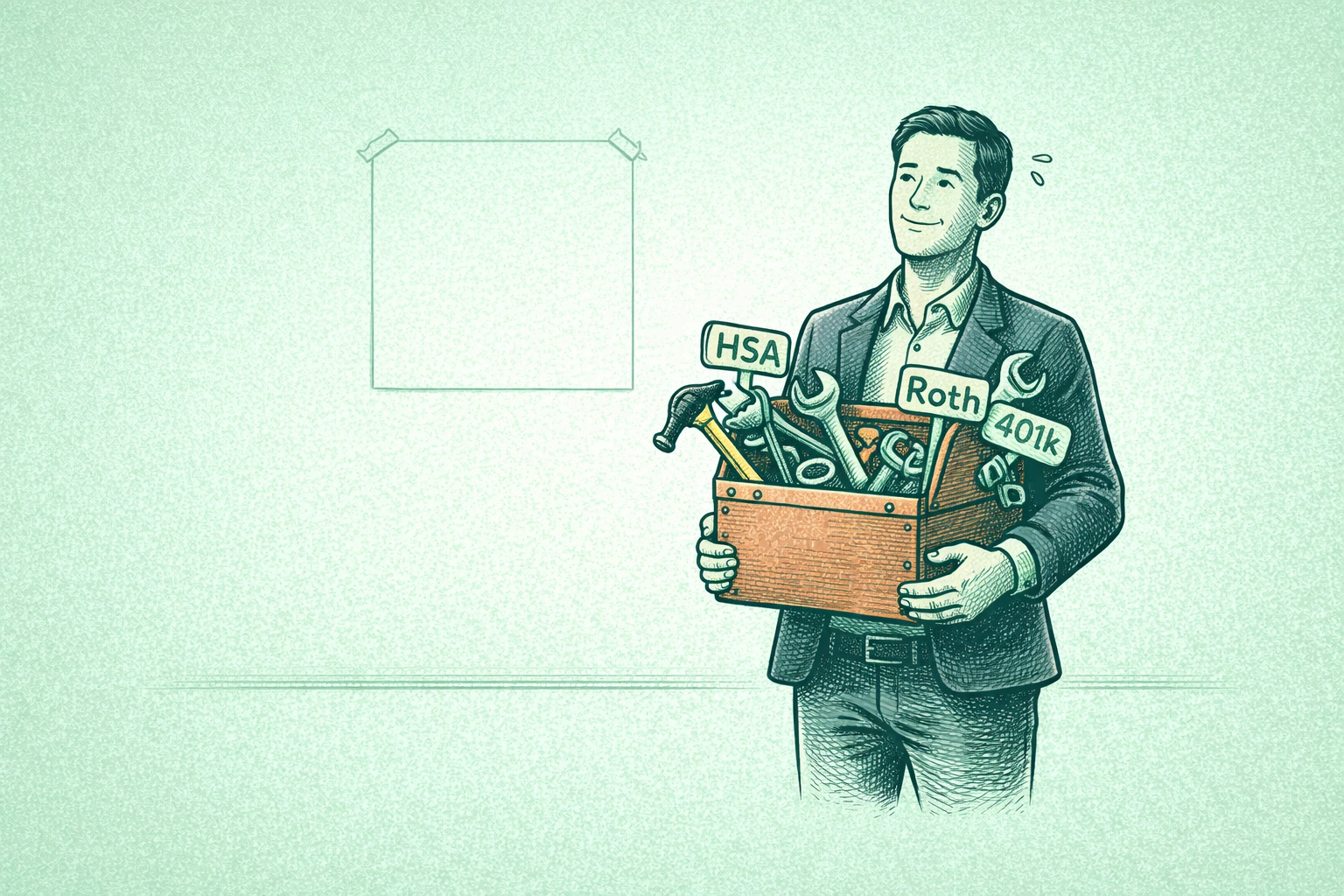
Let me be direct about what backdoor Roths, HSAs, mega backdoor Roths, and tax-loss harvesting actually are: they’re tools. Powerful ones, genuinely. But a tool is only as useful as the plan it serves.
The backdoor Roth IRA lets high earners sidestep the income limit on Roth contributions — you contribute to a traditional IRA, then convert it. Done right, $7,000 a year flows into an account where it grows and comes out tax-free. That’s real money over 30 years. But if you’re doing the backdoor Roth while sitting on a pre-tax IRA from a previous employer, you’ll trigger the pro-rata rule and suddenly owe taxes on the conversion you thought was clean. The tactic, without context, created a problem.
The HSA is genuinely the best tax vehicle most people aren’t using properly — triple tax advantaged, rolls over indefinitely, and can be invested. But it only works if you’re on a high-deductible health plan, only if you’re actually investing the balance rather than spending it on current medical costs, and only if you’re healthy enough to absorb the higher deductibles in the short term. For someone with ongoing prescriptions or a family with frequent doctor visits, it can cost more than it saves. The math depends on your life, not on the general case the article was written for.
Tax-loss harvesting is another one that sounds smarter than it often is. You sell a position that’s down, realize the loss to offset gains, buy something similar to stay invested. The 30-day wash sale rule makes it fiddly, and if you’re not in a high tax bracket to begin with, the benefit barely clears the friction. For most people doing it manually, the mental overhead outweighs the actual dollar gain.
None of this means you shouldn’t use these tools. It means using them in isolation — chasing each tactic as it crosses your feed — is not a wealth-building approach. It’s housekeeping dressed up as strategy.
When Tax Optimization Defers the Problem Instead of Solving It
Here’s the version of this nobody likes to hear: aggressive tax deferral can actually hurt you, depending on where you end up.
Join The Global Frame
Money, work, and tech — one read every Saturday that actually changes how you think.
The traditional 401k argument goes like this — contribute pre-tax now, pay taxes when you withdraw in retirement, presumably at a lower rate because you’ll be earning less. That logic made a lot of sense when the top marginal rates were steeper and retirement income was predictably modest. It still makes sense for plenty of people. But for high earners on a genuine wealth-building path, the “lower rate in retirement” assumption deserves some scrutiny.
If you’re compounding seriously over 30 years, you might not be in a lower bracket in retirement. You might be pulling from a $3M traditional IRA, taking Social Security, and realizing capital gains on a taxable portfolio — all in the same tax year. Required minimum distributions kick in at 73, and they don’t care whether you need the money or not. You’re forced to take it, and it’s all ordinary income.
This isn’t an argument against traditional 401k contributions. It’s an argument for thinking through your full tax picture at retirement, not just your tax picture this April.
The Roth vs. Traditional decision is probably the most important tax question most people treat as a math problem with a clean answer. It isn’t. It’s a bet on where tax rates are going, where your income is going, and what your withdrawal behavior will look like in 30 years. Anyone who gives you a confident, one-size answer is either selling something or hasn’t thought it through.
What you can do: build flexibility into the system. Having money in both traditional and Roth accounts gives you the ability to manage your taxable income in retirement — pull from Roth in high-income years, pull from traditional in low ones. That optionality is worth something, even if it’s hard to quantify on a spreadsheet today.
The Question Tax Hacks Don’t Answer
After you’ve maxed your 401k, done the backdoor Roth, funded the HSA properly, and set up your taxable brokerage — then what?
This is where the tax optimization content tends to go quiet. Because the answer to “then what” is: it depends on what you’re actually trying to build. And that’s a harder conversation than explaining how the mega backdoor Roth works.
I’ve tracked this pattern across a lot of the personal finance content I’ve consumed over the years. The tactical guides are abundant. The “here’s what to do once you’ve done all the obvious things” content is thin. Because the obvious things are searchable and the not-obvious things are personal.
The framework matters more than the tactic. The three engines — income, investment, and optionality — need to be running together. Tax optimization serves the investment engine. But if you’re so focused on tax efficiency that you’re holding suboptimal assets because of their tax treatment, or avoiding investments because they’d generate taxable events, you’re letting the tax tail wag the investment dog.
A 7% after-tax return beats a 5% tax-free return. The goal is after-tax wealth, not minimized tax bills. Those are related but different objectives, and conflating them leads to some genuinely bad decisions — holding underperforming municipal bonds because they’re tax-exempt, for instance, when the math doesn’t actually work at your income level.
What Optimization Actually Looks Like
The best tax strategy isn’t a list of tactics. It’s a posture: pay the minimum legal amount, in the right accounts, in the right years, without sacrificing investment returns to do it.
For most people building toward real wealth, that posture looks roughly like this. Max the tax-advantaged space first — 401k, Roth where it makes sense, HSA if eligible. Invest the taxable account in a tax-efficient way: broad index funds with low turnover, long-term holds, minimizing unnecessary trades. Review the Roth conversion opportunity each year in lower-income years — a gap year, a sabbatical, the year you start a business at a loss. And stop chasing the marginal tactic when you’re not yet doing the foundational things well.
The high earner who isn’t maxing their 401k but is doing backdoor Roth conversions has the order wrong. The person who’s obsessing over tax-loss harvesting on a $40,000 taxable portfolio is misallocating mental energy. The sequence matters as much as the tactics.
What I’ve come to think is that the best use of your tax optimization energy isn’t finding the next clever move. It’s building a system simple enough that you’ll actually maintain it for 20 years without making emotional decisions in the middle of a market correction. Complexity that you abandon in year three is worse than simplicity you hold through a crash.
The tax code isn’t going anywhere. Neither is the temptation to feel productive by learning another acronym. But somewhere between knowing all the tools and using none of them well, there’s a simpler truth: the people who build wealth don’t have better tax hacks. They have clearer priorities, and they execute them consistently when it’s boring.
That’s not the content that gets shared. But it’s the content that compounds.
This is Part 6 of the Rational Compounding Framework. Read Part 1: The Math of Wealth, Part 2: The 3 Engines, Part 3: Why High Earners Fail, Part 4: The RSU Trap, Part 5: Buy the Dip, or see the complete framework.
Next in the series — Part 7: Designing Your Personal Wealth Operating System