Part 1 of the Rational Compounding Framework
There’s a conversation that happens every December at some holiday party somewhere. Someone mentions their portfolio is up 47% for the year. They caught NVIDIA at the right moment, or rode a crypto wave, or bought a tech stock right before it doubled. The room goes quiet. Everyone recalibrates where they stand.
That conversation never includes the other nine years. The positions that evaporated. The sure things that weren’t. The fact that their actual annualized return over a decade is probably around 6%, not 47% — because one extraordinary year doesn’t change the arithmetic of all the ordinary and bad ones surrounding it.
Luck makes for good stories. Discipline makes for actual compound interest wealth. And the difference between them isn’t a philosophy — it’s a math problem with a clear answer that’s been known for centuries and ignored by most people anyway.
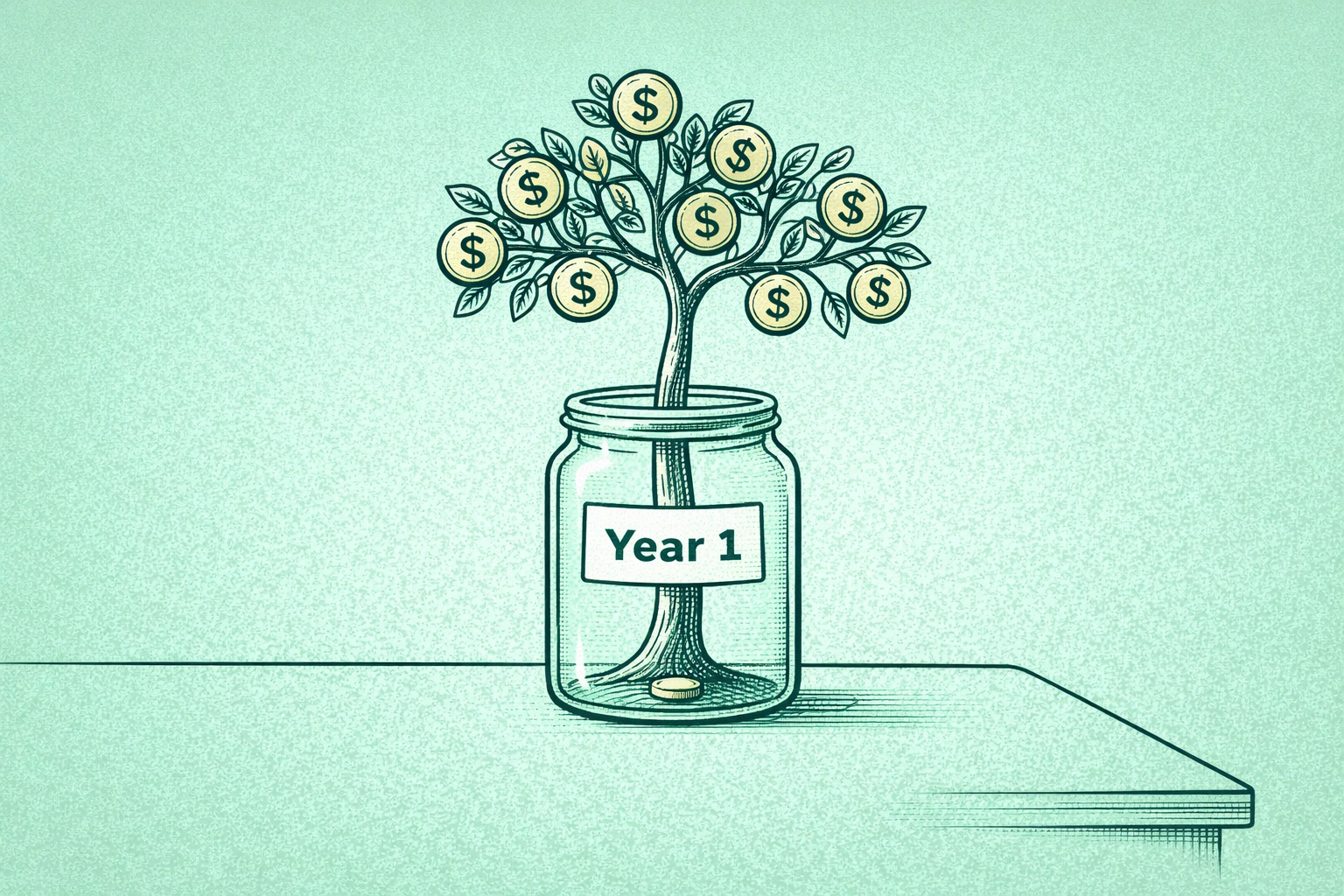
The formula is: A = P(1 + r)^t. Every dollar you deploy grows through compound interest. Wealth isn’t about finding the 47% year. It’s about maximizing P — the capital you put to work — protecting r — your real after-cost return — and extending t — time in the market. Those three variables are the whole game. Everything else is noise.
Why Volatility Is a Hidden Tax on Returns
Most people think about investment returns as additive. Earn 10% one year, lose 5% the next, you’re up 5% on average. That’s not how compounding works, and the gap between what people assume and what the math actually produces is where a lot of wealth quietly disappears.
If you earn 50% in year one and lose 50% in year two, you’re not back to even. You’re down 25%. Start with $100,000, watch it grow to $150,000, then fall by half — you end up at $75,000. The arithmetic average is zero. The actual result is a $25,000 loss. This is called the volatility drag, and it compounds over time in the same direction as growth does — mercilessly.
The practical consequence is that consistency beats brilliance. An investor who earns 9%, 8%, 10%, 7%, 9% for five years ends up with more money than one who earns 40%, -20%, 35%, -25%, 20% — even though the second investor’s average looks higher on paper. Sequence matters more than average. Stability is a feature, not a consolation prize.
This is why the stock-picker at the holiday party is a worse model than they appear. The volatile years that produced the 47% gain also produced the years that didn’t. The disciplined investor who earned 8% to 10% consistently across the same period, in broad index funds, with no dramatic story to tell in December, is almost certainly ahead over any decade you choose to measure.
The Three Variables That Actually Determine Wealth
Time is the variable that surprises people most, because its effect is so disproportionate to how it feels in the early years. Consider two investors: one starts at 25 and contributes $6,000 a year for ten years, then stops entirely. The other starts at 35 and contributes $6,000 a year for thirty years — three times as long, three times as much money invested. At 65, at 8% returns, the person who stopped contributing at 35 has more money than the person who contributed for three decades starting at 35.
Join The Global Frame
Money, work, and tech — one read every Saturday that actually changes how you think.
Early capital has more time to compound. A dollar invested at 25 has 40 years of exponential growth ahead of it. A dollar invested at 45 has 20. The second dollar needs to work twice as hard just to arrive at the same destination, and the math of compounding makes that effectively impossible to compensate for through contribution size alone. Starting at 25 and stopping beats starting at 35 and going forever. That’s not intuitive. It’s also not debatable.
The implication is that the single most financially consequential decision most people make in their 20s isn’t which stocks to pick or which account to open. It’s whether they start at all. Time is the only variable you genuinely cannot recover once it’s gone.
Deployed capital — P in the formula — matters almost as much, and it’s more controllable than people realize. The gap between investing $24,000 a year and $30,000 a year isn’t $6,000. Over 30 years at 8%, it’s more than $700,000. Small changes to the amount you consistently deploy have enormous terminal consequences because of the same exponential math that makes time so powerful. This is also why increasing your savings rate by 5% generates more wealth than chasing an extra percentage point of returns — the former is reliably within your control, the latter mostly isn’t.
Returns — r — are the variable most people obsess over and the one with the least room for reliable improvement beyond a certain point. Getting from 6% to 8% is achievable: use low-cost index funds rather than actively managed ones, keep money in tax-advantaged accounts rather than taxable ones, minimize transaction friction. Those moves are available to anyone and they reliably improve after-cost returns. Getting from 8% to 10% through active management or concentrated bets requires either genuine edge or luck, and the research on which one most active investors are relying on is not encouraging.
The hidden destroyers of r are fees and taxes. A 1% annual fee sounds inconsequential. On $500,000 invested over 30 years at 8%, the difference between a 0.1% expense ratio and a 1% one is over $900,000 in ending wealth. That’s not a fee — it’s a second retirement account you quietly handed to someone else. Tax drag works similarly: an 8% return in a taxable account at a 35% effective rate becomes roughly 5.2% after taxes. The same 8% in a Roth IRA stays at 8%, tax-free forever. Over 30 years on the same initial capital, the Roth account compounds to roughly three times the after-tax value of the taxable one. Maxing the 401k, backdoor Roth, HSA, and mega backdoor Roth where available isn’t advanced strategy. It’s plugging the most obvious and expensive leaks in the system.
Why Discipline Beats Luck — and How to Engineer It
The 2020 COVID crash is the clearest recent example of what this looks like in real time. The S&P 500 fell 34% in 23 days between February 19th and March 23rd. Investors who panic-sold locked in those losses. They then waited for clarity before re-entering — but by the time things felt clear, the market had already recovered more than 30% from the bottom. Investors who held through, and particularly those who kept deploying capital during the drawdown, ended 2020 up 16%. The market timers, on a $500,000 portfolio, were looking at six-figure differences versus where they’d have been if they’d done nothing.
Research on this pattern is consistent and has been for decades: missing the ten best trading days over a 30-year period roughly halves your ending returns. Seven of those ten best days typically occur within two weeks of the ten worst days. The investor who tries to time out the bad days almost inevitably misses the good ones. The investor who stays invested through both captures the full compounding sequence.
The mechanism that makes discipline reliable is removing yourself from the decision loop. A wealth system that runs automatically — contributions that happen on payday before you see the money, index fund purchases that execute on a schedule, rebalancing that triggers based on rules rather than feelings — doesn’t require courage during market downturns. It just continues. Automation isn’t a hack or a shortcut. It’s the infrastructure that makes discipline structurally inevitable rather than emotionally dependent.
I’ve watched this play out on both sides. People who made $500,000 in one year from crypto and are now broke — not because the money disappeared overnight, but because a large win confirmed a model of the world in which they had edge, which led to larger bets, which led to lifestyle expansion to match the wins, which left nothing to survive the inevitable bad year. And people who never earned more than $150,000 in any year of their career who retired with $3 or $4 million, because they automated their investing in their mid-20s and didn’t touch it for four decades.
The lucky investor needs everything to continue going right. One bad sequence at the wrong time, one period of lifestyle inflation that drains the reserves, one emotional decision at a market bottom — and the compounding stops, or reverses, in ways that are very difficult to undo. The disciplined investor is structurally protected from most of those failure modes, not by superior judgment in the moment but by decisions made in advance that reduce the role of judgment altogether.
Compounding is indifferent. It doesn’t care about your income, your intelligence, your work ethic, or the quality of your intentions. It rewards deployed capital and time, consistently and without exception, for whoever is patient enough to let it run. Maximize what you put in. Protect the return from fees and taxes. Start as early as possible and don’t stop. That’s the whole framework. Everything built on top of it — the three engines, the tax strategies, the wealth system — exists to serve those three variables.
The math works. The question is only whether you will.
This is Part 1 of the Rational Compounding Framework. Read the complete framework to see how income, investment, and optionality work together.
Next in the series — Part 2: The 3 Engines of Wealth