Updated July 2026: Contribution limit note: the $69,000 Solo 401(k) limit referenced in this post reflects 2024 figures. The 2025 limit increased to $70,000, and the 2026 limit will be slightly higher (IRS adjusts annually for inflation — verify the current year’s limit at IRS.gov). The $7,000 IRA limit is accurate for 2026. The strategic case for the Solo 401k over the SEP-IRA remains unchanged.
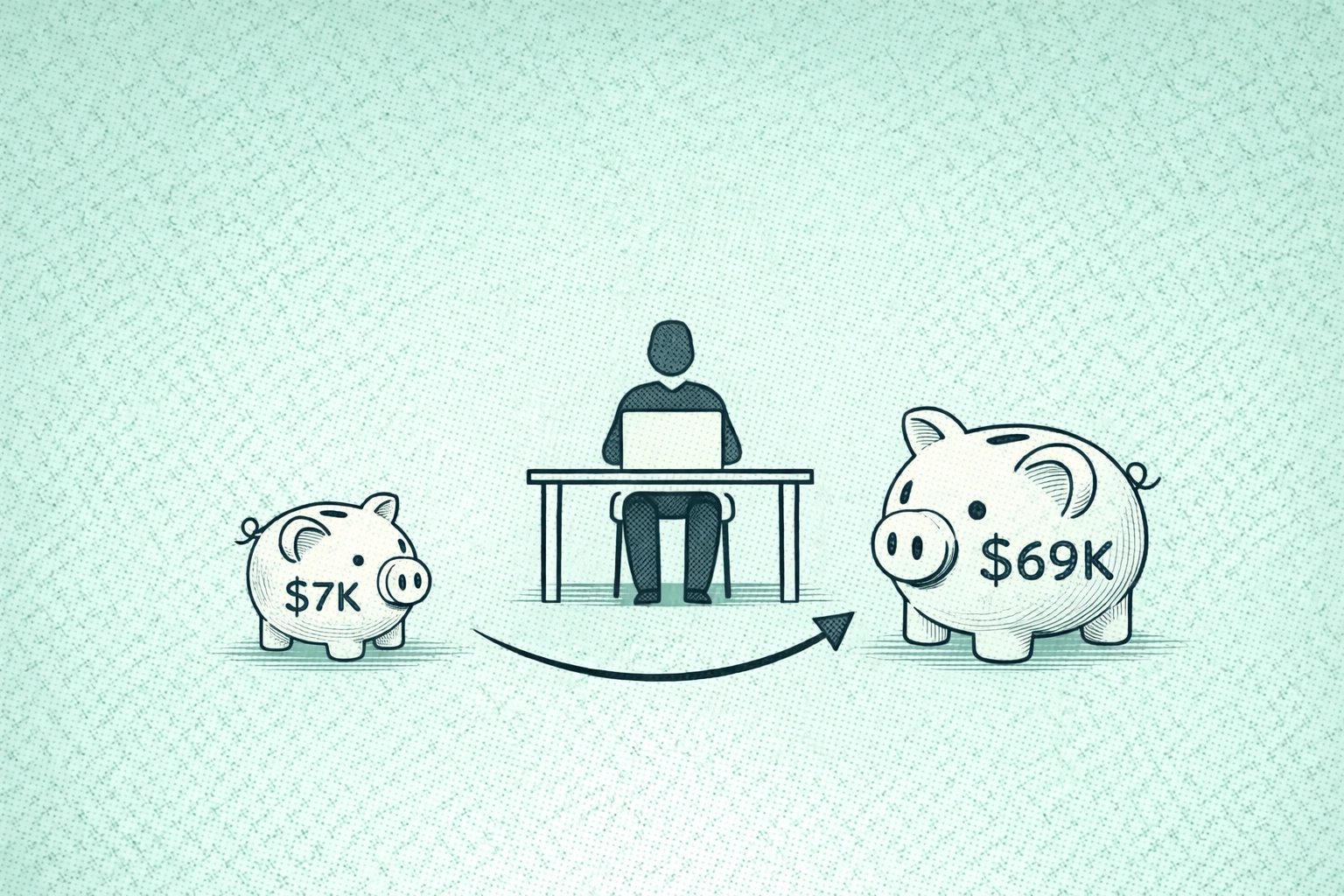
The IRA contribution limit in 2026 is $7,000. The Solo 401(k) contribution limit is $69,000. Both are available to self-employed people. Most freelancers, consultants, and side business owners are using the first one.
I noticed this pattern when I started looking closely at how people with 1099 income approach retirement savings — not just the high-earning consultants, but the person doing $80,000 in freelance work on the side of a W-2 job, or the designer running a small client practice. The IRA is the default because it’s what they’ve heard of. The Solo 401(k) exists in their tax code but not in their mental model, and the difference in contribution capacity between the two is roughly a factor of ten.
That gap is worth understanding precisely because the tax math on it is substantial. A freelancer who contributes $40,000 annually to a Solo 401(k) instead of $7,000 to an IRA, and is in a combined federal plus state tax bracket of 30%, is generating roughly $9,900 in additional tax savings per year just from the contribution differential. Over a decade that compounds into something that looks like a different retirement entirely.
How the Contribution Structure Works
The Solo 401(k) is a retirement plan for self-employed people with no full-time employees other than a spouse. What makes it unusual is that you’re simultaneously the employer and the employee — which means you get to make contributions from both sides of that relationship.
The employee side allows you to defer up to $23,500 in 2026 ($31,000 if you’re 50 or older, including the catch-up contribution). This works exactly like a regular 401(k) employee deferral, and critically, it can be designated as Roth — meaning after-tax contributions that grow and withdraw tax-free. This is something a SEP IRA doesn’t offer, and it’s one of the reasons the Solo 401(k) is the better choice for most self-employed people despite the SEP’s reputation for simplicity.
The employer side allows profit-sharing contributions of up to 20% of your net self-employment income (after subtracting half of self-employment tax from your gross). These must be traditional pre-tax contributions — no Roth option on the employer side — but they stack on top of the employee deferral.
The practical math on a $100,000 freelance income: net self-employment income after the SE tax deduction runs roughly $83,000. Twenty percent of that is about $16,600 in employer contributions. Add the $23,500 employee deferral and you’re at roughly $40,000 in total contributions for the year — compared to $7,000 in an IRA.
To reach the full $69,000 limit, you’d need approximately $280,000 in gross self-employment income, since the employer contribution calculation requires enough net income to generate $45,500 on the profit-sharing side. Most freelancers won’t hit that ceiling, but most don’t need to. Contributing $30,000 to $50,000 annually on a moderate self-employment income is realistic and represents a dramatically better outcome than the IRA default.
Who Can Use This and One Important Wrinkle
You’re eligible for a Solo 401(k) if you have self-employment income — freelancing, consulting, a side business, commission income — and no full-time W-2 employees other than a spouse. The business structure doesn’t matter much: sole proprietor, single-member LLC, S-corp, C-corp, and partnerships all qualify.
Join The Global Frame
Money, work, and tech — one read every Saturday that actually changes how you think.
The wrinkle worth knowing: if you have both a W-2 job and self-employment income, you can still open a Solo 401(k), but the employee deferral limit is shared across all your 401(k) accounts. If you’re contributing $15,000 to your employer’s 401(k) through your day job, your Solo 401(k) employee deferral for the year is capped at $8,500 — the remaining space to the $23,500 limit. The employer profit-sharing contribution from your self-employment income is entirely separate and not affected by your W-2 contributions at all.
This is actually how people with a side business alongside a W-2 job end up contributing $40,000 or more to retirement annually: the full employee deferral through their employer’s plan, plus 20% of net self-employment income as employer profit-sharing through the Solo 401(k). The two contribution types operate independently on the employer side.
If you hire a full-time W-2 employee at any point — other than a spouse — the Solo 401(k) is no longer available and you’d need to convert to a regular employer 401(k) plan. This is worth knowing before you scale a business that relies on the Solo 401(k) structure.
Setting It Up
The setup is genuinely straightforward and the most common reason people haven’t done it is simply that nobody told them it existed. Fidelity, Vanguard, and Schwab all offer Solo 401(k) plans with no annual fees. Fidelity is the most commonly recommended for first-time setup — the platform is clean, the investment options are wide, and the process takes roughly 30 minutes online.
You’ll need your Social Security number or EIN if you have an LLC, your business name and structure, and an estimate of your annual self-employment income. Sole proprietors can use their SSN; if you have an LLC or corporation, you need an EIN, which you can get free in about five minutes through the IRS website.
The account approval is typically instant. Fidelity generates the required plan document automatically — you download it, keep it in your records, and that’s the IRS compliance box checked. The Form 5500-EZ annual filing requirement only kicks in when the account balance exceeds $250,000, so early on there’s no annual paperwork beyond keeping the plan document.
There’s one deadline that matters significantly: the account must be opened by December 31 of the tax year for which you want to make employee deferral contributions. The employer profit-sharing contribution has more flexibility — it can be made up until your tax filing deadline the following year, including extensions, which means you can wait until your final income numbers are confirmed before calculating and depositing the employer side.
If you’re thinking about this in November or December: open the account now. The cost of waiting until January is losing the employee deferral contribution entirely for the current year.
The Tax Picture
Solo 401(k) contributions reduce taxable self-employment income, which affects both federal income tax and self-employment tax simultaneously. The self-employment tax component is often underappreciated in the calculation.
On $100,000 of gross self-employment income, contributing $40,000 to a Solo 401(k) alongside standard business deductions might bring taxable income to $50,000. The federal tax savings at 24% on that $40,000 is $9,600. The SE tax savings — since contributions reduce the net income that self-employment tax is calculated on — adds several thousand more. Add state income tax at a 5-9% rate depending on where you live and the total tax reduction from a $40,000 Solo 401(k) contribution can approach $15,000 to $18,000.
The way to think about this: that $40,000 contribution doesn’t cost you $40,000 in cash flow. After the tax savings it costs roughly $22,000 to $25,000 in actual after-tax dollars, and the other $15,000 to $18,000 that would have gone to taxes instead compounds inside the retirement account. The compounding math on those tax savings, reinvested over decades, is substantial.
How It Fits Into the Broader Retirement Stack
The Solo 401(k) doesn’t operate in isolation from other tax-advantaged accounts — it stacks with them.
The HSA is the first priority for self-employed people on a qualifying high-deductible health plan. The triple tax advantage — deductible contribution, tax-free growth, tax-free withdrawal for medical expenses — makes it the most efficient savings vehicle in the tax code on a per-dollar basis, and self-employed people can deduct their own health insurance premiums, which often makes the HDHP structure financially favorable even before accounting for the HSA.
After the HSA, the Solo 401(k) employee deferral is the next priority, and specifically the Roth version if you’re in a moderate bracket and have a long time horizon. The Roth versus traditional calculus applies here the same way it does in a standard 401(k) — if you expect to be in a similar or higher bracket in retirement, tax-free growth wins.
The backdoor Roth IRA can sit alongside the Solo 401(k) — $7,000 annually in Roth contributions through the backdoor route, on top of the Solo 401(k) contributions. For a self-employed person earning $100,000 who also contributes $7,000 via backdoor Roth and $4,300 to an HSA, total annual tax-advantaged savings approaches $52,000. That’s a meaningfully different retirement trajectory than the $7,000 IRA default.
The remote work tax deduction picture connects here too — home office, internet, and equipment deductions reduce the gross self-employment income that SE tax is calculated on, which affects the net income figure used in the Solo 401(k) employer contribution calculation. Getting the full deduction picture right before calculating your contribution maximizes both benefits simultaneously.
The Loan Provision — Worth Knowing, Rarely Worth Using
Solo 401(k) plans, unlike IRAs, permit loans. The limit is $50,000 or 50% of the account balance, whichever is less, with a five-year repayment period and an interest rate you effectively pay to yourself.
This feature gets mentioned frequently in Solo 401(k) marketing as a benefit. It’s worth knowing about for genuine emergencies — it’s better than a 10% early withdrawal penalty — but it’s not a reason to treat the retirement account as a capital reserve. Money borrowed from the Solo 401(k) isn’t compounding. The tax savings from the original contribution were real; the growth lost during the loan period is equally real. Most people who open a Solo 401(k) should expect never to use the loan feature.
What to Do This Week
If you have any self-employment income in 2026 and don’t have a Solo 401(k), the action is straightforward: open one before December 31. The employee deferral deadline is the end of the calendar year; the employer contribution deadline extends to your filing date.
Go to Fidelity, search for their Individual 401(k) or Self-Employed 401(k), complete the online application with your personal and business information, download the plan document, and make your first contribution. The business checking account you use for self-employment income is what you’ll link for contributions.
If you’re unsure about your exact contribution limits, the employer profit-sharing calculation is the piece that benefits from a CPA review — particularly if your income varies through the year or you have both W-2 and self-employment income. The employee deferral side is simple; the employer side involves the net self-employment income calculation that can have meaningful variance depending on your business expense picture.
The freelancing economics of self-employment involve absorbing costs that W-2 employment covers — self-employment tax, health insurance, no employer retirement match. The Solo 401(k) is the most direct tool available for closing that gap. The contribution capacity exists in the tax code. Whether it actually gets used is a matter of whether someone told you it was there.