The thing that makes high earners hesitate when they first hear about this strategy: It sounds like a workaround. Something that technically works but might get flagged, might get challenged, might become a problem later.
It isn’t. The backdoor Roth IRA has been discussed in Congressional testimony. It’s been acknowledged by the IRS in guidance documents. Multiple major tax reform bills have explicitly left it intact while targeting other provisions. It’s been executed millions of times by high earners at every major brokerage. The “backdoor” name is informal — what it actually describes is two entirely legal, explicitly permitted transactions used in sequence.
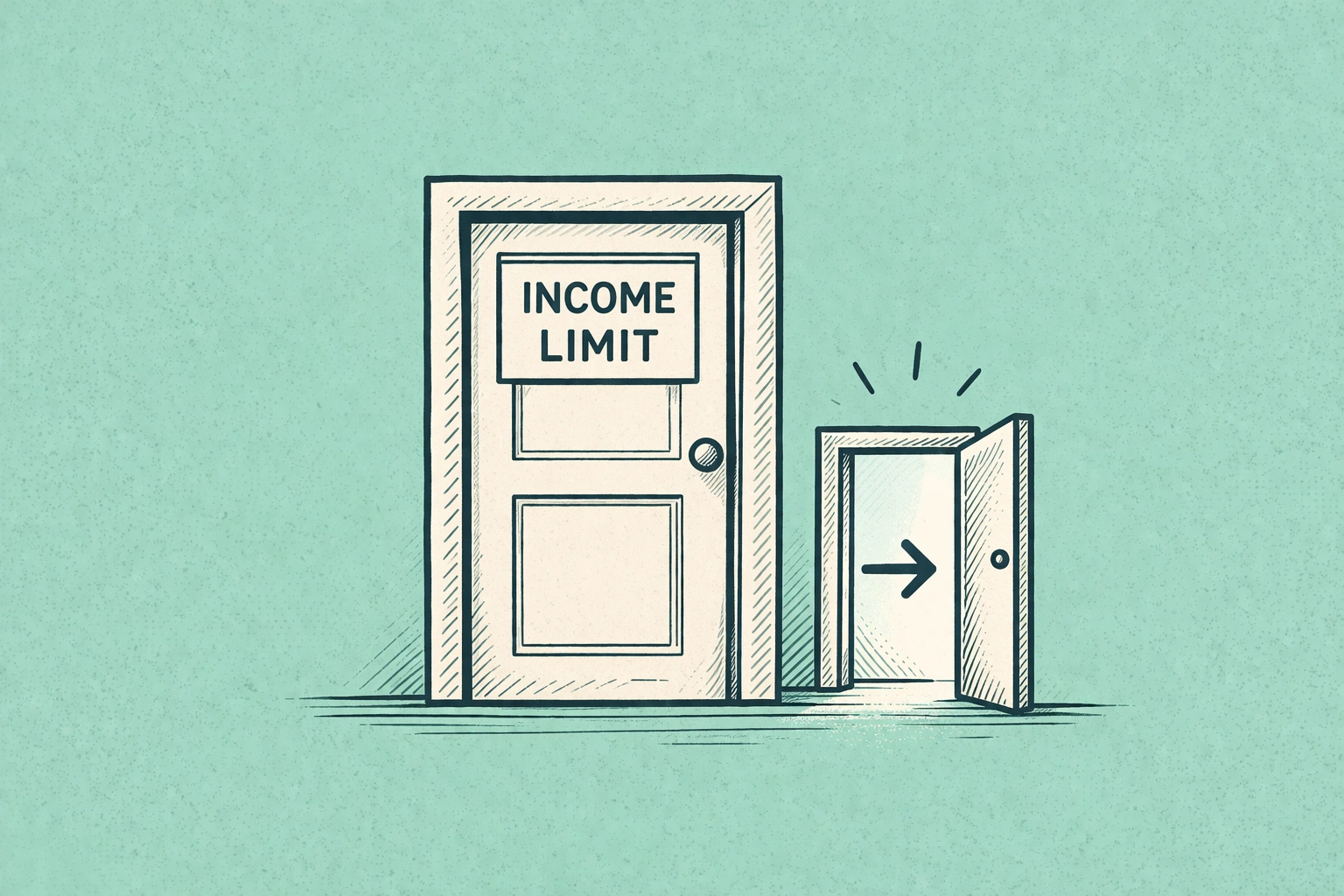
Here’s the underlying structure. The IRS sets an income limit for contributing directly to a Roth IRA — in 2026, that’s $161,000 for single filers and $240,000 for married couples filing jointly. Above those thresholds, you’re locked out of direct Roth contributions. But there’s no income limit on converting a traditional IRA to a Roth IRA. And there’s no income limit on making a non-deductible contribution to a traditional IRA.
So: contribute to a traditional IRA, then convert it to a Roth IRA. Two permitted transactions. The money ends up in a Roth account. The government knows. They’ve chosen to allow it.
The catch is real and it matters — I’ll get to it — but it isn’t about legality. It’s about a tax rule called the pro-rata rule that catches people who skip the preparation step.
Who This Is For and What It’s Worth
The income thresholds that trigger the need for this strategy: single filers begin to phase out of direct Roth contributions at $146,000 in 2026, phasing out completely at $161,000. Married couples filing jointly phase out between $230,000 and $240,000.
If you’re above those thresholds and have earned income, a direct Roth contribution isn’t available to you. The backdoor is the path.
The 2026 contribution limits are $7,000 for anyone under 50, and $8,000 for those 50 and older — the same as a direct Roth contribution, because this is effectively a Roth contribution by a different route.
The long-run math is worth stating plainly. Contributing $7,000 annually for 30 years at an 8% average return produces roughly $816,000 in a Roth account — tax-free at withdrawal, with no required minimum distributions forcing you to take money out before you need it. The same contribution compounding in a taxable account produces the same $816,000, but you owe approximately $122,000 in long-term capital gains taxes when you eventually access it. That gap is the entire case for doing this every year.
Roth accounts also carry no required minimum distributions, unlike traditional IRAs where the IRS mandates withdrawals starting at 73. For people who don’t need the money at that point, RMDs are an unwanted tax event. A Roth IRA can continue compounding for as long as you choose to leave it alone.
Join The Global Frame
Money, work, and tech — one read every Saturday that actually changes how you think.
The Two-Step Execution
The mechanics are simple once you’ve done the preparation work. I’ll describe the preparation separately because it’s what most people skip.
Step one: make a non-deductible contribution to a traditional IRA. Open a traditional IRA at any major brokerage if you don’t already have one — Fidelity, Vanguard, and Schwab all work without meaningful differences. Contribute $7,000 (or $8,000 if you’re 50 or older). When prompted about the contribution type, select non-deductible. Do not claim a tax deduction for this contribution. Leave the money in cash or a money market position — don’t invest it.
Step two: convert the traditional IRA to a Roth IRA. Wait one to two business days for the contribution to settle, then initiate the conversion. Every major brokerage has a “Convert to Roth” option in the account interface. Convert the entire balance. The reason you left it uninvested is that any gains between contribution and conversion are taxable. With a same-week conversion on a cash contribution, the taxable amount is zero or negligibly small.
When you file taxes, you’ll report the non-deductible traditional IRA contribution on Form 8606, Part I, and the Roth conversion on Form 8606, Part II. All major tax software handles this automatically if you enter the transactions correctly. If the execution was clean, you owe nothing on the conversion.
The Pro-Rata Rule: The One Thing That Can Break This
Here’s the trap that turns a clean tax-free Roth contribution into an unexpected tax bill, and it catches more people than it should because it’s not obvious until you encounter it.
The IRS doesn’t evaluate a Roth conversion by looking only at the specific account you’re converting from. It looks at your total balance across all traditional IRAs, SEP IRAs, and SIMPLE IRAs combined — then calculates what percentage of that total is pre-tax money versus after-tax money. That percentage applies to every conversion you do, regardless of which specific account the money comes from.
The scenario where this works perfectly: you have $0 in traditional, SEP, or SIMPLE IRAs. You contribute $7,000 non-deductible to a new traditional IRA. You convert $7,000 to Roth. The entire $7,000 was after-tax money, the conversion is tax-free, execution is clean.
The scenario where it fails expensively: you have $63,000 sitting in a rollover IRA from an old job. You contribute $7,000 non-deductible to a traditional IRA. Your total traditional IRA balance is now $70,000 — of which $63,000 is pre-tax and $7,000 is after-tax. That’s 90% pre-tax. When you convert $7,000 to Roth, 90% of that conversion — $6,300 — is taxable income. At a 32% marginal rate, you’ve just generated a $2,016 tax bill for a transaction you thought was tax-free.
I think about this in the same way I think about the HSA receipt strategy — the tax advantage is real and substantial, but it requires one specific preparatory step that most people skip because nobody explained why it matters.
How to Handle Existing Traditional IRA Balances
If you have pre-tax money in traditional, SEP, or SIMPLE IRAs, you have three realistic paths before the backdoor Roth makes sense.
The cleanest solution for most people with employer-sponsored plans is a reverse rollover — moving the traditional IRA balance into your current employer’s 401(k). Most 401(k) plans at larger companies accept incoming rollovers from IRAs. The balance leaves your IRA entirely, your total traditional IRA balance drops to zero, and future backdoor Roth conversions are clean. Check with your HR department or plan administrator. This doesn’t trigger a taxable event — it’s a direct transfer between qualified accounts.
If a reverse rollover isn’t available through your employer’s plan, you can convert the entire traditional IRA to Roth in one year, paying income tax on the pre-tax portion. This makes sense if you’re in a lower income year — a gap between jobs, a period of part-time work, starting a business with initial losses — when the conversion gets taxed at a lower marginal rate than it would be in a peak-earning year. It’s a one-time tax cost that permanently clears the pro-rata problem.
The third path, if neither of the above is practical, is to skip the backdoor Roth and use taxable brokerage accounts instead. Long-term capital gains rates — 15-20% for most high earners — are meaningfully lower than ordinary income rates. For people with large traditional IRA balances who can’t move them, a taxable account often produces a better outcome than paying pro-rata conversion taxes every year.
Combining This With the Mega Backdoor
The backdoor Roth and the mega backdoor Roth are separate strategies that work through different mechanisms and can be executed simultaneously.
The standard backdoor Roth runs through an IRA — $7,000 annually, available to anyone with earned income regardless of employer. The mega backdoor runs through a 401(k) that supports after-tax contributions and in-plan Roth conversion — up to $47,500 in additional after-tax contributions annually, on top of the standard $24,500 deferral limit.
If your employer’s plan supports both features — and the plans at many large tech companies, financial firms, and Fortune 500 employers do — you can execute both in the same calendar year. $7,000 through the backdoor IRA route, up to $47,500 through the 401(k) route. That’s a meaningful amount of tax-free growth available annually to someone with the right plan and the right income level.
The HSA fits into the same priority sequence. For most high earners, the practical ordering is: 401(k) to the employer match first — that’s an immediate guaranteed return on the matched dollars. HSA to the maximum contribution next, because the triple tax advantage on those dollars is the most efficient use of savings in the tax code. Backdoor Roth after that. Mega backdoor Roth if the plan supports it. Taxable brokerage for everything beyond those limits.
The Spousal Version
If you’re married and filing jointly, both spouses can execute backdoor Roths independently, even if only one spouse is employed. The requirement is that the household has combined earned income of at least $14,000 — or $16,000 if both spouses are 50 or older. Each spouse needs their own traditional IRA and their own Roth IRA; the accounts can’t be shared, and the IRS tracks them individually.
The execution is identical for each: non-deductible traditional IRA contribution, same-week conversion to Roth, Form 8606 filed with the tax return. Done correctly, this is $14,000 in annual Roth contributions for a couple — $16,000 at 50 and older — regardless of income.
The pro-rata rule applies individually to each spouse’s IRA balances, not to combined household balances. So a spouse with no existing traditional IRA balance can execute a clean conversion even if the other spouse has a pre-tax IRA balance that requires resolution first.
Doing It Every Year
For someone above the income limits with no pro-rata complications, this is a January ritual — contribute, wait two days, convert, done. It takes about fifteen minutes annually. The Form 8606 is handled by any major tax software if you enter the two transactions correctly.
The compounding case for doing it every year rather than occasionally is straightforward. Each year you skip is a year of tax-free growth you don’t recover. The math of compounding is unforgiving about gaps — the years closest to retirement contribute less to the final balance, but the early years compound the longest and matter most. Starting this in your 30s rather than your 40s, and continuing it every year, produces outcomes that aren’t available to people who execute it inconsistently.
The IRS has left this open through multiple reform cycles. Congress has explicitly debated closing it and chosen not to. There’s no guarantee that continues indefinitely, which is an argument for going through it while the door is still open.