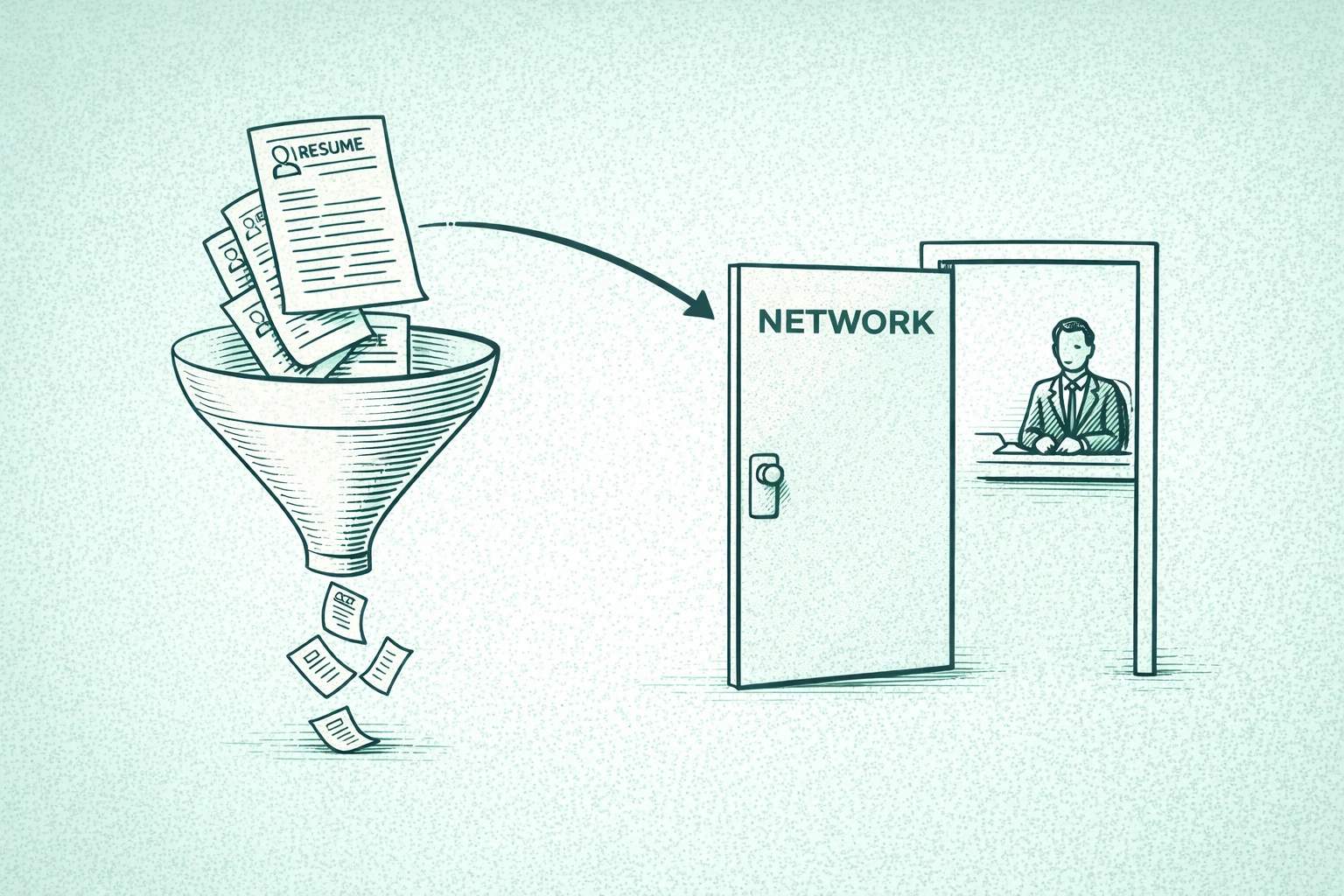
I spent about three hours rewriting a resume last year based on advice I’d read about ATS compatibility — adjusting keywords, switching to a single-column format, removing a table I’d used for skills. I used a scoring tool to check my “ATS score” before submitting. I felt productive. I felt like I was solving a real problem.
The role went to someone who knew the hiring manager from a previous job.
I’m not saying the network win was unfair. I’m saying I was optimizing for the wrong variable entirely, and the reason I was doing it traces back to a statistic that doesn’t exist.
“75% of resumes never get read by a human.” You’ve seen this everywhere. Career coaches cite it. LinkedIn influencers build courses around it. Resume services use it as their primary sales argument. One problem: HR consultant Christine Assaf tracked down the origin of the statistic and found that it traces to Preptel, a resume service company that went out of business in 2013. No study. No methodology. No data. A marketing claim that got laundered through repetition into received wisdom.
The $268 million resume-writing industry needed you anxious about algorithms. So they gave you one to be anxious about.
What ATS Actually Does
Applicant Tracking Systems are databases with search functions. That’s the complete description.
When you submit a resume, it gets parsed into structured data — name, contact info, job titles, skills — and stored alongside hundreds of other applications. Recruiters then use keyword searches and filters to build a shortlist of candidates to actually review. The system doesn’t reject anyone. It surfaces candidates based on how recruiters search, which means if a recruiter searches for “Python developer” and your resume says “software engineer with Python experience,” you might not appear in their results — not because you were rejected, but because the search query didn’t match your phrasing.
Enhancv interviewed 25 recruiters across tech, healthcare, and finance and found that 92% do not configure their ATS to auto-reject candidates based on content. The remaining 8% use it only for strict binary criteria — legal work authorization, specific required certifications. Jobscan surveyed 384 recruiters in 2025 and found that 99.7% use keyword filters to prioritize candidates, not eliminate them.
The Interview Guys investigated how major systems actually work by talking to recruiters at Amazon, Google, and Microsoft. Their conclusion: none of the major ATS systems automatically reject resumes or hide them from recruiters. The ATS organizes applications. Humans make rejection decisions.
This is a meaningful distinction. If the problem is search query mismatch, the fix is using the same language the job posting uses — a ten-minute task, not a $500 resume rewrite. The myth that you’re being screened out by software creates a much more expensive problem with a much more expensive solution, which is exactly why the myth exists.
Join The Global Frame
Money, work, and tech — one read every Saturday that actually changes how you think.
The Actual Problem: Volume
Here’s what’s really happening when you submit an application for a competitive role.
Entry-level positions average 400-600 applicants. Customer service and remote roles exceed 1,000 in the first week. Technical roles at well-known companies hit 2,000 quickly. A single recruiter working through 2,000 resumes at seven seconds each — which is roughly how long an initial scan takes — requires four hours of pure review time with zero interruptions. Nobody has that bandwidth.
So recruiters build shortlists using whatever heuristics let them process volume: keyword searches, application order, employment gaps, job title matching. One VP of HR told Enhancv, simply: “First-come, first-served, because I don’t have time to review thousands.”
Jobscan’s recruiter survey found that 76% of recruiters start by filtering on skills keywords. Years of experience comes second at 68%. Job title matching is third at 62%. Notice what’s missing from that list: “ATS compatibility score.”
You’re not competing against an algorithm. You’re competing for finite human attention in an environment structurally designed to favor speed over depth. That’s a different problem, and it has a different solution.
The Filter You’re Actually Being Screened By
Referrals represent 7% of job applications and account for 40% of all hires.
Let that ratio settle. If the hiring process were a fair meritocratic evaluation of resumes, referrals should convert at roughly the same rate as any other application source. Instead, they convert at roughly 5.7 times the rate of standard applications. Referred candidates are four times more likely to receive an offer than applicants from job boards, and eight times more likely than LinkedIn Easy Apply submissions.
This isn’t because referred candidates have better resumes. It’s because a referral bypasses the volume problem entirely. When someone internally vouches for you, the hiring manager actually reads your resume instead of scanning it for seven seconds in a stack of 400. You get context, credibility, and attention that no amount of keyword optimization can manufacture.
I’ve been tracking this pattern in the work context since writing about what actually creates job security — the same social positioning that protects you inside an organization is what gets you into it in the first place. The people who are structurally hard to fire are usually the same people who were structurally hard to overlook during hiring.
The data on referrals extends beyond just the offer rate. Referred employees stay 70% longer than non-referral hires. 82% of employers rate referrals as their highest-ROI hiring channel. 88% of companies offer cash bonuses — typically $1,000 to $5,000 — for successful referrals. Companies know exactly how this works. The system isn’t broken. It’s working as designed.
The Hidden Market Nobody Tells You About
Research consistently shows that around 70% of positions get filled before they’re publicly posted. They move through internal promotions, employee referrals, and direct recruiter outreach — channels that don’t involve job boards at all.
Internal promotions account for roughly 21% of hires. The first place any organization looks when a role opens is its existing workforce. External candidates are expensive bets — average cost-per-hire runs $4,000 to $18,000, and new employees take six to twelve months to reach full productivity. A known internal candidate eliminates most of that risk.
Employee referrals through structured programs with financial incentives account for 30-50% of hires at companies that run them seriously. Direct recruiter sourcing fills another 19% through outreach to passive candidates who never applied at all.
What’s left for public job postings is 10-30% of actual hiring. Which means the applications you’re carefully optimizing for ATS compatibility are competing for a minority slice of available positions. Most of the market is operating on a different layer.
This is the context the ghost job research fits into — companies posting roles they don’t urgently intend to fill, collecting resumes for the warm bench, signaling growth to investors. Even the publicly posted roles that are real often have a preferred internal or referred candidate already in mind, with the posting existing to satisfy HR process requirements.
What Your Resume Actually Needs to Do
None of this means resumes are irrelevant. They matter at a specific moment: when you’ve gotten in front of a decision-maker through some channel and they want to review your background. At that point, a clean, clear resume is important. At the cold-application stage, it’s largely irrelevant because it’s not what determines whether your application gets human attention.
The baseline that actually matters is simpler than the industry suggests. Clean format — single column, standard fonts, clear section headers. PDF and Word both work fine in modern systems, the “PDF breaks ATS” concern is mostly outdated. Relevant keywords from the job description used naturally throughout, not stuffed. Quantified results wherever possible — “increased pipeline by 30%” communicates more than “responsible for pipeline development.” Job titles that match the role you’re applying for where the responsibilities genuinely align.
That’s 90% of what you need. Test once using a free tool like Resume Worded or Jobscan to catch any obvious parsing issues, fix them, and stop. The marginal return on further resume optimization — the fourth rewrite, the ATS score chase, the $500 professional service — is essentially zero if the resume isn’t getting human attention in the first place.
The how recruiters actually screen resumes research is consistent on this: the six-second scan that determines whether your resume gets read longer is mostly about clarity of structure and immediately legible relevance. Not keyword density.
What to Redirect That Energy Toward
The math on where effort should go is uncomfortable but clear. Twenty hours spent perfecting a resume and running 100 cold applications produces roughly two to three interviews at a 2-3% response rate. Twenty hours spent on genuine relationship-building — informational interviews, thoughtful LinkedIn outreach, alumni network activation — produces three to five referral conversations at a 40-55% response rate. Same time, higher-probability outcomes, better quality conversations.
The reason most people don’t do this is psychological, not strategic. Resume optimization feels productive. You can see the changes, measure the keyword score, track applications sent. Relationship-building is slower, less measurable, and requires tolerating the uncertainty of whether outreach will be reciprocated. Humans reliably prefer low-probability actions they can control over high-probability actions that depend on other people.
The resume optimization industry profits from this preference. They sell marginal improvements in application quality — a definable, measurable, deliverable product. They can’t sell you genuine professional relationships. So they convince you the bottleneck is technical, when it’s social.
The practical version of redirecting this energy doesn’t require becoming someone who loves networking events. Informational interviews — reaching out to people in roles you want and asking about their experience, not for jobs — have a meaningful response rate and occasionally produce advocates when positions open. LinkedIn optimization for inbound visibility, where recruiters find you rather than you chasing postings, is a higher-leverage use of the same hours spent on resume perfection. Alumni networks are pre-warmed and consistently underused. Publishing work publicly — writing, building, contributing to visible projects — generates inbound that no application volume can replicate.
None of this is faster than submitting applications. It’s slower, and then much better.
The Honest Version of the Advice
Your resume needs to be clean enough not to create friction when someone who’s already interested in you looks at it. It does not need to be optimized for software that isn’t actually screening you out.
The filter that’s determining 70% of hiring outcomes is social. It’s whether you have the network access that gets your name in front of a decision-maker before the role is posted, or the referral that moves your application to the top of a shortlist that would otherwise take seven seconds to scan.
The salary negotiation leverage that comes from being recruited or referred is also meaningfully different from what you have as one of a thousand cold applicants — another reason the channel you come through matters beyond just getting the interview.
The resume industrial complex built a $268 million business on convincing you the bottleneck is technical. Spend 90 minutes making sure your resume is clean and clear. Then spend the next nineteen hours on the thing that actually determines whether it gets read.