I looked at my HSA balance about two years into having one and felt genuinely embarrassed. I had been dutifully contributing, paying medical bills with the card, and congratulating myself on using a tax-advantaged account. What I hadn’t done was invest any of it. It was sitting in the default cash position earning 0.1% interest — which, after inflation, was a reliable way to lose money slowly while feeling responsible.
That’s the most common HSA mistake, and it’s not a small one. But it’s the second most expensive one. The first is using the account as a spending account at all.
The HSA investment strategy that actually builds wealth looks almost nothing like how most people use these accounts. It treats the HSA not as a medical expense fund but as a third retirement account — one that, by any rigorous tax analysis, outperforms both the 401(k) and the Roth IRA for people who qualify for it. Here’s why that’s true and what it looks like in practice.
Why the Tax Structure Is Genuinely Different
Every tax-advantaged account in the US benefits you at one end of the transaction or the other. The traditional 401(k) and IRA give you a deduction now and tax you on withdrawal. The Roth IRA taxes you now and exempts you on withdrawal. The taxable brokerage account taxes you at every stage — contributions come from after-tax income, dividends are taxed annually, and capital gains are taxed on sale.
The HSA is the only account that benefits you at all three stages simultaneously.
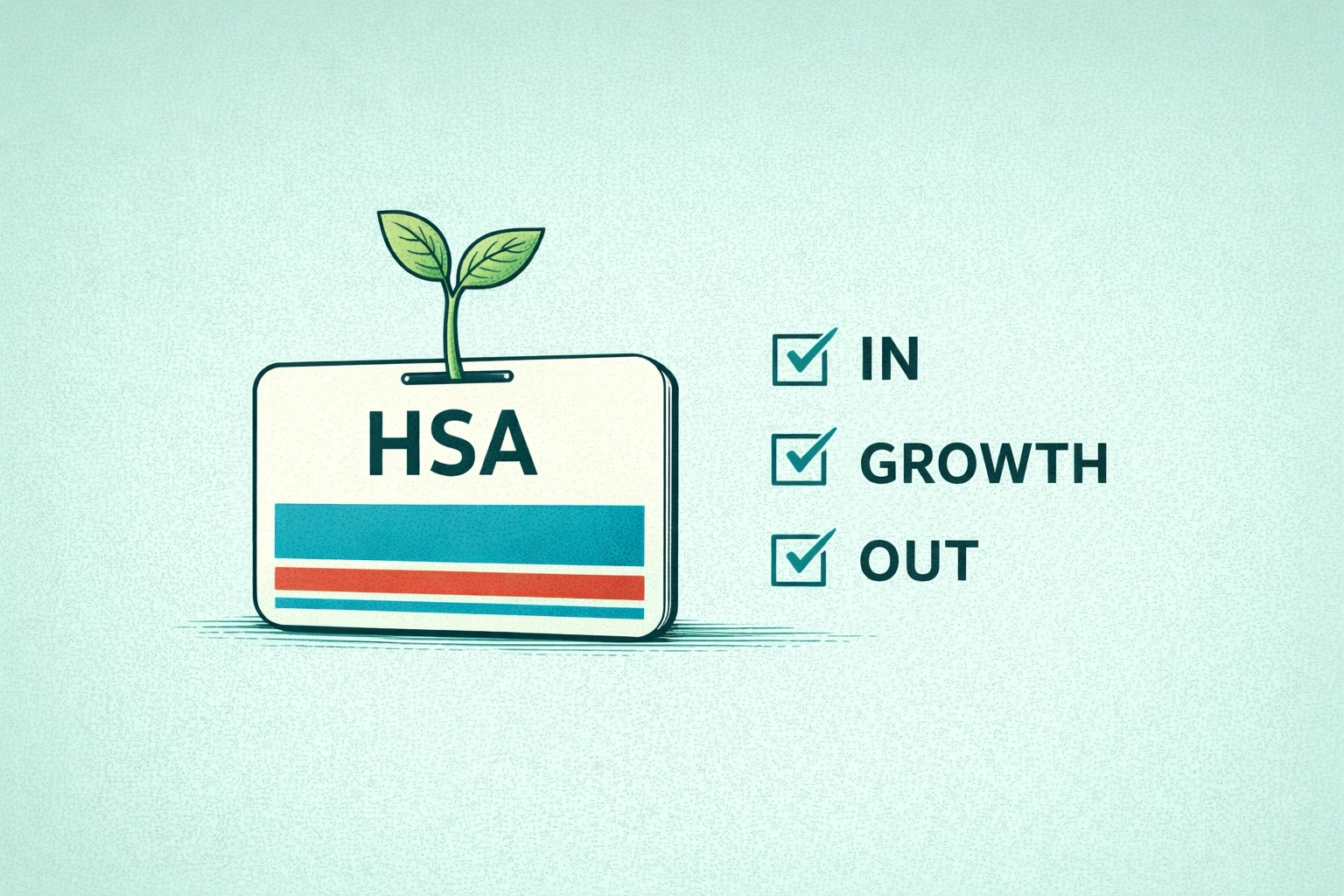
Contributions reduce your taxable income in the year you make them, exactly like a traditional 401(k). The money then grows inside the account — invested in index funds or whatever your provider offers — without any capital gains tax, dividend tax, or annual tax drag. And withdrawals for qualified medical expenses come out completely tax-free, with no income tax owed regardless of how much the account has grown.
No other account in the US tax code does all three. The Roth IRA is excellent but you pay income tax going in. The traditional 401(k) is excellent but you pay income tax coming out. The HSA bypasses both.
There’s a fourth benefit that barely gets mentioned. HSA contributions made through payroll deduction are exempt from FICA taxes — Social Security and Medicare — which run at 7.65% for employees. A 401(k) contribution avoids income tax but still gets hit by FICA. An HSA contribution through payroll avoids both. That’s an immediate, guaranteed 7.65% return on every dollar contributed via payroll that you simply cannot replicate anywhere else. If you’re contributing directly from a bank account rather than through payroll, you lose this specific benefit — worth checking how your employer’s plan is structured.
The Part Almost Nobody Does: The Receipt Strategy
Here’s the thing about qualified medical expenses as the withdrawal trigger. There is no time limit on when you have to claim the reimbursement.
You can pay a medical bill out of pocket today, let the equivalent amount sit invested in your HSA for twenty or thirty years, and then withdraw that money tax-free to reimburse yourself for the original expense decades later. The IRS requires that the expense was a qualified medical expense and that it occurred after you opened the HSA. It does not require that you claim the reimbursement in the same year.
Join The Global Frame
Money, work, and tech — one read every Saturday that actually changes how you think.
I’ve been running this approach for a while now, and the operational side is simpler than it sounds. Every time I pay a medical bill out of pocket — a copay, a prescription, a dental visit — I photograph the receipt and drop it into a cloud folder. The HSA balance stays invested and keeps compounding. Eventually, when I need a tax-free cash withdrawal in retirement, I have decades of receipts to draw against.
The math on why this works is straightforward. A $500 medical expense paid out of pocket today, with the equivalent $500 left invested in the HSA at 7% annual returns, becomes roughly $3,800 over 30 years. When I reimburse myself for that original $500 expense, the withdrawal is tax-free. The remaining $3,300 stays in the account for future qualified withdrawals. Compare that to simply paying the $500 from the HSA today — the $500 is gone, the compounding never happened.
The compounding argument applies to every account, but the HSA compounds with no tax drag at all. There are no annual dividends being taxed, no capital gains events reducing the base. Every dollar of growth stays working.
The 2026 Contribution Numbers
The 2026 HSA contribution limits are $4,400 for self-only coverage and $8,750 for family coverage, with an additional $1,000 catch-up contribution available at 55 and older. These are indexed to inflation and have been rising steadily.
To contribute, you need to be enrolled in a High Deductible Health Plan — currently defined as a plan with a minimum deductible of $1,650 for self-only or $3,300 for family coverage. Not every employer offers an HDHP, and for some people — particularly those with chronic conditions or predictably high medical expenses — an HDHP with an HSA isn’t the right trade against a lower-deductible plan. The math of HDHP vs. traditional coverage depends heavily on your actual healthcare utilization, and that calculation is worth running honestly before committing to the strategy.
For healthy people with relatively low medical expenses, the HDHP premium savings plus the HSA tax benefits typically more than compensate for the higher deductible. For people with regular, predictable medical costs, the calculus is less clear.
One constraint worth knowing: you cannot contribute to an HSA if you’re enrolled in Medicare. This affects the timing of when to maximize contributions — the years between HDHP enrollment and Medicare eligibility are the contribution window, and front-loading contributions in those years produces more compounding time.
Where the HSA Sits in the Savings Priority Order
The standard advice on account prioritization — 401(k) to the employer match first, then HSA, then max the 401(k), then Roth IRA — is a reasonable starting point but worth thinking about more carefully.
The employer match on a 401(k) is a 50% to 100% immediate return on contribution, depending on the match structure. Nothing beats that, so capturing the full match comes first regardless.
After the match, the HSA’s triple tax advantage plus the FICA exemption means it often outperforms additional 401(k) contributions from a pure tax efficiency standpoint. The 401(k) defers income tax but doesn’t eliminate it. The HSA, used correctly, eliminates it entirely on dollars deployed against qualified medical expenses.
The practical priority order for most high earners: 401(k) to the match, then HSA to the maximum, then continue 401(k) or backdoor Roth IRA depending on income and time horizon. If you’re eligible for a mega backdoor Roth through your employer, that enters the sequence after the HSA max.
For people building toward early retirement or a more complex wealth management structure, the HSA’s flexibility at age 65 adds another dimension. After 65, the account functions exactly like a traditional IRA for non-medical withdrawals — you pay ordinary income tax but no penalty. So the worst-case scenario for someone who never has significant medical expenses is a conventional pre-tax retirement account. The best case is decades of tax-free compounding against an unlimited receipt archive.
The Two Changes That Actually Matter
Most of the complexity in HSA strategy collapses into two decisions.
The first is switching from cash to invested. Most HSA providers default new accounts to a cash position — sometimes earning a nominal interest rate, sometimes essentially zero. The investment option usually requires a separate election in the provider portal, and it’s often buried. Fidelity, Lively, and HealthEquity all offer direct index fund investing with no threshold requirement. If your current provider charges fees or doesn’t offer good investment options, HSA portability is real — you can transfer to a better provider without tax consequences, similar to an IRA rollover. This is worth doing once and not thinking about again.
The second is paying medical expenses out of pocket and keeping receipts. This requires the cash flow to cover medical costs without tapping the HSA, which isn’t available to everyone. If paying a $300 medical bill from your regular checking account would genuinely strain your budget, the receipt strategy doesn’t work for you yet — and that’s a reasonable place to be. The strategy pays off most dramatically for people who can afford to let the HSA accumulate untouched for years.
For people who can absorb the out-of-pocket costs, the discipline of not touching the card is largely psychological. The HSA debit card is convenient. Using it feels like “using the benefit.” But spending from the HSA converts a tax-free compounding asset into a payment method — and payment methods don’t compound.
What Twenty Years of This Looks Like
A family contributing $8,750 annually to an HSA, investing it in a broad index fund, and paying all medical expenses out of pocket has roughly $508,000 in the account after 20 years at 7% annualized growth. That entire balance is available tax-free against any qualified medical expenses incurred over those two decades — and healthcare costs in retirement are among the most significant financial variables most people are underplanning for.
Fidelity estimates the average retired couple needs approximately $315,000 to cover healthcare costs in retirement, in today’s dollars. A well-funded HSA addresses most of that number in a way no other account can, because the withdrawals stay tax-free regardless of income level — unlike a traditional 401(k), where large withdrawals push you into higher brackets at exactly the time you need the money most.
The combination of tax-free growth, tax-free qualified withdrawals, FICA exemption on payroll contributions, and unlimited reimbursement timing makes the HSA the most structurally efficient savings vehicle available to someone with access to an HDHP. Most people with access to one are using it to pay for contact lenses.
The account is already open. Most people just never bothered to read what it actually does.