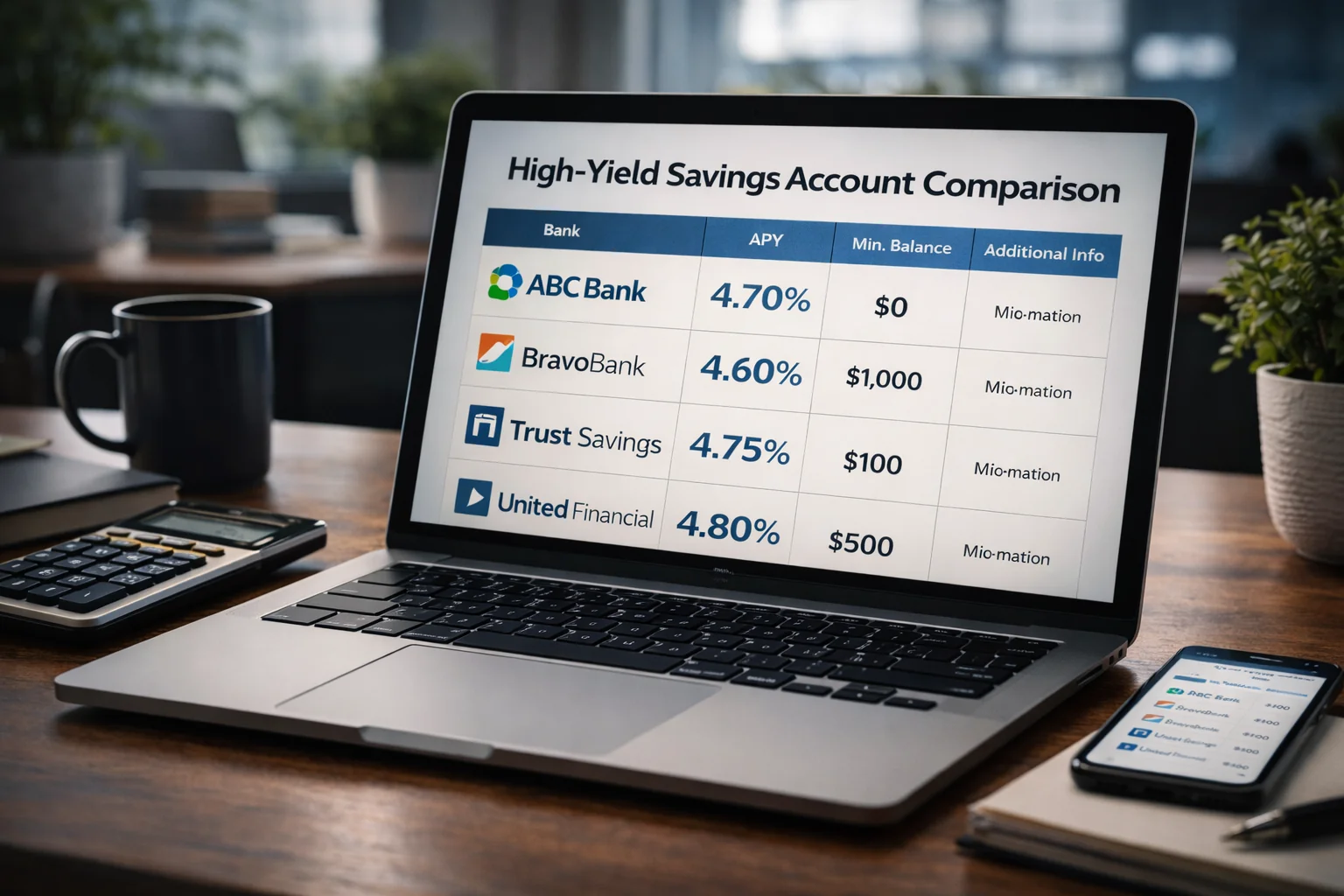
Remember when high-yield savings accounts paid 5.5% and everyone was dumping money into them like it was free lunch?
That party’s over.
We’re in the yield cliff phase now—rates have dropped from 5.5% to an average of 3.8%, and they’re still falling. The banks that aggressively competed for deposits in 2023 are quietly cutting rates every quarter, hoping you won’t notice.
But some banks are still paying competitive rates. And more importantly, there’s a dollar threshold where HYSAs stop making sense entirely and you need to consider alternatives.
Here’s the complete breakdown of who pays what in 2026, which accounts are worth your time, and when to graduate from savings accounts to actual investments.
The Current HYSA Landscape (What Happened to 5.5%?)
The peak: October 2023, when the Fed funds rate hit 5.5% and online banks were paying matching rates to attract deposits.
The reality in 2026: The Fed has started cutting rates. Not aggressively, but enough that HYSA yields have dropped to 3.5-4.5% across most institutions.
Why this matters:
If you have $50,000 in a HYSA:
- At 5.5%: You earn $2,750/year
- At 3.8%: You earn $1,900/year
- Difference: You just lost $850/year in interest income
This is the yield cliff I warned about—and it’s accelerating.
Join The Global Frame
Money, work, and tech — one read every Saturday that actually changes how you think.
But: Some banks are still fighting to retain deposits and haven’t cut as aggressively. Let’s find them.
The Top 5 High-Yield Savings Accounts (January 2026)
I’m ranking these on:
- Current APY (as of January 2026)
- Rate stability (how often they cut)
- Account features (minimums, fees, accessibility)
- FDIC insurance (all must be FDIC insured)
1. CIT Bank Platinum Savings – 4.85% APY
Why it’s #1: CIT Bank has historically been slower to cut rates than competitors. While other banks dropped to 3.8-4.0%, CIT is still holding at 4.85%.
The catch:
- Minimum balance: $5,000 to earn the high rate
- Below $5,000: You earn only 0.25% (brutal)
- Monthly fee: None if you maintain $5,000
Best for: People with $5K-50K who want high rates and don’t need constant access.
Downsides:
- No physical branches (online only)
- ACH transfers take 2-3 business days
- Customer service is hit-or-miss
How to open: CIT Bank’s signup is fully online, takes about 10 minutes. You’ll need:
- Social Security number
- Driver’s license
- Existing bank account for initial funding
My take: If you have $5K+ sitting in cash, this is the highest rate you’ll find from a legitimate bank in 2026. The $5K minimum keeps out the “rounding error” accounts, so CIT can afford to pay more.
2. Marcus by Goldman Sachs – 4.50% APY
Why it’s solid: Marcus (Goldman Sachs’ consumer bank) has been one of the most stable HYSA providers. They don’t play games with promotional rates or tier requirements.
The details:
- No minimum balance
- No monthly fees
- Easy transfers to/from external accounts
- FDIC insured (up to $250,000)
Best for: People who want simplicity and stability. No surprises.
Downsides:
- Rate is good but not market-leading
- No checking account option (it’s savings only)
- Limited account types (just HYSA and CDs)
Marcus vs CIT:
- CIT pays 0.35% more (4.85% vs 4.50%)
- On $25,000, that’s $87.50/year difference
- Marcus has no minimum balance requirement
If you have under $5K → Marcus wins.
If you have over $5K → CIT pays more.
3. Ally Bank Online Savings – 4.35% APY
Why people love Ally: Ally was one of the first online banks and has the most mature platform. Their app is excellent, customer service is actually good, and they offer checking accounts alongside savings.
The details:
- No minimum balance
- No monthly fees
- Buckets feature (organize savings into goals)
- Checking account integration (instant transfers)
Best for: People who want a full banking relationship, not just a HYSA.
Downsides:
- Rate is 0.5% lower than CIT
- On $25,000, that’s $125/year you’re giving up
The trade-off: You’re paying ~$125/year for superior user experience and customer service. For some people, that’s worth it.
When Ally makes sense:
- You want checking + savings in one place
- You value customer service
- You’re organizing multiple savings goals (emergency fund, vacation, down payment)
4. Discover Online Savings – 4.30% APY
Why Discover? If you already have a Discover credit card, adding their savings account is seamless. Same login, integrated dashboard.
The details:
- No minimum balance
- No monthly fees
- 24/7 customer service (actually good)
- Free ATM access with debit card
Best for: Existing Discover customers who want to consolidate accounts.
Downsides:
- Rate is middle-of-the-pack
- Not as feature-rich as Ally
- Debit card is barely useful (few transactions allowed from savings)
Real talk: Discover is fine. It’s not exciting. If you need a HYSA and you’re already in the Discover ecosystem, go for it. Otherwise, Marcus or Ally are better.
5. American Express Personal Savings – 4.25% APY
Why Amex? Brand recognition. If you trust American Express for credit cards, you might trust them for savings.
The details:
- No minimum balance
- No monthly fees
- FDIC insured through American Express National Bank
- Easy online/app management
Best for: Amex loyalists who want everything under one umbrella.
Downsides:
- Rate is lowest in this list
- No checking account option
- Limited account types
Verdict: Unless you’re deeply invested in the Amex ecosystem, there’s no reason to choose this over Marcus or Ally.
The Comparison Table (Cut Through the Noise)
| Bank | APY | Minimum Balance | Monthly Fee | Best Feature |
|---|---|---|---|---|
| CIT Platinum | 4.85% | $5,000 | $0 (if above minimum) | Highest rate |
| Marcus | 4.50% | $0 | $0 | No minimums, stable |
| Ally | 4.35% | $0 | $0 | Best platform/UX |
| Discover | 4.30% | $0 | $0 | Integrated if you have card |
| Amex | 4.25% | $0 | $0 | Brand trust |
The $25,000 annual interest breakdown:
| Bank | Annual Interest |
|---|---|
| CIT (4.85%) | $1,212.50 |
| Marcus (4.50%) | $1,125.00 |
| Ally (4.35%) | $1,087.50 |
| Discover (4.30%) | $1,075.00 |
| Amex (4.25%) | $1,062.50 |
Difference between best and worst: $150/year.
For most people, that’s not enough to stress about. Pick the one with the best user experience for you.
The “Chasing Rates” Trap
Here’s what you shouldn’t do: open accounts at 5 different banks to get the absolute highest rate.
Why this is dumb:
- You’ll spend hours tracking multiple accounts
- ACH transfer limits make moving money around annoying
- You’ll get 1099-INT forms from every bank
- The interest rate differences are tiny
Example:
Let’s say you have $50,000 and you chase rates aggressively:
- You move $10K to Bank A (5.0%)
- You move $10K to Bank B (4.9%)
- You move $30K to Bank C (4.85%)
Total time spent: 3 hours opening accounts, setting up transfers, managing logins.
Extra interest earned vs just putting it all in one 4.5% account: Maybe $75/year.
Your time is worth more than $75 for 3 hours of work.
Better strategy: Pick one bank with a competitive rate (Marcus or CIT), put all your cash there, and stop thinking about it.
When to Stop Using HYSAs Entirely
Here’s the uncomfortable truth: if you have more than $100,000 in savings accounts, you’re doing it wrong.
Why?
1. Inflation is eating you alive
Even at 4.5% APY, if inflation is running at 3.0%, your real return is only 1.5%. You’re barely beating inflation.
Over 10 years, $100,000 at 1.5% real return becomes $116,000 in purchasing power. That’s pathetic.
2. You’re not investing for growth
The S&P 500 has averaged ~10% annually over the last 50 years. Even with volatility, $100,000 invested becomes $259,000 over 10 years at 10%.
Savings account: $100K → $156K (at 4.5%)
Index fund: $100K → $259K (at 10%)
Difference: $103,000
You’re leaving six figures on the table.
3. You’re scared of volatility
I get it. Savings accounts feel safe. But the actual risk is different:
- Savings account risk: Inflation erodes purchasing power slowly
- Stock market risk: Volatility in the short term, but growth over 10+ years
If you don’t need the money for 5+ years, it shouldn’t be in a savings account.
The Cash Allocation Framework (How Much Should Be in HYSAs)
Here’s the rule I use:
Tier 1: Emergency Fund (3-6 months expenses)
→ Keep in HYSA (Marcus, Ally, CIT—pick one)
→ Example: $30,000 if your monthly expenses are $5,000-10,000
Tier 2: Short-Term Goals (0-2 years)
→ Keep in HYSA or short-term CDs
→ Example: Down payment fund, car replacement, known expenses
Tier 3: Medium-Term Goals (2-5 years)
→ Move to conservative investments (60/40 stock/bond portfolio)
→ Example: Index funds with modest allocation to bonds
Tier 4: Long-Term Wealth (5+ years)
→ Move to growth investments (stocks, real estate, alternatives)
→ Example: Private credit paying 10% yields, infrastructure plays, index funds
If you have more than Tier 1 + Tier 2 sitting in HYSAs, you’re mis-allocating capital.
HYSA Alternatives (When 4% Isn’t Enough)
Let’s say you have $100,000 that you don’t need for 6+ months, but you’re still uncomfortable with stock market volatility.
Here are better options than HYSAs:
Alternative 1: Treasury Bills (4.5-5.2% Right Now)
How they work:
- Buy directly from TreasuryDirect.gov
- Lock in for 4 weeks, 13 weeks, 26 weeks, or 52 weeks
- Interest is exempt from state taxes (bonus if you’re in CA, NY)
Current rates (January 2026):
- 4-week: 4.7%
- 13-week: 4.9%
- 26-week: 5.0%
- 52-week: 5.2%
Why this beats HYSAs:
- Higher yield (5.2% vs 4.5%)
- State tax exempt (worth another 0.5-1% if you’re in a high-tax state)
- Backed by US government (safer than FDIC insurance)
The catch:
- Money is locked until maturity
- TreasuryDirect website is from 1997 and barely works
- You have to manually reinvest when they mature
Best for: $50K+ that you definitely don’t need for 6-12 months.
Alternative 2: I Bonds (Currently 5.27%)
How they work:
- Inflation-protected savings bonds
- Rate adjusts every 6 months based on CPI
- Lock in for 1 year minimum, penalties if withdrawn before 5 years
Current rate: 5.27% (as of January 2026, adjusted for inflation)
Why this is interesting:
- Inflation protection (rate goes up if inflation goes up)
- Can’t lose principal
- State tax exempt
The catch:
- Limit of $10,000/year per person ($20K for married couples)
- Must hold 1 year minimum
- Lose last 3 months interest if withdrawn before 5 years
- Also purchased through TreasuryDirect (terrible website)
Best for: Long-term emergency fund money. Buy $10K/year, build a ladder over 5 years.
Alternative 3: Money Market Funds (4.8-5.2%)
How they work:
- Mutual funds that invest in ultra-short-term debt
- Trade like stocks (instant access)
- Higher yields than HYSAs
Examples:
- Vanguard Federal Money Market (VMFXX): 5.1%
- Fidelity Government Money Market (SPAXX): 5.0%
- Schwab Value Advantage Money Fund (SWVXX): 4.9%
Why this beats HYSAs:
- Higher yield (5%+ vs 4.5%)
- Instant access (sell anytime, settled next day)
- No transfer delays
The catch:
- Not FDIC insured (but extremely low risk)
- Technically can “break the buck” (lose value), though this hasn’t happened since 2008
- Requires brokerage account
Best for: People who already have Vanguard/Fidelity/Schwab accounts and want easy cash management.
The Tax Gotcha Nobody Warns You About
HYSA interest is taxed as ordinary income, not capital gains.
What this means:
If you earn $2,000 in HYSA interest and you’re in the 24% federal bracket + 9.3% CA state bracket:
- Federal taxes: $480
- State taxes: $186
- Total: $666 in taxes
Your “4.5% APY” is actually 3.0% after taxes.
Compare to index funds:
- You pay 0% on unrealized gains (just hold)
- You pay 15% long-term capital gains when you sell (if held 1+ year)
- Qualified dividends are taxed at 15%, not 24%
This is another reason to limit HYSA holdings. You’re getting hit with the worst tax treatment possible.
Red Flags to Avoid (Scammy “High-Yield” Accounts)
Not all high rates are legit. Watch for:
1. Promotional rates that expire
“6.0% APY for 3 months, then 0.5%!”
You’ll forget to move your money after 3 months and earn nothing. Banks count on this.
2. Tiered rates
“5.0% on balances up to $1,000, 0.5% on everything above.”
So if you have $25,000, you earn:
- 5% on $1,000 = $50
- 0.5% on $24,000 = $120
- Effective rate: 0.68%
This is predatory.
3. Accounts requiring debit card usage
“5% APY if you make 10 debit card transactions per month!”
You’ll spend time making fake transactions just to hit minimums. Your time is worth more.
4. Credit unions with membership requirements
“5.5% APY if you live in this county, work in this industry, and donate $10 to this charity!”
Unless you’re already eligible, don’t bother.
My Personal HYSA Strategy
Here’s what I actually do with cash:
$25,000 emergency fund:
→ Marcus by Goldman Sachs (4.5%)
→ Why: No minimums, stable, easy to access
$10,000/year to I Bonds:
→ Purchased every January through TreasuryDirect
→ Why: Inflation protection, building a 5-year ladder
Everything else:
→ Invested in index funds, private credit, or infrastructure plays
→ Why: 4.5% isn’t enough for wealth building
I don’t:
- Chase promotional rates
- Open accounts at 5 different banks
- Keep more than $35K in cash equivalents
- Stress about 0.2% rate differences
Life’s too short to optimize savings account rates.
How to Open a HYSA (Step-by-Step)
1. Pick your bank (Marcus or CIT are my recommendations)
2. Go to their website (google “Marcus savings account” or “CIT Bank Platinum Savings”)
3. Click “Open Account”
4. You’ll need:
- Social Security number
- Driver’s license or state ID
- Current address
- Existing bank account info (for initial funding)
5. Fund the account:
- Link your external bank account (checking/savings)
- Initiate ACH transfer
- Wait 2-3 business days for funds to arrive
6. Confirm the rate:
- Double-check the APY shown in your account
- Rates change monthly, make sure you’re getting what was advertised
Total time: 15 minutes
When Rates Will Go Back Up (And They Will)
The Fed will cut rates through 2026-2027 as inflation moderates. HYSA rates will drop to 3.0-3.5%.
Then: The next recession or crisis hits, the Fed cuts to 0%, HYSA rates drop to 0.5%.
Then: The economy recovers, inflation picks up, Fed raises rates, HYSA rates hit 5%+ again.
This cycle repeats every 7-10 years.
The lesson: Don’t get too comfortable with 4-5% HYSAs. It’s temporary. Build wealth through assets that grow regardless of interest rates: stocks, real estate, businesses.
HYSAs are for parking cash, not building wealth.
The One-Minute Action Plan
If you have under $25K in cash: → Open Marcus HYSA, transfer everything, forget about it.
If you have $25K-100K in cash: → Put $25K in Marcus for emergency fund
→ Put the rest in Treasury Bills (6-12 month ladder) or money market funds
If you have over $100K in cash: → Keep $25K emergency fund in Marcus
→ Allocate rest to investments based on timeline (stocks, bonds, alternatives)
→ Stop hoarding cash
If you’re chasing 0.2% rate differences: → Stop. Your time is worth more than $50/year.
The Bottom Line
The best HYSA in 2026 is whichever one you’ll actually open and use.
For most people, that’s Marcus by Goldman Sachs:
- Competitive rate (4.5%)
- No games (no minimums, no fees)
- Easy to use
- Stable company
If you have $5K+, CIT Bank Platinum pays more (4.85%), but the $5K minimum is annoying.
But honestly?
Stop obsessing about HYSA rates. The difference between 4.25% and 4.85% on $50,000 is $300/year.
Focus on the big picture:
- Don’t keep more than 6 months expenses in cash
- Invest everything else for growth
- Optimize your tax deductions (way bigger impact than 0.5% rate differences)
- Build wealth through assets, not savings accounts
HYSAs are a tool for parking cash. Use them correctly: emergency fund + short-term goals only.
Everything else should be working harder for you.