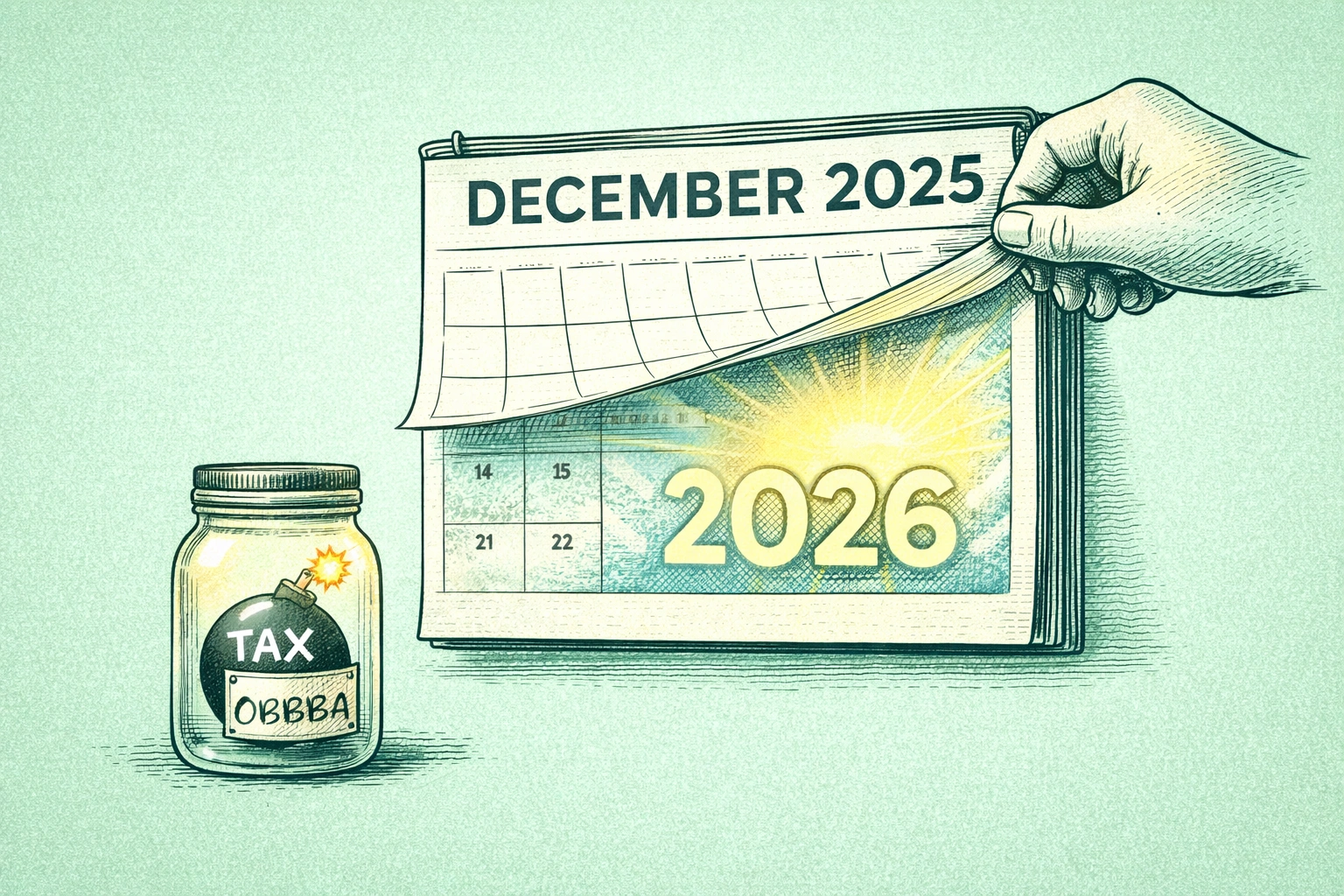
Updated July 2026: The One Big Beautiful Bill Act was signed July 4, 2025, making TCJA income tax brackets permanent. The 37% top rate did not revert to 39.6%. Standard deduction increased incrementally. The urgency around Roth conversions and income acceleration before a TCJA sunset is now resolved — the post below provides accurate context for understanding what changed and who benefits from the new permanent structure.
For most of 2024 and early 2025, financial advisors were running the same playbook: execute Roth conversions now, accelerate income, act before the clock runs out on the Tax Cuts and Jobs Act. December 31, 2025 was the date circled in red. After that, the 22% bracket would revert to 25%, the standard deduction would be slashed in half, and millions of Americans would wake up to a meaningfully higher tax bill on January 1, 2026.
That didn’t happen. On July 4, 2025, President Trump signed the One Big Beautiful Bill Act into law, making the lower TCJA rates permanent and keeping in place the current individual income tax brackets. The 2026 tax brackets that most people feared — the ones that would have pushed a married couple earning $190,000 from 22% into 25% — never materialized. If you spent 2024 executing urgent Roth conversions to beat the sunset, you made the right call for the wrong reason. The rates you locked in are now the permanent rates anyway. The urgency was real. The deadline was not.
What actually changed on January 1, 2026 is a different and more nuanced story — one involving a cluster of new temporary deductions that expire in 2028, a shift in how high earners in expensive states think about itemizing, and a quiet signal from Congress about where Roth accounts may be heading next. Understanding the actual landscape matters more right now than relitigating the crisis that didn’t arrive.
What the One Big Beautiful Bill Actually Did
The most consequential thing OBBBA did for the 2026 tax brackets was prevent a reversion. The law preserves tax cuts from Trump’s first term that were set to expire at the end of 2025, including the elevated standard deduction. For 2026, the 401(k) contribution limit rises to $24,500 and the IRA limit increases to $7,500 — standard cost-of-living adjustments, no structural changes from the legislation itself. The OBBBA makes no changes to 401(k) contribution limits, and SECURE Act 2.0 legislation will continue to be the driving force for regulatory change within retirement plans. Your retirement accounts work exactly as they did before July 4.
What changed is the deduction landscape above and around those accounts. OBBBA raises the cap on state and local tax (SALT) deductions from $10,000 to $40,000 for the 2025 through 2029 tax years, though this enhanced deduction begins to phase out when income hits $500,000. For anyone in a high-tax state who has been limited by the $10,000 SALT cap since 2018, this is a material change — and a temporary one. The cap reverts to $10,000 after 2029. A married household in California or New York paying $30,000 in state and property taxes can now deduct the full amount through 2029 if income stays below the phase-out threshold. That’s a real planning opportunity with a real expiration date attached to it.
The bill also introduced several new deductions that are uniformly temporary, expiring after 2028. Workers receiving overtime can deduct up to $12,500 in qualified overtime pay from their taxable income ($25,000 for joint filers), with the deduction phasing out for individuals earning over $150,000. Individuals age 65 and older are eligible for a new $6,000 annual income tax deduction that does not require itemizing, phasing out at $75,000 for single filers and $150,000 for joint filers. A new car loan interest deduction of up to $10,000 applies to qualifying US-assembled vehicles purchased between 2025 and 2028. None of these are permanent. All of them create a planning window — similar to the one the TCJA created in 2017 — that expires on a known date.
The Roth Case Just Got Stronger, Not Weaker
Here is the counterintuitive implication of OBBBA for anyone with a traditional 401(k) or IRA: the case for Roth conversions didn’t go away when the sunset threat disappeared. It became more compelling in a different way. By eliminating the TCJA deadline and extending these rates into the future, OBBBA has opened the door to conversions in future years at today’s low tax rates — without the artificial urgency of a December 31 deadline. You now have years, not months, to execute a conversion strategy deliberately rather than reactively. The 22% bracket isn’t going anywhere unless Congress acts affirmatively to change it. That’s a structurally better environment for staged, multi-year Roth conversions than the one that existed six months ago.
The mega backdoor Roth strategy fits into this same framework — not as an emergency measure to beat a deadline, but as a long-term tax diversification play executed over several years at permanently lower rates. The HSA’s triple tax advantage is similarly more valuable in a permanently low-rate environment: contributions are deductible today at rates that are now locked in, not subject to a scheduled increase.
There is one emerging risk worth watching. While OBBBA does not change the SECURE 2.0-mandated glide path raising the Required Minimum Distribution age to 75, it directs the Treasury Department to explore RMDs for Roth IRAs and large 401(k) balances. This is currently a directive to study the question, not a law. But many experts believe that the passage of OBBBA will continue the trend of “Rothification” — Congress has turned to Roth accounts in attempts to plug holes in the budget, because Roth accounts are after-tax accounts and thus provide immediate revenue. The future tax-free growth in Roth accounts is someone else’s problem, and Congress knows it. Required minimum distributions on large Roth balances would be a significant policy reversal, but the direction of the signal is worth noting if you are building a substantial Roth position over the next decade.
Join The Global Frame
Money, work, and tech — one read every Saturday that actually changes how you think.
The original tax bomb narrative wasn’t wrong about the underlying logic — it was wrong about the timing. Traditional 401(k) and IRA balances represent a deferred tax liability, and the government’s share of that liability shifts with whatever rates happen to be in effect at withdrawal. By cementing tax cuts made in Trump’s first term, the OBBBA is most significant not for what it implemented, but for what it avoided. The 2026 tax brackets stayed low. The window for strategic Roth conversions stayed open. What changed is that the window no longer closes on a fixed date — which means the planning can be deliberate rather than panicked, executed across multiple years at rates that are now, for the first time in a decade, something you can actually count on.