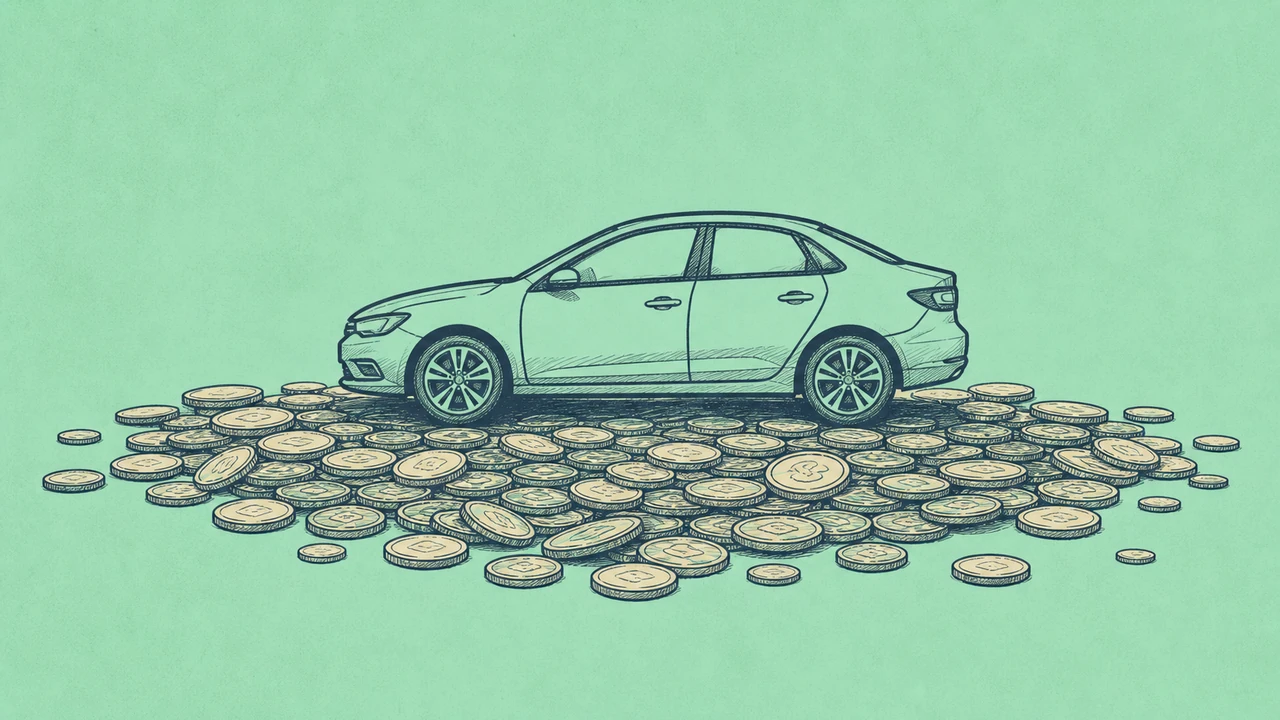
I’ve had this conversation more times than I can count. Someone mentions their car payment and when I ask about the full cost of the car, they go quiet. Not because they’re embarrassed — because they genuinely haven’t added it up.
According to AAA’s 2025 Your Driving Costs study, the average cost of owning and operating a new vehicle in the US is $11,577 per year, or $965 per month, assuming 15,000 miles driven annually. That’s not the car payment. That’s everything: depreciation, fuel, insurance, maintenance and repair, license and registration, and finance charges. The car payment alone averages $748 per month for new vehicle financing according to Experian’s Q3 2025 data. The full cost is $217 higher than that — every month — in costs most people aren’t tracking.
The number that makes the $965 figure genuinely surprising is the depreciation: $4,334 per year on average, or $361 per month. It doesn’t show up on any bill. No one invoices you for it. But a new vehicle typically loses 15-20% of its value in the first year and another 15% or so each year after that. You’re paying for it continuously in the form of declining resale value, and most people don’t include it when they think about whether they can afford a car.
The “Used vs New” Debate Is the Wrong Debate
The standard advice when someone is worried about car costs is “buy used.” The logic: let someone else take the depreciation hit in year one. It’s correct in principle and I’m not going to argue against it.
But the used vs new framing distracts from the variable that actually drives total cost of ownership: which vehicle you buy. A used full-size pickup truck can run $9,000-$12,000 per year to own and operate even after the year-one depreciation hit. A used Honda Civic or Toyota Corolla runs closer to $5,000-$6,000 per year once the initial depreciation has been absorbed by the previous owner. The difference between a modest small sedan and a modest SUV, all-in over five years, can approach $25,000. The difference between a modest sedan and a truck or luxury crossover can be $40,000-$60,000 over that same window.
AAA’s data is clear on this: small four-door sedans are consistently the cheapest category to own and operate, followed by small SUVs and hybrids. Trucks and full-size SUVs are the most expensive. Most people know this in the abstract. Very few sit down and run the full five-year cost comparison on the vehicles they’re actually considering before they sign anything.
What You’re Actually Paying Per Mile
Another way to look at it: AAA calculates depreciation at 28.9 cents per mile on average. That’s separate from fuel (13 cents per mile), insurance (roughly 10 cents per mile), and maintenance (about 10 cents per mile). The all-in cost per mile for the average new vehicle is around 77 cents.
If your commute is 20 miles each way, five days a week, 50 weeks a year — that’s 10,000 miles of commuting alone. At 77 cents per mile, your commute is costing you $7,700 per year in vehicle operating costs, before you drive anywhere else. For comparison, a Lyft or Uber at average US rates runs $1.50-$2.50 per mile in most markets. Mass transit passes in most major cities run $100-$150 per month. The car is rarely the cheap option when you do the math; it’s just the convenient one, and convenience has a real price that most household budgets absorb invisibly.
The Purchase Decision Most People Make Wrong
Here’s what actually happens when most people buy a car: they figure out what monthly payment they can afford, and they work backward from there. They’re usually thinking about the loan payment only, without the full operating cost picture. This leads to systematically buying more car than a complete cost analysis would suggest.
The math that most people don’t run before buying: add up your expected monthly loan or lease payment, your insurance quote for that specific vehicle, your estimated monthly fuel cost, a monthly set-aside for maintenance (AAA’s figure is roughly $130/month average), and a monthly depreciation figure (divide the expected 5-year depreciation by 60). That’s your real monthly cost. If the number is significantly higher than what you budgeted for, the vehicle choice is the variable to adjust — not just the down payment or loan term.
Join The Global Frame
Money, work, and tech — one read every Saturday that actually changes how you think.
Some of this is obvious and some of it isn’t. The maintenance set-aside and the depreciation calculation are the two most commonly skipped. Both are real costs that you’ll pay regardless of whether you account for them in advance. The car expense analysis connects directly to the broader picture of where large fixed costs actually live in a household budget — and transportation is usually second only to housing.
One practical suggestion before you buy: run the five-year total cost of ownership on the specific vehicle you’re considering using the Edmunds True Cost to Own calculator. It factors in depreciation, financing, insurance, fuel, and maintenance specific to that make, model, and your zip code. The number you get will almost certainly be higher than what you were imagining. That’s useful information to have before you drive off the lot. Vehicle costs are one of the largest fixed expenses in most American households — a central part of what the real cost of middle-class life in 2026 actually looks like, and a key reason high earners can still fail to build wealth despite strong income numbers on paper.