The AI and jobs discourse has two modes, and both of them are getting in the way of useful thinking about your career.
Mode one is the alarm: AI is coming for all knowledge work, white-collar employment is collapsing, Anthropic’s CEO warned of a “white-collar bloodbath,” prepare accordingly. Mode two is the reassurance: AI is just a productivity tool, it makes workers more valuable, the jobs created will outpace the jobs lost, the same thing happened with the printing press and the steam engine.
Both of these framings are selectively true. Neither one helps you make a specific decision about your career or what to build over the next three years.
The data that actually exists — peer-reviewed labor economics, not predictions — tells a more precise and more useful story. The disruption is real, it’s measurable, it’s already in the payroll data. But it’s not uniformly distributed. It’s concentrated in specific job categories at a specific career stage, driven by a specific characteristic of the work itself. Once you understand the distinction, the question of whether AI threatens your job becomes substantially more answerable.
What the Actual Data Shows (Not the Headlines)
What the Stanford Data Actually Shows
In August 2025, Stanford economist Erik Brynjolfsson and his team published a study using ADP payroll data from millions of American workers — not survey data, not projections, actual payroll records. The findings were specific.
Entry-level workers aged 22 to 25 in the most AI-exposed occupations have experienced a 13% relative decline in employment since late 2022, when generative AI tools entered mainstream use. That decline is concentrated: entry-level workers in AI-exposed fields saw a 6% absolute employment decline from late 2022 to mid-2025, while experienced workers in the same occupations saw 6% to 9% growth. Software developers aged 22 to 25 saw employment fall nearly 20% over the same period.
The study was careful to rule out confounding factors. The effect only emerged after late 2022 — not during the pandemic, not during the interest rate shock. It’s not limited to technology roles specifically. It appears across occupations where AI tools are substituting for routine, codified tasks. And critically, it does not appear in occupations where AI augments work rather than replaces it.
This last point is the one that most coverage glosses over and that actually determines whether AI is a threat or a tool for your specific role.
The Substitution vs. Augmentation Distinction
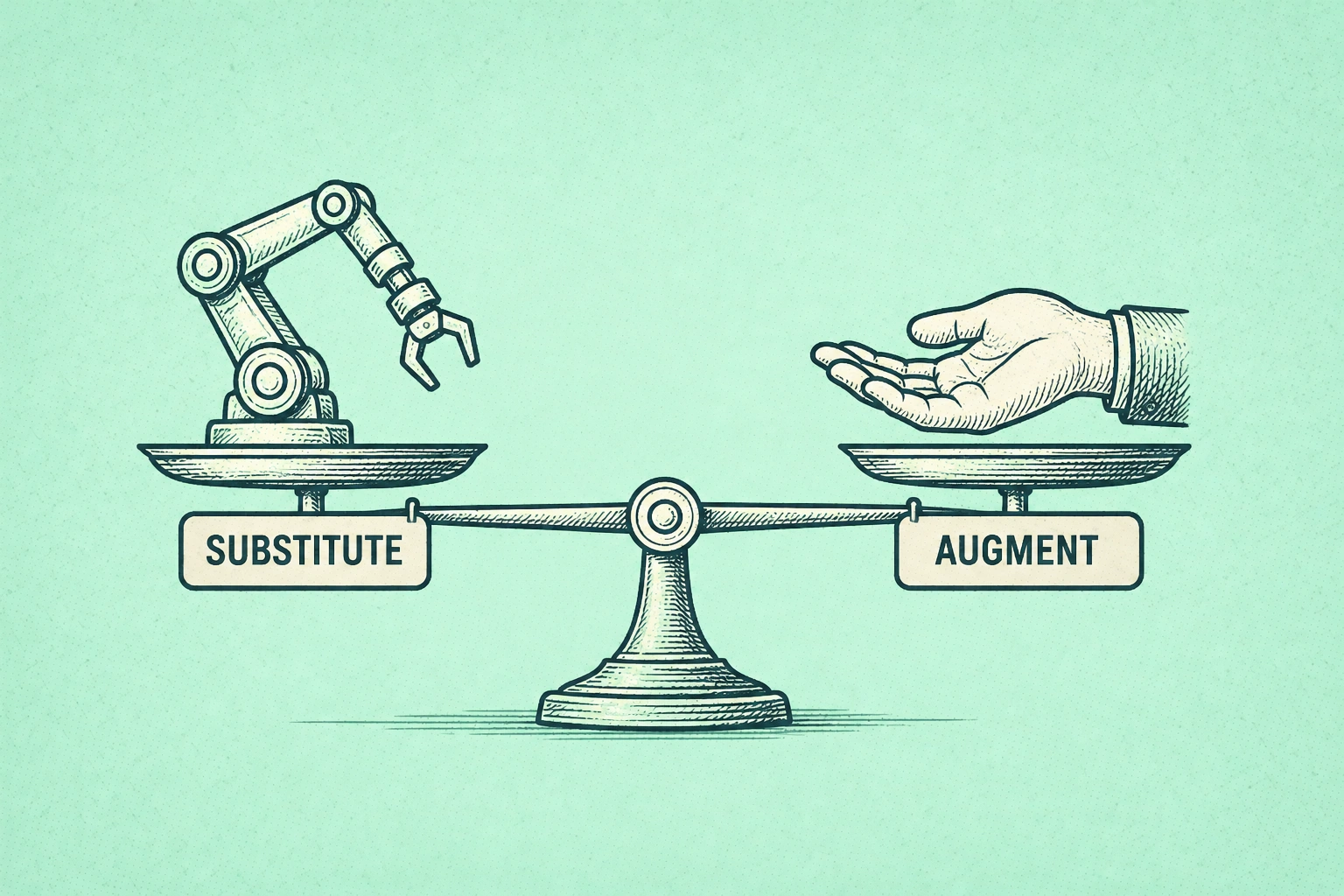
In April 2026, Goldman Sachs published an analysis combining standard AI exposure scores with an IMF-developed complementarity index. The framework distinguishes between two different relationships AI can have with a job:
Substitution is when AI can handle most of the core tasks in an occupation outright. The human doing that work becomes redundant. Goldman’s examples: insurance claims clerks, bill collectors, data entry processors, basic customer service.
Join The Global Frame
Money, work, and tech — one read every Saturday that actually changes how you think.
Augmentation is when AI handles some tasks but human judgment, physical presence, client relationships, or specialized expertise remain essential. Goldman’s examples: lawyers, construction managers, physicians.
Under Goldman’s model, AI substituted roughly 25,000 US jobs per month over the past year, while augmenting in ways that added back approximately 9,000 — a net of 16,000 monthly job losses attributable to AI. The unemployment gap between entry-level workers and experienced workers has widened sharply in substitution-heavy occupations. In augmentation-heavy occupations, that gap has not widened at all.
This is the frame that clarifies everything else. The question isn’t “is my industry exposed to AI?” Almost every industry is exposed to AI. The question is whether AI is primarily substituting for what you do or primarily augmenting it — and whether the tasks AI most readily substitutes for are the ones you spend most of your time on.
The Occupational Detail That Changes the Picture
What “Big Freeze” Actually Looks Like
One reason the disruption is harder to see than a mass layoff wave is that it mostly isn’t showing up as mass layoffs. The Yale School of Management and other researchers have identified the pattern as a “big freeze”: companies are not firing workers en masse, they’re not replacing workers who leave through natural attrition, and they’re not hiring for the entry-level positions that have historically served as career pipelines.
Aggregate unemployment remains near historic lows. That headline number is stable. Underneath it, unemployment among recent college graduates has exceeded the overall unemployment rate — for the first time since Bank of America Global Research began tracking that data — and the unemployment rate among recent computer science graduates specifically has reached levels comparable to liberal arts fields that were long associated with difficult job markets.
This is what AI-driven disruption looks like in practice in 2026. The experienced senior worker in a law firm, a tech company, or a financial services firm is not losing their job. They may even be doing more with less support staff. The 24-year-old who would have been hired as a junior analyst, a paralegal, an entry-level coder, or a basic content coordinator is not getting that job. The entry-level pipeline is contracting while the senior tier is stable or growing.
The structural problem this creates isn’t just for the current cohort of young workers. When fewer people enter a field at the junior level, the pool of experienced senior workers thins out a decade later. The disruption at the entry level has long-run implications that aren’t visible yet in the employment data.
The Fields Where This Is Already Measurable
Based on the Stanford and Goldman data, the job categories showing the clearest AI substitution effect right now — where entry-level employment has declined most sharply — cluster around a few characteristics: the core tasks are routine, codified, and describable in writing; the output can be evaluated against a clear standard; the work doesn’t require physical presence or ongoing client relationships that depend on specific individuals.
Junior software development is the most documented case — AI code-generation tools have compressed the number of junior engineers needed to support a given senior engineer’s output. Entry-level customer service has been extensively automated through conversational AI. Basic legal research and paralegal work — document review, contract summarization, case research — has significant AI substitution exposure. Entry-level data analysis involving standard reports and dashboards faces similar pressure. Basic content production and marketing coordination are in the same category.
Where the data shows stable or growing employment, the pattern is different. Physical trades and skilled labor requiring presence and manual judgment are essentially untouched. Clinical roles in healthcare. Teaching and direct instruction. Sales roles involving complex relationship development with high-value clients. Management of physical operations. The research, client judgment, and domain authority dimensions of law and medicine — as opposed to the research and documentation tasks AI is already handling.
The skills-based hiring shift I’ve written about before connects here directly. The roles showing the strongest demand growth are those requiring what Goldman’s model identifies as high complementarity: work where human judgment, accumulated expertise, and relationship depth make AI more effective rather than redundant. The AI generalist skill set — knowing when to use AI tools, how to evaluate their outputs, and where human judgment remains irreplaceable — is becoming the differentiating layer in fields that would otherwise face substitution pressure.
What This Means for How You Position Yourself
What This Means If You’re Mid-Career
The Stanford study’s most important finding for someone a decade or more into their career is the asymmetry: experienced workers in AI-exposed fields are not seeing the same employment decline. In fact, the productivity gains flowing to experienced workers in augmentation-heavy fields are substantial. The Stanford AI Index 2026 documents a 26% productivity improvement in software development from AI tools and a 14% improvement in customer service — but those gains are concentrated in the productivity of existing experienced workers, not in the employment of entry-level replacements.
If you’re in your 30s or 40s, working in a field with significant AI exposure, the data does not suggest you’re facing imminent displacement. It suggests you’re positioned to be more productive — which means your organization may need fewer total headcount over time, but the reduction happens through attrition and slower hiring, not through eliminating your role. The career positioning that makes you genuinely hard to replace — owning specific domain knowledge, managing critical client relationships, providing judgment that can’t be automated — is exactly the profile that shows stability in this data.
The more important question for mid-career workers isn’t “will AI take my job” but “am I actively using AI tools to extend my capabilities?” The augmentation effect is real. The workers in AI-exposed fields who are capturing it are doing more, faster, at higher quality. The ones who aren’t are watching their relative productivity stagnate while colleagues who do use the tools advance more quickly.
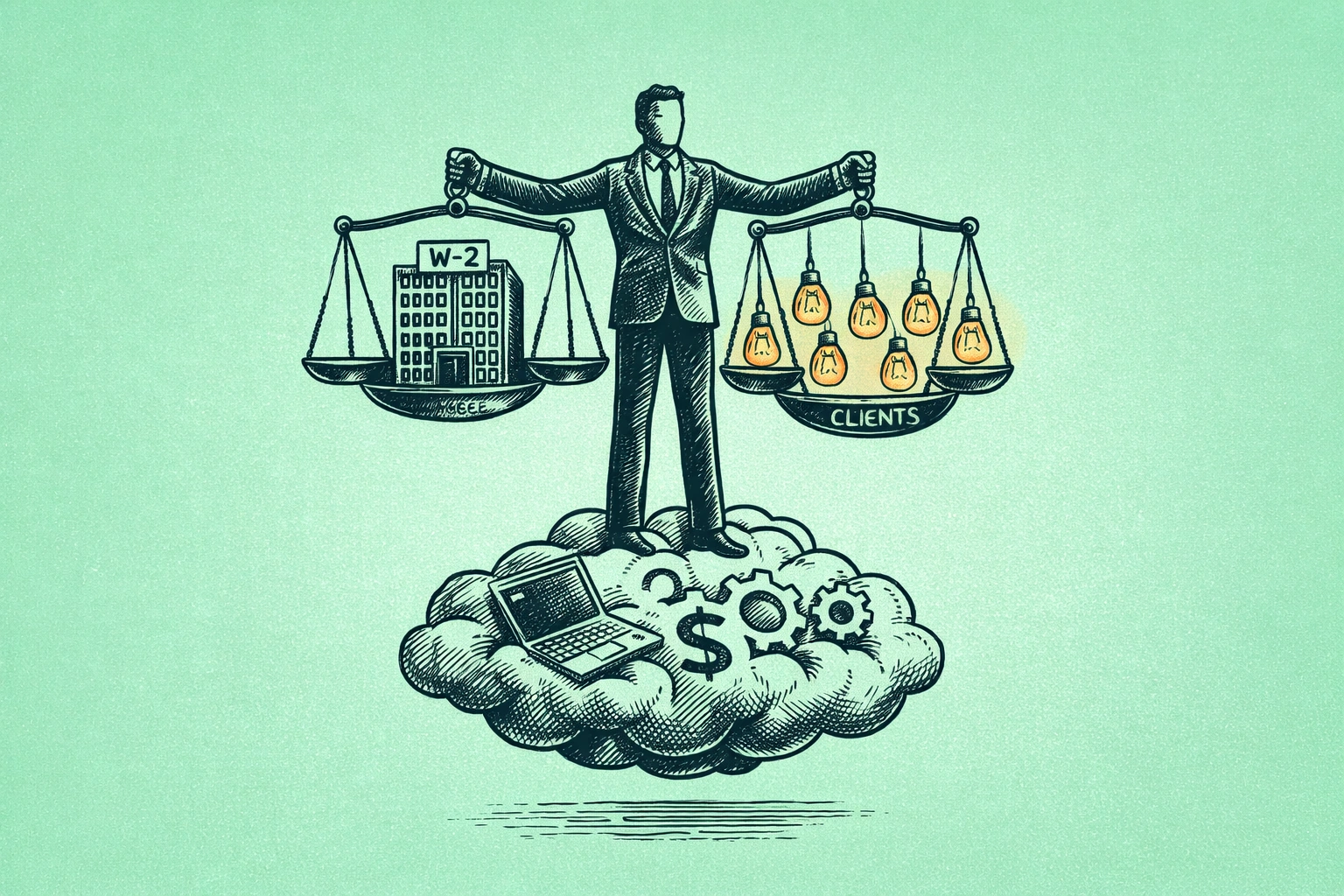
The solopreneur and AI team model is the clearest example of this dynamic — one experienced person with well-configured AI tools producing what previously required a small team. That’s augmentation in its most concentrated form. Whether you’re an employee or building independent income, the career compounding that matters over the next decade comes from being on the augmentation side of that divide rather than the substitution side.
What to Do With This
The answer isn’t panic. The overall employment picture is stable, experienced workers in most fields are not in imminent danger, and the long-run historical pattern of technology creating more jobs than it destroys is real. The cautionary note is that the historical pattern plays out over decades, and the specific workers disrupted at the leading edge of a transition don’t necessarily benefit from the jobs created later.
The practical response for someone building a career over the next decade is to be honest about where your work sits on the substitution-augmentation spectrum, and to invest deliberately in the capabilities that move you toward augmentation: accumulated domain knowledge that’s hard to replicate, judgment in ambiguous situations, relationships that clients or colleagues value specifically because they’re with you, and fluency with AI tools that makes all of those human capabilities more productive rather than less.
The long-term investing mindset applies here as much as it does to financial compounding. The value of building genuine expertise in a specific domain, over years, compounds in ways that make you progressively harder for AI to substitute for. Staying generalist and keeping skills shallow — the career equivalent of holding cash — is what leaves someone exposed when the substitution pressure arrives.