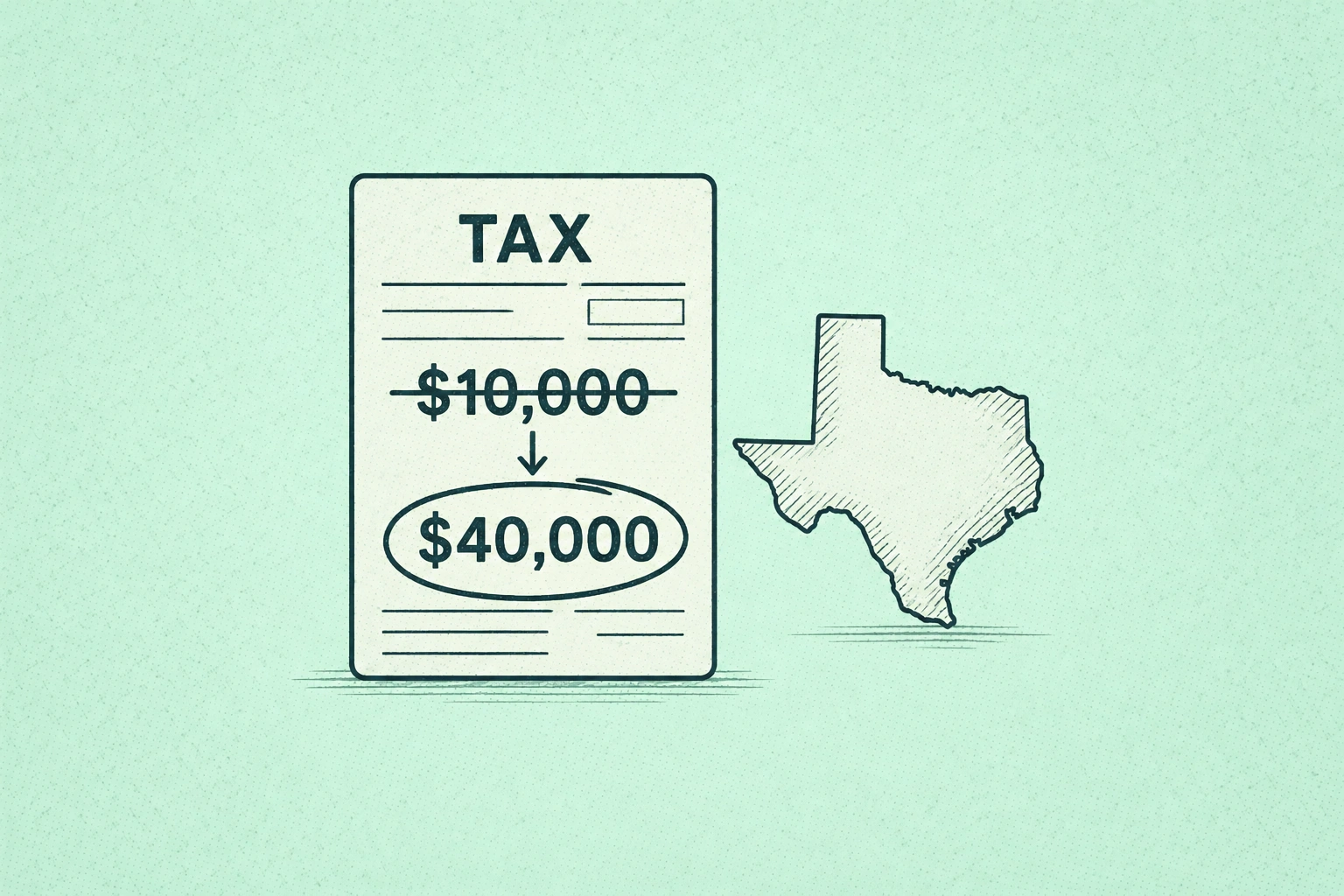
Updated July 2026: Key detail to add since publication: the $40,000 SALT cap phases down above $500,000 MAGI — specifically, the deduction limit is reduced by 30 cents for every dollar of MAGI above $500,000, with a floor of $10,000. Married couples filing jointly use a $500,000 threshold (not doubled). The enhanced SALT cap expires after 2029 and reverts to $10,000 in 2030. All other figures in this post remain accurate.
Most coverage of the One Big Beautiful Bill fixated on the headline provisions. The SALT cap expansion got buried. That’s the one that actually matters if you live in a high-tax state and earn good money. Not because it’s complicated — the mechanics are actually straightforward — but because the people who benefit most from it haven’t fully processed what changed and what it’s worth to them in dollar terms.
Here’s the short version: if you live in California, New York, New Jersey, Illinois, or any other state with meaningful income and property taxes, and your household income is between roughly $150,000 and $500,000, the federal government just handed you a deduction that was capped at $10,000 for the past seven years and is now capped at $40,000. For a homeowner in that income range in a high-tax state, that’s potentially $20,000 to $30,000 in additional deductible amount — money that was generating a federal tax bill before and now generates nothing.
The window is five years. It closes in 2030.
What Changed and What the Numbers Actually Are
Before the OBBBA, the Tax Cuts and Jobs Act of 2017 had capped the state and local tax deduction — the combined total of state income taxes, property taxes, and local taxes you pay — at $10,000. For residents of high-tax states, this was deeply painful. Annual state income taxes alone frequently exceeded $10,000 for professional-class households, before property taxes entered the picture at all.
What the OBBBA Actually Changed on SALT
The OBBBA raised that cap to $40,000, effective for tax year 2025. In 2026, the cap rises to $40,400 — it’s indexed at 1% annually through 2029 before reverting entirely to $10,000 in 2030. The full schedule, per HCVT’s SALT analysis:
Tax year 2025: $40,000 Tax year 2026: $40,400 Tax year 2027: $40,804 Tax year 2028: $41,212 Tax year 2029: $41,624 Tax year 2030: back to $10,000
This applies to people who itemize their deductions rather than taking the standard deduction. That’s an important qualifier and I’ll return to it.
The phase-out structure is where most coverage glosses over a critical detail. The $40,000 cap is not available to everyone. For tax year 2025, it begins phasing out at MAGI of $500,000, reducing by 30 cents for every dollar over that threshold. By MAGI of approximately $600,000, the deduction is fully phased back to $10,000 — the same as it was before the OBBBA. In 2026, those thresholds shift upward by 1%: phase-out begins at $505,000, full phase-out at approximately $606,000.
This means the people the OBBBA SALT expansion is actually designed to help are not the ultra-high earners. Anyone earning above approximately $600,000 in 2025 sees no change at all. The beneficiaries are households earning between roughly $150,000 and $500,000 who live in high-tax states and own homes. That’s a specific and identifiable group, and many of them haven’t sat down to calculate what this is actually worth.
Join The Global Frame
Money, work, and tech — one read every Saturday that actually changes how you think.
The Real Dollar Difference for a Typical Beneficiary
SmartAsset’s SALT analysis uses a New Jersey example that illustrates the mechanics cleanly. A married couple with $450,000 in combined income paying $25,000 in state income taxes and $15,000 in property taxes — totaling $40,000 in SALT payments — was previously limited to deducting $10,000 under the old cap. Under the new $40,000 cap, they deduct the full $40,000. That’s $30,000 in additional deductible income.
At the 24% federal marginal rate applicable to that income level, $30,000 in additional deductions generates $7,200 in federal tax savings. Every year. Through 2029.
For a California couple with similar income dynamics — state income taxes running $18,000 to $22,000 depending on composition of income, plus property taxes on a moderate California home — the math runs in the same direction. Total SALT payments in the $30,000 to $38,000 range, previously capped at $10,000, now largely or fully deductible.
The HCVT example shows a couple at $520,000 MAGI — in the phase-out zone — still receiving a meaningful partial benefit. At $520,000, they’re $20,000 over the $500,000 threshold. The phase-out reduces their cap by $6,000 (30% × $20,000), bringing their effective SALT cap to $34,000. That’s still $24,000 more than the old $10,000 limit. At 37% — the marginal rate at that income level — $24,000 in additional deductions is worth roughly $8,880 in tax savings annually.
Who Benefits and By Exactly How Much
The Itemizing Question
The expanded SALT cap only helps if you itemize. Taking the standard deduction instead means the SALT cap, regardless of what it is, doesn’t factor into your tax calculation at all.
The 2026 standard deduction for married filing jointly is $32,200. To make itemizing worthwhile, your total itemized deductions need to exceed that number. For most high-income homeowners in high-tax states, the combination of SALT, mortgage interest, and charitable giving clears that bar comfortably. But it’s worth running the actual calculation rather than assuming.
The scenario where itemizing clearly wins: you’re paying $25,000 or more in SALT, have a mortgage generating $10,000 to $20,000 in interest, and make modest charitable contributions. Your itemized total is well above $32,200 and the expanded SALT cap changes your federal tax bill materially.
The scenario where it’s worth checking: your SALT is on the lower end — say $15,000 — because your property taxes are modest or your state income tax rate isn’t high, and your mortgage is small or paid off. In that case, your itemized total may not exceed the standard deduction even with the expanded SALT cap. The break doesn’t apply to you even though you live in a nominally high-tax state.
This is why the OBBBA SALT benefit is more targeted than the headline number suggests. It flows primarily to homeowners with mortgages in high-tax states at the professional-class income level. That describes a lot of TGF readers specifically — and many of them were capped at $10,000 for seven years while paying two to four times that in actual state and local taxes.
The PTET Path for Business Owners
One provision that survived the OBBBA negotiations intact — and is worth knowing about if you own a pass-through business — is the pass-through entity tax workaround. Business owners operating through S-corporations, partnerships, or LLCs can elect to have their state income taxes paid and deducted at the entity level rather than the individual level. The deduction flows through to owners on K-1s, effectively bypassing the individual SALT cap entirely.
The OBBBA does not restrict or modify PTET elections. For business owners whose personal SALT exposure exceeds even the new $40,000 cap, the PTET election remains the mechanism that captures the full deduction. This is a planning conversation worth having with a CPA, particularly for owners in states that have permanently enacted PTET regimes — New York, New Jersey, California, Connecticut, and roughly 32 others as of 2026.
How to Claim the Full Deduction
What to Do With the Window You Have
The SALT expansion runs from tax year 2025 through tax year 2029 — five years. Unless Congress acts to extend it, 2030 brings the hard revert to $10,000. That sunset creates two planning implications worth thinking through now rather than in 2029.
First, if your SALT payments have been consistently exceeding $10,000 — which they almost certainly have been if you live in California, New York, or New Jersey and own a home — you’ve been over-withholding federal taxes in a sense. Your estimated tax payments and withholding may have been calibrated to a world where you could only deduct $10,000. If you’re now deducting $30,000 to $40,000, your actual federal tax liability is lower than your withholding may reflect. That’s worth reviewing with a CPA to avoid overpaying quarterly estimates.
Second, the 2030 sunset is a reason to pull income-generating decisions forward where you have flexibility. The tax loss harvesting and Roth conversion discussions on this blog both touch on the same principle: tax policy creates temporary windows, and the years inside a favorable window are structurally different from the years outside it. Contributing more to retirement accounts during 2025 to 2029 using the freed-up cash from lower federal tax bills — rather than waiting until after the cap reverts — is the kind of compounding advantage that tends to be visible only in retrospect.
The renting versus buying math also shifts with this change. Property taxes are a SALT component, which means the after-tax cost of owning a home in a high-property-tax state just got more favorable for households under $500,000 MAGI. That’s not the only variable in the rent-versus-buy decision, but it’s a real one that should be included in any analysis done before the cap reverts.
The most important thing the OBBBA SALT expansion requires of you isn’t complex planning. It’s making sure you’re actually itemizing on your 2025 and 2026 returns rather than defaulting to the standard deduction out of habit — and that your CPA knows you’re running the comparison deliberately, not assuming.