Updated July 2026: Rates have dropped significantly since this was written. I Bonds are now paying 4.26% (May–October 2026 composite rate), down from 5.27%. 52-week T-bills are around 3.96%, down from 5.2%. Paper I Bonds via tax refund were discontinued as of January 1, 2025 — TreasuryDirect is now the only purchase channel. The advice on I Bonds vs T-bills and the state tax advantage remains accurate; only the specific rates have changed.
I’ve been watching the HYSA rate decline for about eighteen months now and I keep noticing the same gap: families with meaningful cash reserves sitting in savings accounts earning 3.5 to 4.5%, when two government-backed alternatives have been paying materially more — and carrying zero default risk because they’re direct obligations of the US Treasury.
I Bonds are currently paying 5.27%, adjusted for inflation. 52-week Treasury bills are paying around 5.2%, fixed at purchase. Both are state tax-exempt, which in a high-income-tax state like California or New York adds another 0.5 to 1 percentage point to the effective yield advantage over a savings account. Both are backed by the full faith and credit of the federal government — not FDIC insured, which is a different mechanism, but for practical purposes at least as secure.
The question I get most often is which one is better. The honest answer is that it depends almost entirely on one variable: when you need the money back.
The Single Variable That Decides Everything
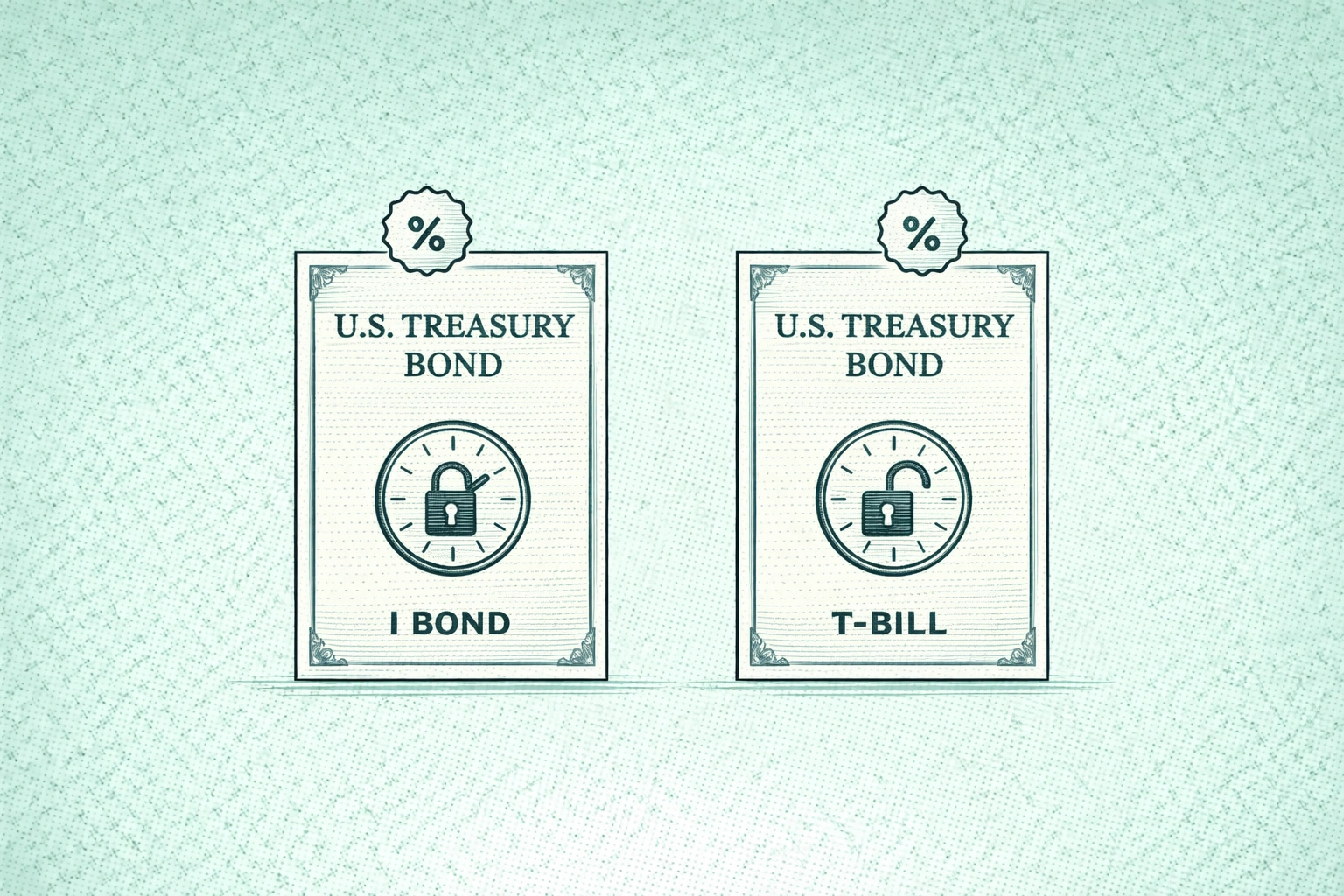
I Bonds have a mandatory twelve-month holding period with no exceptions. You put money in, and for the next year you cannot get it back under any circumstances. After twelve months, you can redeem, but if you do so before five years you forfeit the last three months of interest. After five years, you can redeem any time with no penalty.
Treasury bills have no minimum holding period at all. If you buy a 52-week T-bill through a brokerage and need the money in three months, you sell it on the secondary market and receive face value plus accrued interest. There’s no penalty, no waiting period, no friction beyond the normal transaction.
That distinction resolves the choice for most situations immediately. If you’re saving for a house down payment in nine months, a wedding in eighteen months, or any goal with a defined near-term date, I Bonds aren’t available to you — the money is locked. T-bills are the only government-backed option for that use case. If you’re building a long-term emergency fund that you realistically won’t touch for years, I Bonds’ inflation protection and slightly higher current rate make them the superior vehicle once you clear the twelve-month lock-up.
The liquidity asymmetry also determines which works for large cash positions. The I Bond purchase limit is $10,000 per person per year — $20,000 for a married couple filing jointly, with Note: the $5,000 paper bond option via tax refund was discontinued as of January 1, 2025. The standard limit is $10,000 per person per calendar year viaing a tax refund. Someone with $200,000 in cash reserves cannot deploy more than $10,000 of it into I Bonds in a given year. T-bills have no purchase limit. For anyone managing a large cash position, T-bills are the only vehicle that can hold the full amount.
How the Rate Structures Differ and Why It Matters
The I Bond rate has two components that work very differently. A fixed rate — currently 1.20% — is set at purchase and stays permanently for the life of the bond, which runs up to thirty years. On top of that sits an inflation adjustment that resets every six months on May 1 and November 1, based on changes in the Consumer Price Index over the preceding period. The two components combine to produce the composite rate: at current figures, 1.20% fixed plus 4.07% inflation adjustment equals 5.27%.
What this structure means in practice: if inflation stays around 2%, your I Bond pays roughly 3.2%. If inflation spikes to 6%, it pays roughly 7.2%. If deflation somehow occurs, the composite rate floors at zero — your principal is protected but you earn nothing. You’re not betting on a specific rate. You’re betting that inflation will remain elevated, and you’re getting paid based on whatever actually happens.
Join The Global Frame
Money, work, and tech — one read every Saturday that actually changes how you think.
The 1.20% fixed rate on current I Bonds is meaningfully higher than the fixed rates available during most of the 2010s, when rates sat at 0% for years. The fixed component is locked in at purchase — which creates a modest urgency to buy when fixed rates are elevated rather than when they might be lower.
T-bills work differently. The rate is set at the auction and remains fixed for the duration. A 52-week T-bill bought today at 5.2% pays 5.2% regardless of what inflation does over the next year. If inflation accelerates to 8% during your holding period, you still earn 5.2% — which is now a negative real return. If inflation drops to 1%, you’ve done better in real terms than the rate implied at purchase.
The T-bill rate also reflects the current monetary policy environment. When the Federal Reserve has rates elevated, T-bill yields are high. As the Fed cuts rates, new T-bill auctions reflect the lower rate environment. Someone rolling a 13-week T-bill ladder in a declining rate environment will see yields step down with each new purchase. I Bonds reset based on inflation, not Fed policy, which makes them a different kind of hedge.
State Tax Exemption: The Math High-Tax State Residents Should Run
Both I Bonds and T-bills are exempt from state and local income taxes. This is a feature that often goes unnoticed by investors in low-tax or no-income-tax states, but it changes the calculation materially for residents of California, New York, New Jersey, Oregon, and similar states.
The effective yield comparison to a HYSA should always be run after taxes in your specific state. A California resident in the 9.3% state bracket earning $1,000 in HYSA interest keeps $907 after state tax and then pays federal tax on top of that. The same $1,000 from a T-bill is exempt from California tax entirely — only federal income tax applies. On a $100,000 position, the annual difference in after-tax yield between a 4.5% HYSA and a 5.0% T-bill in California runs approximately $500 in additional after-tax income from the T-bill, from state tax exemption alone. That’s not trivial.
This effect compounds the argument for using T-bills or I Bonds over savings accounts for cash that doesn’t need to be instantly accessible. The financial privacy and banking considerations I’ve written about separately are an additional reason to diversify where you hold cash — but the tax math alone justifies moving beyond HYSAs for funds with any flexibility on timeline.
How to Fit Them Into a Coherent Cash Strategy
The structure that makes sense for most households managing meaningful cash reserves:
The truly liquid layer — three months of expenses, maybe slightly more depending on income stability — belongs in an HYSA or money market fund where it’s accessible instantly. This isn’t the layer to optimize for yield. It’s insurance, and the cost of that insurance is the yield difference between a savings account and something with more friction.
The medium-term layer — funds you won’t need for six to eighteen months — fits naturally into T-bills structured around your actual timeline. A 26-week T-bill ladder where you’re buying $5,000 to $10,000 at the start of each month, with bills rolling off as they mature, gives you a yield premium over savings accounts, full state tax exemption, and liquidity within a month or two at any given time. If you have a specific date in mind — a tax payment, a down payment, a known large expense — you can buy a T-bill that matures shortly before that date and know exactly what it will return.
The long-term layer — funds you’re confident you won’t need for five or more years — is where I Bonds earn their place. The annual purchase limit means this is a slow accumulation strategy. Buying $10,000 per year (or $20,000 for a couple) starting now and building toward a $50,000 to $100,000 position over several years creates a meaningful inflation-protected reserve. The five-year ladder that results — with one tranche becoming penalty-free each year — produces exactly the kind of rolling liquidity that makes a long-term emergency fund functional without requiring you to hold everything in low-yield instruments.
This layered approach — barbell thinking applied to cash management — captures different yield premiums across different time horizons without sacrificing the liquidity you need for actual near-term access. The HYSA yield cliff discussion is the starting point for why this matters now: as savings rates continue to decline from their 2023 peak, the yield advantage of T-bills and I Bonds over savings accounts becomes more pronounced, not less.
The TreasuryDirect Friction Problem
Buying I Bonds requires creating an account at TreasuryDirect.gov. The site works but is not a modern user experience — it predates the smartphone and operates accordingly. Account creation is straightforward, the purchase process is functional, and once you have the account it’s not something you visit often. But the interface friction is real and keeps some people from taking the first step.
T-bills through TreasuryDirect have the same interface limitation. The better path for T-bills if you have a brokerage account is to purchase them directly through Fidelity, Schwab, or Vanguard. All three allow you to buy T-bills at auction or on the secondary market through their standard fixed income interface, view them alongside your other positions, set up automatic rollovers at maturity, and sell with a few clicks. For anyone who already has a taxable brokerage account, this is the natural home for a T-bill position. The tax loss harvesting you’re doing in that same account and the T-bill position can be managed in one place.
I Bonds cannot be held through a brokerage — only through TreasuryDirect. There’s no workaround for this. You open the account once, tolerate the interface, make your annual purchase in January, and then mostly ignore it. The annual ritual is genuinely simple once the account exists. The friction is primarily in the setup.
Tax Reporting
I Bond interest is deferred until redemption — you don’t pay federal tax annually on the accumulating interest, only when you actually redeem. This is a structural advantage for long-term holders: the tax deferral means more of your interest is compounding tax-free in the interim, similar to the logic behind tax-deferred retirement accounts. When you eventually redeem, you report the full accumulated interest as ordinary income in that year.
T-bill interest is reported in the year the bill matures. A 52-week T-bill purchased in January and maturing the following January generates ordinary income reported on the following year’s return. This means a 52-week T-bill purchased in calendar year 2026 generates taxable income in 2027. For planning purposes, this can be useful if you’re managing taxable income across years.
Both instruments generate a 1099-INT for the year interest is reportable. For T-bills bought through a brokerage, the 1099-INT arrives automatically as part of your consolidated tax statement. For I Bonds through TreasuryDirect, TreasuryDirect generates the 1099-INT in the year of redemption. Neither requires anything unusual at tax time. The government is literally paying you more to hold their debt than most savings accounts offer. The paperwork is the same either way.