I did the audit for the first time properly about eighteen months ago. Not the casual “I should probably check what I’m paying for” scroll through a bank statement — the actual thing, where I pulled three months of transactions, sorted by vendor, and looked at every recurring charge in order.
The number was embarrassing. Not because I’d made obviously bad decisions, but because most of the charges were for things I’d made perfectly reasonable decisions about and then completely forgotten. A PDF tool I used twice for a project. A meditation app I opened for two weeks in January. A cloud storage upgrade I’d needed for one large file transfer and never revisited.
None of it hurt individually. Collectively it was around $180 a month in services that had drifted into pure inertia.
This is the design. The subscription model — SaaS, streaming, software, connected hardware — is built around one behavioral insight: people tolerate monthly charges below a certain pain threshold without actively evaluating them. $12.99 is calibrated to sit just under the point where you’d actually go find the cancel button. The business model is a tax on inattention, and it works extraordinarily well.
The average American now spends $219 a month on subscriptions, with roughly 42% of those subscriptions unused in the past 30 days. That’s over $2,500 annually compounding away from your savings rate while producing nothing. Here’s how to actually address it.
The Audit You Have to Do First
You can’t cut what you can’t see, and memory is useless here. Your brain has been conditioned not to notice these charges — that’s the whole point.
The actual process: download the last three months of bank and credit card statements in CSV format. Sort by vendor. Look at every recurring line item and answer one question honestly — did I use this in the last 30 days?
I’ve noticed three categories that consistently show up in these audits for most people.
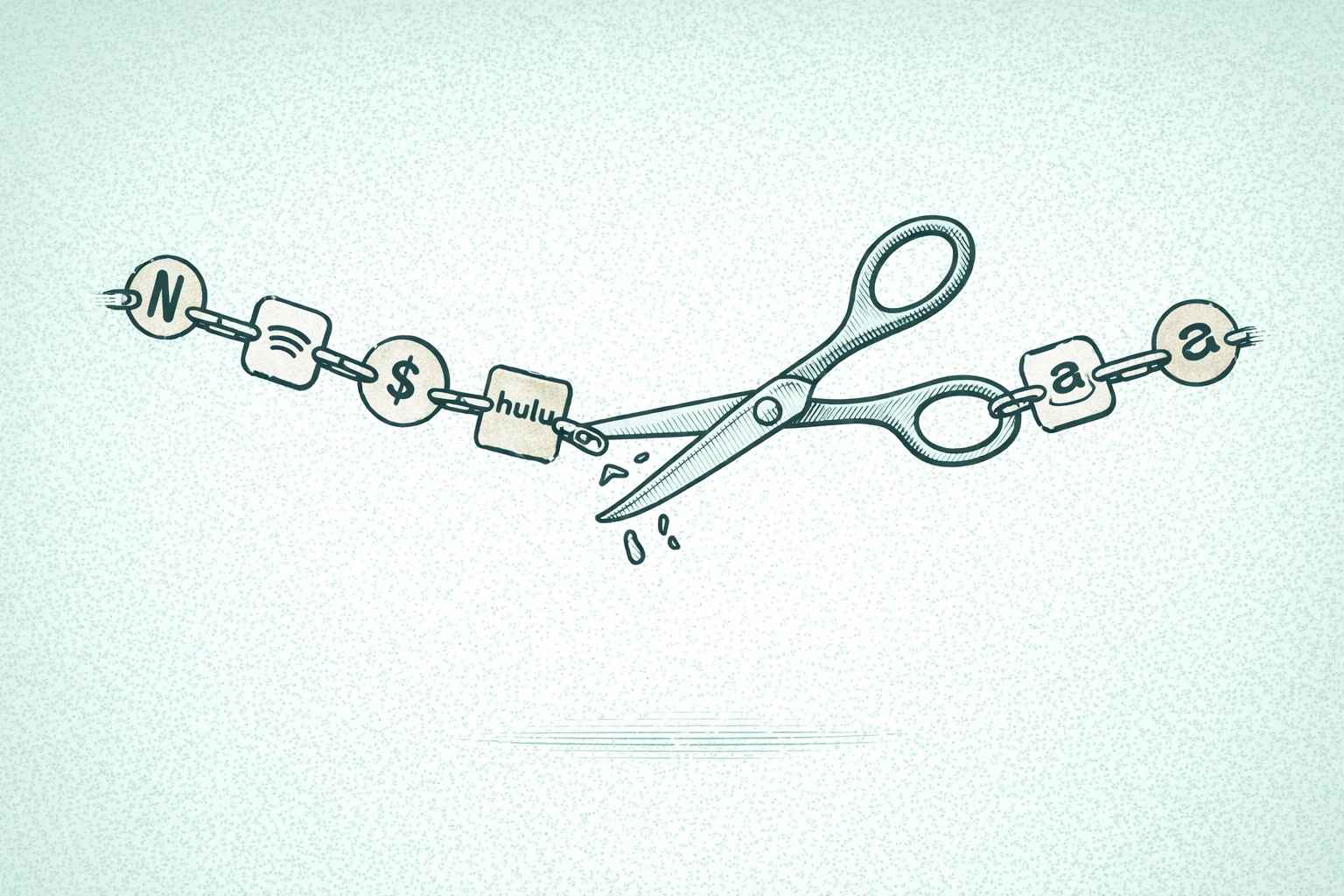
The first is zombie streamers. Netflix, Hulu, Disney+, Max, Peacock, Apple TV+, Paramount+. Most households are carrying four or five of these simultaneously, rotating between them based on which show has their attention this week. The math on running all of them concurrently rarely survives contact with actual viewing habits. A household spending $85 a month across six platforms is almost certainly not watching six platforms worth of content in any given month.
The second is free trial survivors. That project management tool you tried in October. The AI writing assistant you used for one document. The design software your cousin recommended. These are particularly insidious because the charge feels like it’s for something you chose — and you did choose it, months ago, once, for a specific purpose that no longer exists.
Join The Global Frame
Money, work, and tech — one read every Saturday that actually changes how you think.
The third is duplicate cloud storage. iCloud, Google One, Dropbox, OneDrive. Most people are paying for two or three of these and actively using one. The others are carrying old files that could be consolidated in an afternoon.
The rule I apply: if it doesn’t get used monthly and doesn’t generate income, it’s gone. Not reconsidered. Cancelled, with the understanding that resubscribing takes thirty seconds if something changes.
The Streaming Rotation Nobody Implements but Should
Streaming is where the largest recurring spend lives for most households, and the fix is simple enough that the only obstacle is actually doing it.
You don’t need to stop watching television. You need to stop paying for all television simultaneously.
The rotation model: subscribe to one service at a time, based on what you actually want to watch. Finish the show or the season, then cancel and move to the next service. Most streaming platforms let you cancel immediately and retain access through the end of the billing period, so there’s no content loss in the transition.
In practice this looks like: January with Netflix for something you’ve been meaning to watch, February with HBO for something else, March with Disney+ for whatever that month’s release is. You watch everything you want to watch. You pay $15 a month instead of $85. The friction of switching is real but minimal — it’s a cancellation and a resubscription, not a negotiation.
The thing that prevents most people from doing this is the vague anxiety that they’ll miss something. Streaming libraries don’t expire. The show will be there in March when you come back. The urgency that platforms cultivate around their release schedules is a retention mechanism, not a genuine deadline.
The Buy-Once Replacement Worth Knowing About
The larger shift happening in software right now is a partial reversal of the subscription model — a market of lifetime license products that match or approximate the functionality of subscription software for a one-time payment.
Adobe Creative Cloud is the clearest example most people encounter. At $60 a month or $720 a year, it’s a significant recurring expense for anyone who uses Photoshop and Illustrator but isn’t doing it professionally at a level where the latest features justify the cost. Affinity Photo and Affinity Designer are one-time purchases at roughly $70 each — comparable core functionality, permanent ownership, no ongoing billing. For the majority of non-professional users, the feature gap is not material.
Microsoft 365 at $10 a month is similarly replaceable for most use cases. LibreOffice is free and handles standard document, spreadsheet, and presentation work without requiring a monthly payment to Microsoft. Google Docs is free and covers the collaboration use case that actually drives most people toward the subscription. The people who genuinely need Microsoft 365 are those running complex Excel models with VBA macros or working in enterprise environments where format compatibility is critical. That’s a smaller group than Microsoft’s marketing suggests.
For smart home privacy, the subscription dynamic appears in security cameras. Ring’s cloud storage subscription is $3-10 a month per camera. Eufy and certain Reolink models store footage locally on a home hub or SD card — no monthly fee, better privacy, functionally equivalent results. I wrote about this in the context of what your smart devices are actually collecting; the subscription to store your own home’s footage on someone else’s server is one of the more absurd product structures in consumer tech.
The Lifetime Deal market — AppSumo being the main aggregator — surfaces software at one-time purchase prices, typically for smaller tools and utilities that compete with subscription products. The quality varies significantly, but for specific utility use cases — a particular type of document converter, a scheduling tool, a specific workflow automation — the market is worth checking before defaulting to the subscription version.
The Infrastructure That Prevents Recurrence
Cutting subscriptions once doesn’t solve the problem permanently. The creep returns through free trials, new tools, and the general accumulation of decisions made in different contexts at different times.
The structural fix is virtual cards for any new subscription. Privacy.com generates a virtual card number that can be locked to a specific merchant and a maximum monthly charge. Sign up for a free trial with a virtual card capped at $5, and if they attempt to charge $15 at the end of the trial period, the charge declines automatically. You don’t have to remember to cancel. You don’t have to handle the intentionally obscured cancellation flow. The trial ends and the billing attempt fails.
This inverts the default. The subscription model is designed around the assumption that inertia favors the vendor — that you’ll forget to cancel and the charge will go through. A virtual card with a charge cap makes inertia work in your direction. The subscription has to prove its value at each renewal actively, not just survive your forgetting.
For subscriptions you do want to continue, virtual cards also provide a useful forcing function: when the annual renewal comes up and the card requires you to re-enter payment information, you’re prompted to make an active decision rather than letting it renew silently.
Most major banks offer virtual card or single-use card numbers through their existing account infrastructure. Check whether your bank’s app has this before signing up for a separate service.
The Math on What This Actually Produces
The compounding argument for subscription reduction is straightforward but worth making explicit.
$150 a month in cancelled subscriptions is $1,800 a year. Redirected into a high-yield savings account at current rates, that’s a low-risk $72 in annual interest. Redirected into a tax-advantaged investment account and compounding at historical market returns, $1,800 a year over ten years is roughly $27,000. The subscription you forgot to cancel isn’t just costing you $12.99 a month — it’s costing you the compounded future value of that $12.99 a month.
This isn’t an argument for radical deprivation. Netflix at $15 a month is a reasonable entertainment expenditure if you use it regularly. Spotify at $12 is reasonable if music is important to your daily life. The subscription purge isn’t about minimalism as a philosophy — it’s about making active decisions rather than passive ones, and ensuring that every recurring charge is there because you’ve evaluated it recently, not because you’ve forgotten about it.
The audit takes about an hour. The cancellations take another thirty minutes. The virtual card setup takes fifteen. That’s roughly two hours to recover what is, for most households, somewhere between $50 and $200 a month that’s currently going to nothing.
The subscription economy is very good at making that feel complicated. It isn’t.