Note on 1099-K thresholds (July 2026): The 1099-K reporting threshold has changed under the OBBBA. If this post references the $600 threshold or earlier transition figures, the current 2026 rules differ — verify at IRS.gov before reporting decisions. The business banking and account separation guidance in this post is not affected by 1099-K threshold changes and remains fully applicable.
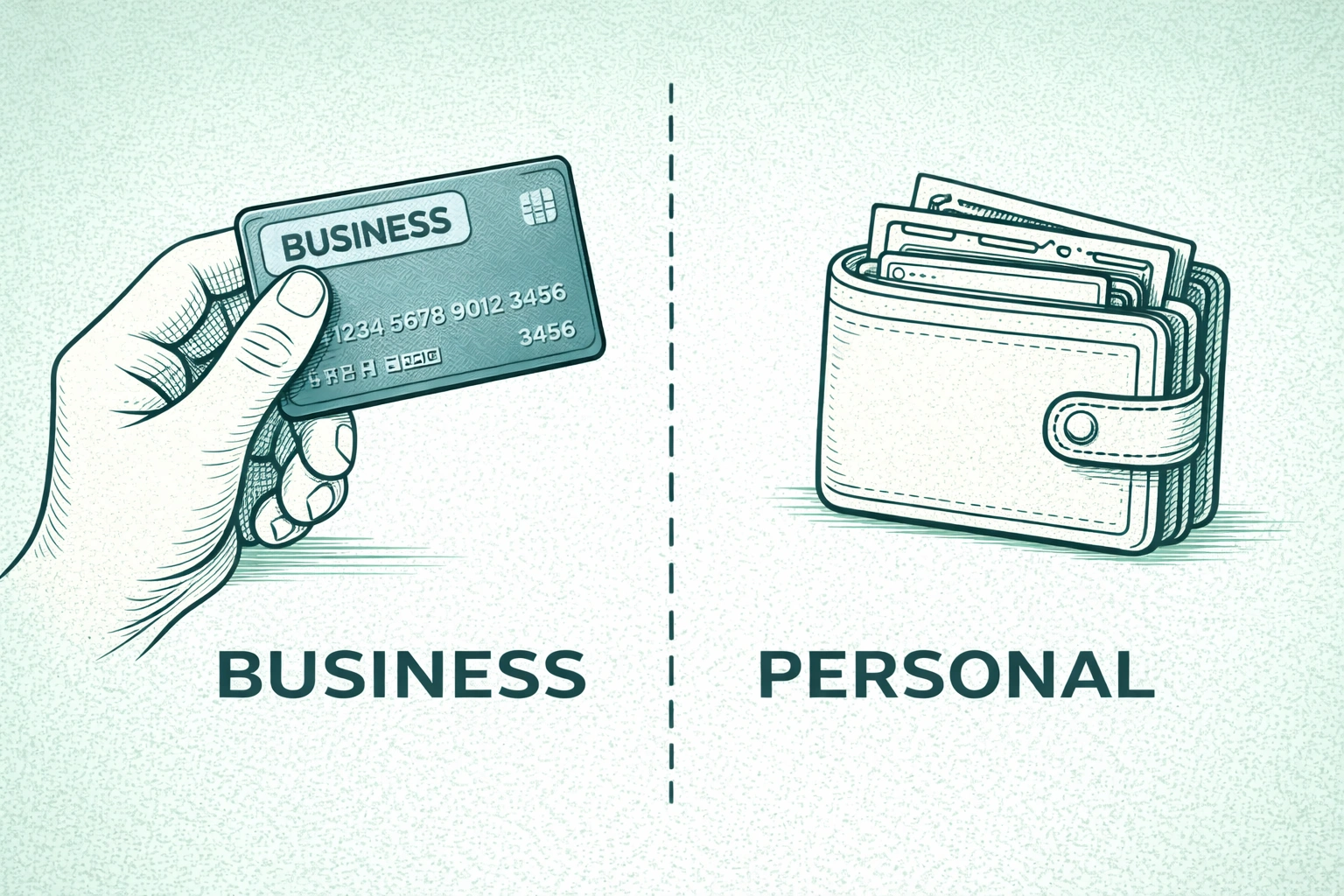
I mixed personal and business transactions in a single checking account for the first few months of running The Global Frame. It felt fine until I sat down to file taxes and realized I had no clean way to separate 240 transactions into “business” and “not business.” My accountant charged me an extra two hours to do what proper separation would have made automatic. That was the last year I made that mistake.
The IRS doesn’t require freelancers to maintain separate business accounts. What it does require, if you’re ever audited, is clear documentation of which expenses were legitimate business deductions. A mixed account makes that nearly impossible without significant reconstruction work — and reconstruction work costs money, either your time or your accountant’s.
Beyond the tax argument, the fintech accounts built specifically for self-employed professionals in 2026 have features that traditional personal accounts simply don’t offer: automatic tax withholding on every deposit, real-time expense categorization, Schedule C-ready reports, integrated invoicing. These aren’t luxury features. They’re things that make the operational side of freelancing meaningfully less painful.
Opening a business checking account as a sole proprietor takes about fifteen minutes online. You don’t need an LLC or an EIN — a Social Security number and a business name (which can be “Your Name Consulting”) is enough for all five accounts below.
Lili — Best for Tax Management
Monthly fee: $0 | APY: 4.00% | Opening deposit: $0
Lili is the account I’d recommend most readily to a freelancer who’s setting up their financial infrastructure for the first time, and the reason is specific: it solves the two problems that derail most freelancers before they get traction.
The first is quarterly taxes. Every freelancer knows they’re supposed to set aside money for estimated payments. Almost nobody actually does it consistently, which means April and the quarterly due dates arrive as a series of financial emergencies. Lili solves this structurally — you set a tax percentage (25-30% is the standard starting point), and the platform automatically transfers that portion of every deposit into a separate tax savings account. The money disappears before you can spend it.
The second is bookkeeping. Lili automatically categorizes transactions into IRS Schedule C expense categories — office supplies, travel, meals, software — and generates profit and loss statements in formats your CPA can use directly. If you’ve ever paid an accountant to sort through a year of uncategorized transactions, you understand the dollar value of this.
The 4.00% APY on balances up to $1 million is genuinely competitive. On a $10,000 operating balance, that’s $400 annually — not life-changing, but more than you’d earn at most traditional banks.
Join The Global Frame
Money, work, and tech — one read every Saturday that actually changes how you think.
The constraints worth knowing: Lili only supports sole proprietors filing with a Social Security number, so LLCs with EINs need to look elsewhere. Cash deposits are extremely limited. And the most useful features require the Pro tier at $9 per month, though the free version covers the basics for most early-stage freelancers.
Bluevine — Best for Higher Volume Operations
Monthly fee: $0 | APY: 1.3–3.0% depending on tier | Opening deposit: $0
Bluevine is what Lili grows into. As a freelance business matures — more clients, more transactions, larger operating balances — Bluevine’s infrastructure handles the volume better. Unlimited transactions is the headline feature, and it matters more than it sounds: traditional banks typically cap monthly transactions at 100–500 before charging per-transaction fees, which becomes expensive quickly for active businesses.
The platform integrates directly with QuickBooks, Xero, Stripe, and Square, which means accounting software gets transaction data automatically rather than requiring manual export and import. For anyone already running on Stripe for client payments, the connection is frictionless.
The $500 signup bonus is worth mentioning if you’re opening an account soon — it requires meeting one of three monthly activity thresholds for 90 days after funding. The most accessible for most freelancers is $2,000 in monthly debit card spending, which is realistic if you run business expenses through the account. Verify the bonus terms are still current before opening — these promotions change.
The APY structure is tiered and activity-dependent, which makes it less straightforward than Lili’s flat rate. At the Standard tier, you need either $500 in monthly debit card spending or $2,500 in monthly incoming payments to earn the 1.3% rate. Below that threshold, the rate drops. The Premier tier at 3.0% APY is genuinely competitive but targets businesses at a significantly higher revenue level than most solo freelancers.
Cash deposits incur a $4.95 fee at Green Dot locations — not a dealbreaker for a digital operation, but worth knowing if you occasionally receive physical payment.
Found — Best for Variable Income
Monthly fee: $0 basic, $12.99/month Plus | APY: 1.00% on tax savings | Opening deposit: $0
Found targets the specific financial anxiety that comes from lumpy, unpredictable income — the feast-or-famine pattern that characterizes a lot of freelance work. Its core feature is a real-time tax liability calculator that updates as deposits come in, showing you what you owe this quarter based on actual earnings rather than estimates.
The platform syncs with Cash App, PayPal, Venmo, Stripe, and QuickBooks, which makes it useful for freelancers pulling income from several sources simultaneously. All of that income flows into a single dashboard with automatic expense categorization and receipt capture. At year-end, Found generates a tax package in Schedule C format.
Built-in invoicing is a meaningful addition for freelancers who aren’t already using a dedicated tool — clients can pay via ACH or card directly from the invoice, and the payment deposits into Found automatically.
The limitations are worth considering before committing. Customer support is email-only, which is manageable when things work but frustrating when they don’t. Cash deposits are capped at $1,000 weekly with a $2 fee per transaction. And the 1.00% APY applies only to the dedicated tax savings bucket, not the main operating balance — if you’re maintaining significant operating cash, the interest math is less favorable than Lili or Bluevine.
Novo — Best for Platform-Heavy Operations
Monthly fee: $0 | APY: 0% | Opening deposit: $0
Novo makes an explicit trade: it pays no interest on balances, and in exchange it offers the most detailed integration ecosystem of any account on this list. If your freelance operation runs primarily through Stripe, Shopify, QuickBooks, Xero, or FreshBooks, Novo connects to all of them and consolidates transaction data automatically.
The invoicing is particularly well-built — clients can pay via credit card, Apple Pay, Google Pay, PayPal, or Venmo from a single invoice link, with payment depositing directly into Novo. For anyone currently cobbling together Stripe for payments, a separate invoicing tool, and manual accounting reconciliation, Novo replaces all three.
The Novo Reserves feature lets you set up automated fund allocation rules — a defined percentage of every deposit routes to a tax bucket, another percentage to operating expenses — similar to Lili’s automatic tax withholding but more configurable.
The zero APY is the clear tradeoff. For a freelancer maintaining $15,000 or more in operating cash, the difference between Novo’s 0% and Lili’s 4.00% is $600 annually. Whether the integration convenience justifies that gap depends on how much value you’re actually getting from the platform connections.
No cash deposit capability at all is the other hard constraint — if any portion of your income arrives in physical form, Novo doesn’t work as a standalone account.
Relay — Best for Financial Compartmentalization
Monthly fee: $0 | APY: 0% | Opening deposit: $0
Relay operates on a different model than the other four. Rather than one account with features, it gives you up to 20 separate checking accounts — each with its own account and routing number — within a single platform. The practical application: dedicated accounts for taxes, operating expenses, each major client or project, emergency reserves, whatever organizational structure makes sense for your specific business.
The rational compounding approach to personal finance that I write about regularly has a direct operational analogue here — money designated for a specific purpose stays in the account designated for that purpose, with automated transfer rules enforcing the allocation without requiring manual discipline. Relay lets you set rules like “transfer 30% of every deposit to the tax account” or “move $500 to operating expenses every Monday.”
Fifty debit cards with individual spending limits is overkill for most solo freelancers but genuinely useful for anyone working with subcontractors or a virtual assistant. Free wire transfers — both domestic and international — are a practical advantage for anyone with clients overseas, where Bluevine and others charge $15 per wire.
Like Novo, Relay pays zero interest. Combined with no mobile check deposit as of early 2026, it’s clearly built for a specific type of organized, digitally-operating freelancer rather than as a general-purpose account.
How to Choose
The right account depends less on feature comparison and more on which specific problem is currently costing you the most.
If quarterly tax payments consistently catch you underprepared, Lili’s automatic withholding solves that structurally. If you’re processing significant payment volume through Stripe or Square and want that data flowing automatically into accounting software, Bluevine or Novo handle it better. If your income comes from five different platforms and you need a unified view, Found’s aggregation is the most useful. If you want to run your finances like a personal wealth system with dedicated accounts for every purpose, Relay is the only option that makes that genuinely frictionless.
A combination approach is worth considering. Many established freelancers run Bluevine or Novo as their primary operating account and Lili as a separate high-yield tax savings account, capturing the 4.00% APY on funds set aside for quarterly payments. The routing is simple — set up an automatic transfer from your operating account to Lili when deposits arrive — and the interest on your tax reserve is money you’d otherwise be leaving on the table.
The one decision that matters most: make it now rather than at tax time. The cost of running a mixed account isn’t always visible in month one or month three. It shows up when your accountant needs two extra hours to reconstruct what a dedicated business account would have captured automatically, or when an IRS inquiry requires documentation you can’t cleanly produce. The 1099-K threshold change means fewer freelancers will receive automatic income reports from payment platforms in 2026 — which makes clean self-managed records more important, not less.
Fifteen minutes of setup now is worth considerably more than that in avoided headaches later.