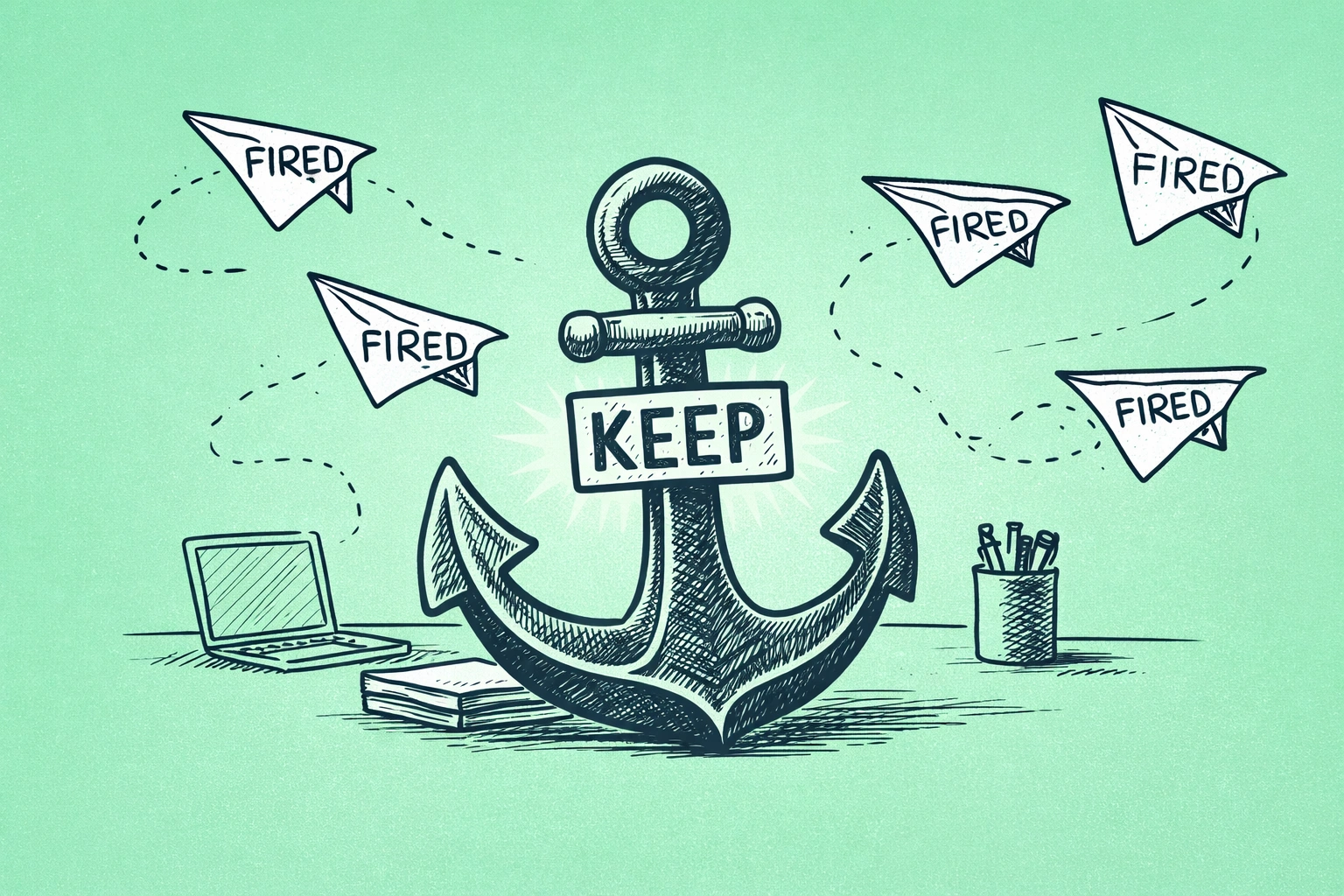
There’s a specific kind of employee that every layoff list skips over. Not the most talented. Not the most senior. Not even the best-liked. The one whose departure would cause an immediate, visible, expensive problem — the kind that lands in a board meeting, a customer call, or a 2am incident ticket.
Nobody tells you this in onboarding. But the managers compiling those lists know it intuitively: job security in 2026 is a friction calculation, not a performance review.
The question your company is quietly asking about you, right now, isn’t “how well does this person perform?” It’s “how much would it cost us to remove them?” If that number is low, your name ends up on a spreadsheet. If it’s high — genuinely, structurally high — it doesn’t matter what the macro environment looks like. You stay.
This is the framework nobody teaches, and it changes everything about how you should think about your career right now.
The New Math of Layoffs
The era of the single catastrophic RIF is over. What replaced it is something Glassdoor analysts call “forever layoffs” — continuous, quiet reductions of 10 to 50 people at a time, running in the background like a slow drain. 1.1 million layoffs were announced through November 2025 alone, only the sixth time since 1993 that threshold was breached. The tech sector absorbed 150,000+ of those cuts.
The mechanics are deliberate. Small, rolling reductions avoid the “mass layoff” headlines and sidestep the WARN Act, which mandates 60 days’ notice for any single event involving 50 or more people. Companies can now continuously pressure-test their headcount against quarterly earnings without triggering the morale collapse that comes with a blockbuster announcement.
What this means practically: there is no safe period. Three months since the last round doesn’t mean three months until the next one. The decision loop never fully closes.
This is the environment in which you’re trying to build job security. The old playbook — work hard, be loyal, get good reviews — was never a real defense. In 2026, it’s genuinely useless.
What “Organizational Friction” Actually Means
Friction, in this context, is the cost your company would absorb if you left or were removed. It’s not abstract. It shows up in five very specific places:
Revenue disruption. Do customers buy because of you, specifically? Do renewal conversations happen because you’re on them? Your salary negotiation leverage and your layoff protection share the same source: demonstrable revenue connection. A salesperson who owns a $5M book of business costs more to fire than they make in salary. That math protects them in ways that credentials and effort never could.
Join The Global Frame
Money, work, and tech — one read every Saturday that actually changes how you think.
System dependency. Do you own a process, codebase, or institutional knowledge that would break visibly and immediately without you? The billing pipeline. The compliance workflow nobody else has touched. The integration between legacy and new platforms that only you understand end-to-end. Firing an Infrastructure Owner creates an incident. That’s the protection. The path there is counterintuitive: volunteer for the projects everyone else avoids, and document nothing (knowledge hoarding is leverage, even if it’s uncomfortable to admit).
Executive exposure. Is there a VP or C-level executive whose output would meaningfully degrade without your support? High-judgment adjacency to leadership — building the board deck, running the operational cadence, making the CFO’s calendar function — creates a personal protection umbrella. When layoff lists circulate, executives fight for their people. If you’re one level removed from someone the CEO depends on, you benefit from that fight.
Replacement cost. How long would it take — realistically — to hire, onboard, and ramp someone who could do what you do? Roles requiring specialized domain knowledge, security clearances, or rare technical combinations have high replacement cost regardless of seniority. If the honest answer is “12+ months,” you’re expensive to remove even if your performance is unremarkable.
Cross-functional dependencies. How many other teams rely on your work to function? The more upstream your role — the more your output is an input for others — the more organizational chaos a sudden removal creates. This is why platform engineers, data infrastructure owners, and internal tools developers often survive cuts that flatten the application layer above them.
Your organizational friction score is the sum of these five. If you score high on even two or three, you’re structurally protected. If you score near zero across all five, performance doesn’t save you.
The Skills That Actually Don’t Matter
Here’s what the LinkedIn algorithm won’t tell you, because it doesn’t serve the “hustle harder” content cycle: effort is not leverage.
Companies laid off people who worked 60-hour weeks. They cut domain experts with graduate degrees. They eliminated 15-year veterans who were universally liked and considered top performers. Forrester Research found that 55% of employers who made AI-driven cuts ended up regretting them — but they still made them. Regret is a lagging indicator. You don’t get your job back because your company eventually realized they made a mistake.
The attributes that feel like protection — tenure, likability, specialization, hard work — are all disconnected from organizational friction. They make you valuable. They don’t make you costly to remove. Those are different things, and confusing them is the single biggest career mistake people make in a layoff environment.
Tenure especially deserves scrutiny. Forrester’s research shows companies are increasingly cutting experienced workers specifically to rehire at lower salaries — either junior domestically or mid-level offshore. Your ten years of institutional knowledge might appear on a spreadsheet as a line item too expensive to justify. Seniority without friction is a liability.
The AI Wildcard Nobody Is Being Honest About
Since 2023, AI has been cited as the justification for 70,000+ job cuts. Here’s the part that doesn’t make the press release: Forrester estimates that roughly half of those AI layoffs will result in quiet rehires, because the AI wasn’t ready.
The Klarna case became the clearest data point. In 2024, the company replaced 700 customer service representatives with AI and made a public spectacle of it. By mid-2025, quality had collapsed far enough that customers revolted, and Klarna had to rebuild that function with humans — but not at the original compensation levels.
The lesson isn’t that AI doesn’t threaten jobs. It does. The lesson is that the threat is unevenly distributed, and understanding the distribution is more useful than generalized anxiety about automation.
The roles facing real exposure are generalist ones: basic contract review, routine financial modeling, junior code generation, standard document drafting. According to Indeed’s 2026 hiring data, the roles gaining demand are the ones adjacent to AI systems — data preparation for AI implementation, prompt engineering and workflow design, human-in-the-loop quality assurance, and AI ethics and compliance work. The builders and fixers of AI systems are safe. The workers doing tasks AI is supposed to automate but frequently fails at are in a more precarious position than they realize.
If you’re currently in a role where you can draw a straight line from your daily work to what a language model does in a demo, the window to reposition is open. It won’t stay open indefinitely.
Building Friction Deliberately
Most people accumulate organizational friction accidentally — they end up owning the legacy system because nobody else wanted it, or they become the relationship manager for a key account because they happened to be on the initial call. That’s fine. But you can also build it on purpose, and the path is more direct than most people assume.
Move toward the revenue line. Cost center roles — marketing support, operations, HR, internal IT — carry lower inherent friction than profit center roles. If your function exists to support the business rather than generate it, the arithmetic of cutting you is different. The transition doesn’t have to be dramatic: owning renewals for major accounts, attaching yourself to a monetization initiative, getting your name on a partnership agreement — these moves shift your position on the friction spectrum without requiring a full role change.
Become the single point of contact for something critical. Pick one vendor relationship, one external integration, one compliance obligation, and become the only person who fully owns it. Don’t do this by hoarding information maliciously — do it by being so genuinely deep on that thing that nobody else bothers to develop equivalent knowledge. The result is the same.
Build cross-functional dependencies. The more teams that depend on your work as an input to their output, the more organizational surface area your removal affects. Platform roles, data infrastructure, internal tooling, and shared services all create this naturally. In individual contributor roles, you can approximate it by proactively making your work useful to adjacent teams.
Get executive exposure early. Volunteer for projects that put you in leadership meetings. Write the summary that goes to the VP. Be the person who makes the C-level’s next presentation better. Executive adjacency doesn’t require a formal title change — it requires showing up in contexts where decisions are made and making yourself useful in those rooms.
The Internal Optionality Layer
Even a high friction score doesn’t protect you from every scenario. Your department gets eliminated entirely. Your executive gets fired. The company goes through a full restructuring that resets the org chart. In these situations, internal optionality — the ability to move laterally within the organization rather than exit entirely — becomes the backup layer.
Cross-training is the most accessible version of this. Learn the adjacent role’s core competency. If you’re in marketing, get proficient in SQL. If you’re in engineering, develop the ability to write credible product strategy. Skills-based hiring is reshaping internal mobility the same way it’s reshaping external hiring — versatility is increasingly valued over narrow depth.
Making your wins visible internally matters more than most people are comfortable with. Slack posts, team newsletters, all-hands mentions — these feel self-promotional until you realize that when a manager is compiling a retention list, recent and vivid memories of your name attached to a result carry real weight. The ghost job epidemic — where 40% of external postings are never actually filled — makes internal optionality even more valuable. The external job market is not the safety net it once was.
Performance Reviews as Strategic Evidence
When layoff lists are compiled, managers rank employees, and your self-evaluation becomes part of the evidence base for that ranking. Most people write humble, understated reviews because that’s what feels professional. In a layoff environment, this is a strategic error.
Quantify everything. Revenue impact, time saved, incidents prevented, users gained, deals closed. Frame your contributions in the specific language your manager cares about — if they measure success through “customer obsession” or “operational leverage,” every significant contribution you’ve made in the past year should be expressed through that lens. Position yourself explicitly as a multiplier, not just an executor: you didn’t ship a feature, you unblocked three teams and pulled the Q3 roadmap forward by six weeks. That framing is the difference between a name that stays on the list and one that gets crossed off.
If the Email Comes Anyway
Even a well-constructed friction score doesn’t guarantee survival in every restructuring scenario. Have the fallback positioned before you need it.
The fractional executive model is the fastest path back to income without the six-month full-time job search. Working 20 hours per week for two or three companies as a part-time CFO, CMO, or CTO typically runs $200–300 per hour — which annualizes to $192K–288K at half the hours of a traditional role. Startups cannot afford full-time C-suite compensation but need the expertise. You become the solution to their constraint.
This requires Director-level experience at minimum. But if you’re at that level and a restructuring is on the horizon, positioning yourself as a fractional executive before the email arrives — not after — gives you meaningful leverage over the terms of your exit. Combine this with what you know about how recruiters actually use LinkedIn in 2026 and you have a real contingency plan rather than a wishful one.
The Checklist
Rate yourself honestly across the five friction variables:
- Revenue disruption: Would the business feel my departure in ARR or churn within 90 days?
- System dependency: Would something visible break if I left tomorrow?
- Executive exposure: Is there a VP or C-level who would actively fight to retain me?
- Replacement cost: Would hiring and ramping my replacement take 6+ months realistically?
- Cross-functional dependencies: Do 3+ teams rely on my output as an input to their work?
Five checks: you’re structurally protected for now. Three to four: you’re vulnerable in the next wave. Fewer than two: update your resume today, not because you’re necessarily in danger, but because not having it current is the most expensive kind of laziness in a forever-layoffs environment.
Job security in 2026 isn’t earned through loyalty or effort. It’s engineered through friction. The company that can’t afford to lose you won’t fire you. Everything else is noise.