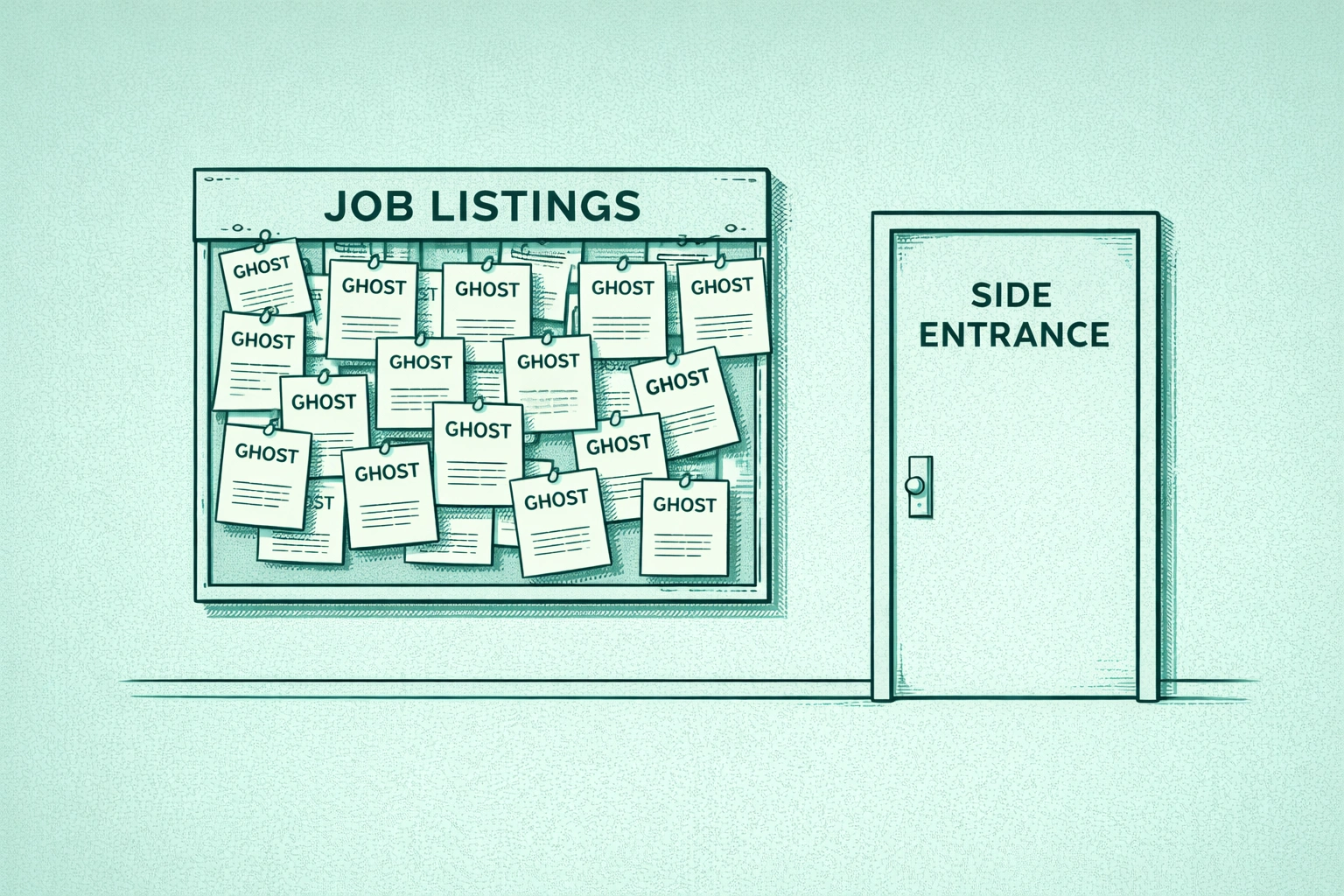
Last year I spent some time mapping how people I know actually got their last job. Not the official version — “I saw the posting and submitted my application” — but what actually happened. The honest chain of events.
Almost universally, the story started somewhere other than a job board. A former colleague mentioned they were hiring before anything was posted. A LinkedIn message led to a conversation that led to a role that was created for the person. A consulting engagement became permanent. A referral from someone inside the company meant the resume went directly to the hiring manager rather than through the applicant tracking system.
The job board application — the process that most job seekers spend most of their time optimizing — appeared in almost none of these stories. And that was before the ghost job data started getting properly quantified.
A 2024 survey by Resume Builder found that 3 in 10 companies currently have fake job listings posted. Clarify Capital research found that 68% of hiring managers admitted to keeping postings open for months or longer without any intention of filling them. The number that circulates most — roughly 40% of active job listings are ghost jobs — is consistent with multiple independent surveys and aligns with what recruiters describe anecdotally when they’re being direct.
If you’ve been submitting applications into silence and wondering what you’re doing wrong, there’s a real possibility the answer is: nothing. The listing wasn’t real.
Why Companies Do This
Understanding the incentive is more useful than being angry about it, so it’s worth being specific about what’s actually happening.
The most common version is what I’d call the warm bench strategy. A company doesn’t have budget approved for a new hire, but they know the approval could come through at any time. Rather than wait 60 to 90 days to source candidates after budget is confirmed, they collect resumes now. They may interview candidates. They might tell you you’re a strong fit. The budget genuinely hasn’t been approved and the role genuinely might not get filled — but if it does, they want to move fast.
The second version is the investor signal. A startup with no open positions reads as stagnant to the market. Active job postings signal growth and momentum, which matters for fundraising conversations and press narratives. A company can project a growth story while actually holding headcount flat, and the job board becomes part of the communication strategy rather than a genuine hiring pipeline.
The third version is internal pacification. A team is overwhelmed and requesting additional headcount. Management doesn’t have the budget to hire but needs to maintain morale. Posting the job is a visible gesture — “we’re working on it” — that buys time without committing to spend. The role may stay posted for months while the internal conversation about budget continues.
None of these scenarios are illegal. Most aren’t even particularly cynical from the company’s perspective — they reflect genuine uncertainty about hiring timelines in an environment where budget decisions are made quarterly and headcount approval can be reversed quickly. But for the job seeker spending an hour tailoring a cover letter for a role that was never going to be filled, the effect is the same.
Join The Global Frame
Money, work, and tech — one read every Saturday that actually changes how you think.
How to Identify Listings Worth Your Time
You can’t eliminate ghost jobs from your search, but you can triage before investing significant effort.
The age of the listing is the most reliable signal. Any listing that’s been open more than 30 days without apparent changes warrants skepticism. Genuinely active searches rarely take that long unless the role is highly specialized. A listing that reappears as “Posted 2 hours ago” while showing 1,000+ applicants is an old listing being auto-refreshed — the applicant count reveals the actual age.
The specificity of the description matters more than most people realize. A real open role with a real hiring manager attached usually has specific requirements that reflect the actual team’s actual needs. Vague descriptions — “dynamic team player with strong communication skills” — often indicate a posting that exists for reasons other than immediate hire. Specific descriptions — “React developer for the payments infrastructure team, experience with Stripe API required” — suggest someone with knowledge of the actual work wrote it.
Cross-referencing the company’s own careers page is the most definitive check. If a listing appears on Indeed, LinkedIn, or a job board but doesn’t exist on the company’s official careers page, it’s often a zombie listing their ATS forgot to deactivate, or a role that’s been internally paused but not removed from aggregators. If you can’t find it on the source, treat it as low probability.
The LinkedIn profile optimization work matters here in a different way than most people use it. Rather than optimizing to appear in recruiter searches for open roles, the more valuable positioning is being visible to people who might think of you when a need emerges — before a listing ever gets posted. That’s a different kind of presence than keyword-stuffing a headline.
The Approach That Actually Works in 2026
The hiring process for most knowledge work roles involves a human being deciding they want to work with someone and then finding a way to make it happen. The job board listing is often a formality that comes after that decision is functionally made, not the mechanism by which the decision gets made.
That inversion — hire decision first, formal process second — is why the people getting the best roles are rarely the ones who found them on job boards. They’re the ones who made themselves visible to the decision-maker before the decision was formally in motion.
I’ve been thinking about this since writing about job security and structural indispensability — the same logic applies to the hiring side. The question isn’t “how do I find a job posting and beat the ATS?” It’s “how do I become the obvious choice when someone who can hire me realizes they have a problem I can solve?”
The most direct version of this is what some people call a permissionless project. Instead of sending a resume to a company you want to work for, you identify a specific, visible problem they have and solve a piece of it without being asked. A designer who redesigns a company’s onboarding flow and shares it with the VP of Product isn’t applying for a job — they’re demonstrating exactly what they’d do if they had one. A marketer who rewrites a company’s weak welcome email sequence and sends it with a note about why the existing version underperforms is doing the same.
This approach works for a reason that has nothing to do with being clever. It creates a qualitatively different interaction than a resume submission. The hiring manager has to evaluate concrete work product rather than credentials. It demonstrates initiative, judgment, and enough domain knowledge to identify a real problem. It generates a sense of reciprocity — you gave something of value without being asked — that the standard application process never produces.
The message that accompanies the work should be brief and direct. Not a cover letter, not a summary of your experience — just an observation about the problem, a link to your solution, and an open-ended question about whether it’s useful. Message the relevant department head or VP directly rather than HR, because HR’s function in the process is to administer a pipeline that already exists, not to create one.
Finding Where the Real Decisions Are Made
Off-market opportunities — roles filled before a listing ever appears — are mostly accessed through relationships that predate the opening. This sounds like networking advice, which people tend to find vague and uncomfortable, so I want to be specific about what actually generates these relationships.
Former colleagues are the highest-probability source. People who have worked with you and can vouch for your work are the ones most likely to think of you when something opens up on their team. Staying genuinely in touch with people from previous roles — not with an agenda, just maintaining the relationship — means you’re in their consideration set when the conversation happens.
Second-degree connections through people you know are the next tier. If a colleague moves to a company you’re interested in, that person becomes a potential bridge — not to ask for a favor, but to understand what the company actually needs and whether your skills genuinely fit.
The skills-based hiring shift is also creating more direct pathways than existed before. Companies increasingly willing to evaluate candidates on demonstrated capability rather than credentials are also more likely to engage someone who shows up with work product rather than a resume. The ATS screening layer that filters most applications never sees the permissionless project approach — you’re going around the system rather than trying to optimize within it.
What to Do With Job Boards
None of this means abandoning job board applications entirely. It means calibrating how much time and energy they get relative to their actual conversion rate.
For senior roles, referral and direct outreach are the dominant hiring channels — LinkedIn’s own hiring data consistently shows referrals close at dramatically higher rates than cold applications. For early-career roles or roles where you have a direct referral into the company, applications still make sense as a confirmation step alongside the relationship.
The practical allocation: spend 20% of your job search time on board applications and 80% on direct outreach, permissionless work, and relationship maintenance. Most people do it exactly backwards. The job board applications feel productive because they generate activity — you submitted something, you completed a task. But activity and progress are different things when 40% of the listings aren’t real.
The salary negotiation use that comes from being directly recruited or referred is also meaningfully different from what you have as an inbound applicant to a posted role. When a hiring manager has decided they want you before the formal process starts, the compensation conversation happens on different terms than when you’re one of 400 applicants who made it through the filter.
The front door works. It’s just rarely how the best roles get filled.